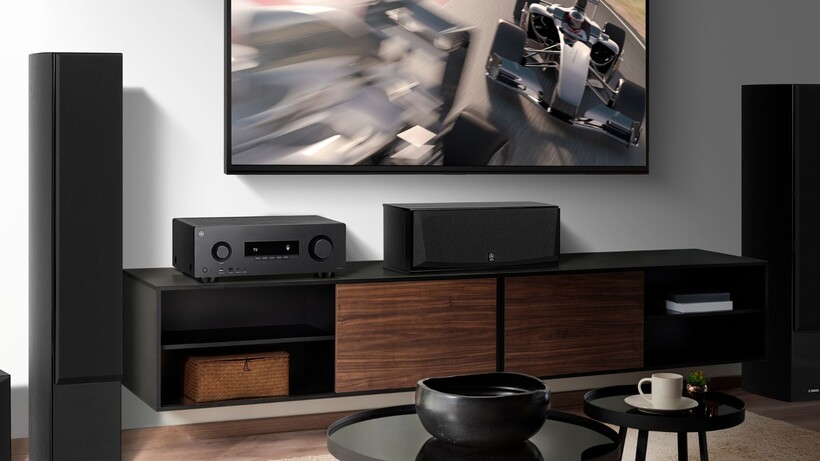
Yamaha’s launched two new AV receivers give home cinemas a boost


Yamaha has introduced two new AV receivers designed to bring more immersive sound and modern connectivity to home cinema setups.

The new RX500A and RX300A sit at different price tiers but both focus on one thing: making Dolby Atmos and next-gen video formats more accessible in everyday living rooms.


At the core of both models is support for Dolby Atmos, allowing for immersive surround sound with flexible speaker configurations. The RX500A offers full 7.2-channel surround, while the more compact RX300A steps down to 5.2 channels.

Both also support virtual height effects depending on setup. The result is a more layered, directional soundstage designed to pull viewers deeper into films, TV shows and games.

On the video side, both receivers support 8K/60Hz and 4K/120Hz passthrough. They also support Dolby Vision and HDR10+, putting them in line with games consoles and most TV displays. Additionally, gaming support is built in, with ALLM and VRR aimed at reducing lag and keeping motion smooth during fast-paced play.

Advertisement

Yamaha has also leaned heavily into usability. Both models feature room correction technology, which uses a setup microphone to analyse your space and automatically adjust audio output for better balance.

In addition, ‘Quick Guide’ setup instructions and dedicated Scene buttons are designed to simplify everyday use. These features let users switch between preset configurations without digging through menus.

Yamaha RX300A lifestyle
Image Credit (Trusted Reviews)

Where the two models differ most is connectivity. The RX500A includes full network support, enabling streaming via services like Spotify Connect, Google Cast, AirPlay 2, TIDAL Connect, and Qobuz Connect. It also has built-in Wi-Fi and Bluetooth multipoint support. Meanwhile, the RX300A skips network streaming but keeps Bluetooth multipoint for easy device switching.

Other areas that Yamaha has also focused include sound stability and build quality. Both receivers use refined internal layouts designed to reduce interference, along with Anti-Resonance Technology (A.R.T.) Wedge, a fifth stabilising foot that helps minimise vibration for cleaner audio performance.

Advertisement

The company says these designs build on decades of AV receiver development. Their goal is to make the technology “disappear” once playback starts, leaving users focused on the content rather than the setup.

With support for the latest audio and video formats, plus a strong focus on ease of use, the RX500A and RX300A look like solid all-rounders for anyone upgrading their home cinema system.

Pricing for the RX300A is expected to be £349 / €399 and it’s available from August onwards. Pricing for the step-up RX500A is still TBC but it’ll launch later this year in September.


Source link

Leave a Reply

Subscribe to Our Newsletter

Get our latest articles delivered straight to your inbox. No spam, we promise.

Recent Reviews


When your car needs service, you’re probably going to turn to the place that’s most convenient, most trustworthy, and most affordable. Everybody has their favorites, but more often than not, people tend to end up at one of the popular auto shop chains on every corner. Two of the most recognizable are Firestone and Pep Boys. These chains have built reputations for dependable service across hundreds of locations coast to coast.

But while both brands do business in similar industries, they don’t have a whole lot in common beyond that. From their business models to their ownership structures to their customer offerings, these two auto shop chains have plenty of differences drivers need to know about. Their tires, their warranties, their in-store selection… Firestone and Pep Boys are far from identical. Looking at the biggest differences between the two might just influence your decision on where to take your car the next time you’re in a bind.

Pep Boys used to be an auto parts retailer and a service center

What makes Pep Boys unique is the fact that it used to double as both a retailer and a service center. It was like an AutoZone and a Firestone combined. This two-part approach meant customers could either buy the parts and do the repair themselves or have them installed on-site. It was a shop that appealed to both DIY car owners and those who’d rather have a professional do it instead. Alas, the company has all but shut down its retail side in recent years to focus on the more lucrative part of the business, which is the service center.

Firestone has never had that kind of flexibility. It’s always been an auto shop and an auto shop alone. There’s no retail component like Pep Boys used to have, where customers can walk into any location and browse a wide range of automotive parts and accessories without needing to commit to service. You won’t get that at Firestone.

Firestone is owned by Bridgestone

You can learn a lot about a company by looking at who owns it. In fact, it’s a big reason why Firestone is so different from Pep Boys: it’s owned by Bridgestone, one of the best tire brands in the world. This ownership shapes nearly every aspect of its business, from its product offerings to its service priorities. Funny enough, Bridgestone also tried to buy Pep Boys in 2015 but ended up being outbid.

For one, it tells you the auto shop chain puts a lot more emphasis on its tire-related services than Pep Boys. It also means that Firestone shops are more beholden to Bridgestone’s product ecosystem than other auto shop chains. (More on that next.) Its Bridgestone ownership also influences how Firestone positions itself in the market. Rather than trying to be multiple things like Pep Boys, Firestone leans more into its identity as a knowledgeable service provider instead.

Pep Boys has more tire variety

Because Pep Boys isn’t owned by a top tire brand, it’s able to offer a much wider variety of tire options to their customers. Firestone, by comparison, puts a lot more focus on parent company Bridgestone’s tires and its in-house exclusive brands. You might not find much else beyond that, except maybe a select few tire brands it just so happens to have in stock. Pep Boys is different: The company has all the top tire brands, from Cooper to Pirelli to Michelin to Goodyear and beyond.

Yeah, that’s convenient, but it also helps you understand what kind of deal you’re getting. When a major tire service company pushes its own tires on you, it can be hard to know if you’re paying a fair price because you can’t make a proper comparison. Because Pep Boys has multiple brands available in one place, you can see your options side-by-side and decide from there, though availability can vary by location. Firestone tires are still quality, but Pep Boys gives you more of a choice.

Firestone has better warranties

One last point: Firestone has a lot more generous warranties than Pep Boys has to offer. Many parts and services are covered for 12 months or 12,000 miles, whichever comes first. Pep Boys, by comparison, only has a 90-day or 3,000-mile warranty on parts and services installed. That’s a pretty stark difference, which means Firestone definitely has the advantage here.

Keep in mind, though: Bridgestone’s limited warranty doesn’t apply to tires, batteries, wheels, or anything bought through the Firestone Off-Road Shop program. Specific tire warranties will vary from brand to brand, but all Bridgestone or Firestone tires come with a 90-day “Buy & Try Guarantee.” If you aren’t happy with your purchase, you can take them back and get credit for different tires instead. Another note: Pep Boys also has an extended warranty available for purchase. This extends things to 12 months with no mileage limit.


Source link