Harbor Freight’s Portable Garage Is A ‘Game Changer’ For Storing Vehicles And Tools


No matter how organized you are with your garage, there’s nothing you can do if there simply isn’t enough space for everything inside it — except get a portable garage. Under one of Harbor Freight’s in-house brands, CoverPro makes several carports, which we think are generally worth buying. 

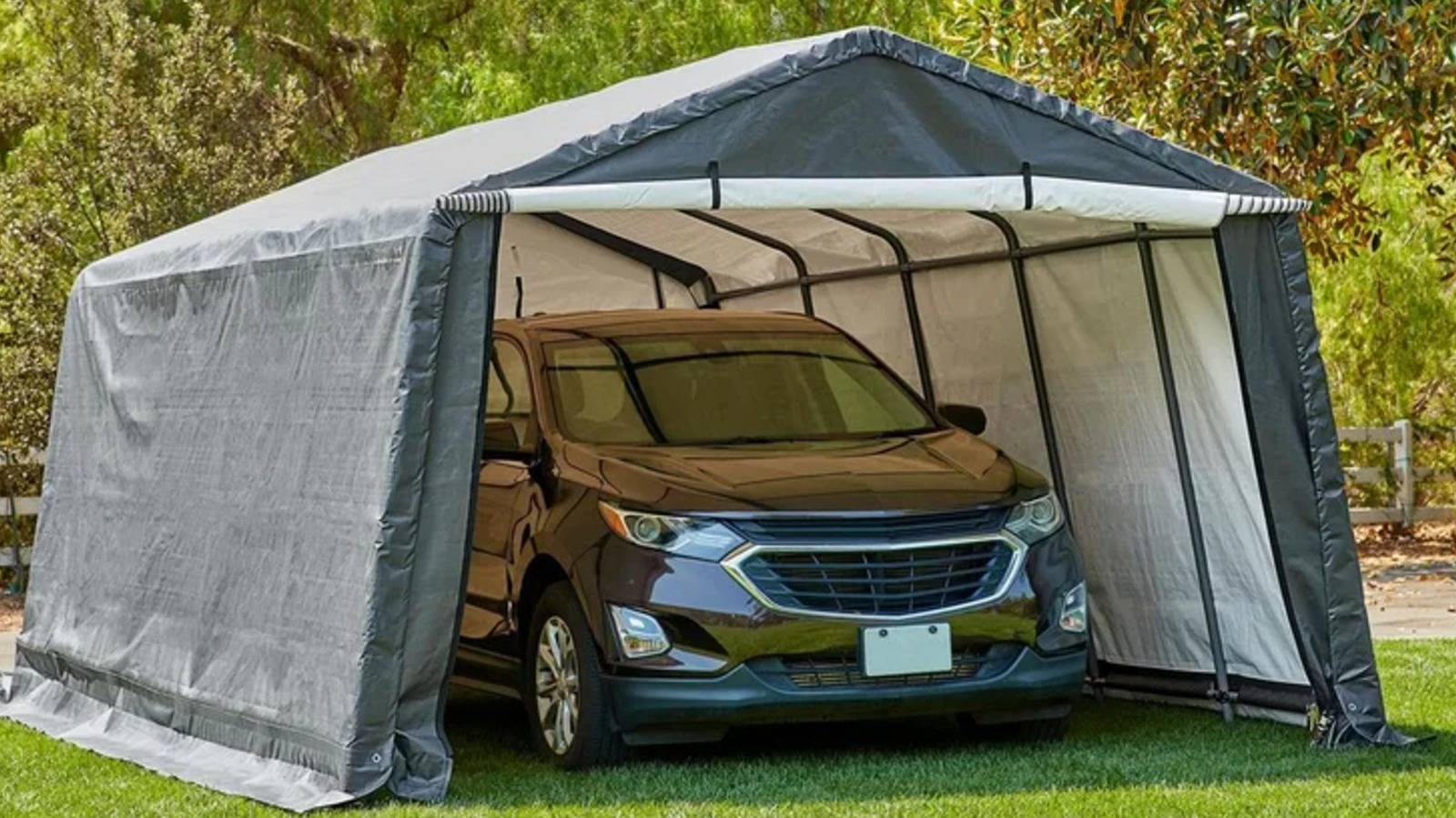
Among them, there’s the 12 ft. by 20 ft. Truck/SUV Portable Garage. Priced at $399.99, the CoverPro 12 ft. by 20 ft. Truck/SUV Portable Garage boasts a 1-½-inch steel frame that is wide enough for larger vehicles and storage requirements. Apart from trucks and SUVs, Harbor Freight notes that it’s also made for outdoor power equipment too. It boasts a UV-treated, polyethylene cover, so it’s meant to keep sun damage like fading to a minimum. It’s also made for all kinds of weather, including rain and snow. 

The unit itself weighs a little over 200 lbs, and the kit ships with nylon rope and anchors to keep it from flying off with strong winds. In total, you’re expecting a coverage area of 240 sq. ft. with a height of a little over 8 ft. Among its competition, it tends to be regularly compared with ShelterLogic’s 12 ft x 20 ft Garage-in-a-Box, which retails for a higher price at $649.99. But, what do customers actually think of its real-world performance?

What do users have to say about the CoverPro Portable Garage

As of June 2026, it’s safe to say that most Harbor Freight customers are satisfied, since it enjoys an average rating of 4.6 stars out of more than 470 buyers. Apart from 94% of customers recommending it, over ¾ of all reviewers have given it a perfect 5-star rating. Several satisfied customers noted that while they bought it as temporary workspaces, they found it could be used semi-permanently. During one particular storm, one reviewer said that it absorbed the impact of a fallen tree branch and saved their car. But while it’s made for vehicles, one user mentioned that they successfully used it for keeping their citrus trees alive.

On the other hand, there are about 3% of Harbor Freight customers who aren’t so happy and have rated it a single star. Some of the most common issues cited were related to the assembly process, such as poor instructions, fit, and sewing. There were a few people who complained of bends in the metal and boltholes that weren’t punched properly. There were also some users who claimed it didn’t live up to its promises of durability when it comes to strong winds, rain, and snow. There were recurring concerns about the cover, wherein people noted that it wasn’t able to keep the water and condensation out. On Reddit, user TallTx lamented how “golf ball sized hail” took theirs down after just two seasons.

Ways to get more out of your portable garage

While it is meant to be a temporary storage solution, it doesn’t mean you’re doomed to throw it out after just a short period of use. In recent times, users who thought it needed some additional reinforcement cited several methods you can try. For example, YouTuber Slip Fit Garage recommends adding strategically placed ratchet straps on ground anchors and across the unit. Creator Lindsey Acres Farm also shared that they laid landscape stones to avoid digging into the ground and added a PVC pipe on the opposite side of the door for added stability. Either way, there are plenty of affordable ways to make your portable garage last longer.

If you think you don’t need as much coverage, CoverPro also sells other similar, highly-rated canopies that are more popular. For temporary storage solutions, these might fulfill your needs already at a fraction of the price, so you have extra budget for the add-ons. On Harbor Freight, you can get both the 10 ft x 10 ft Portable Shed ($164.99) and the 10 ft by 17 ft Portable Car Canopy ($229.99), which also enjoy average ratings above 4 stars. Although, if you’re not in a rush, the 12 ft by 20 ft portable garage does go on sale occasionally. In 2023, we mentioned how it went as low as $379.99 during the Harbor Freight Labor Day weekend.


Source link

Leave a Reply

Subscribe to Our Newsletter

Get our latest articles delivered straight to your inbox. No spam, we promise.

Recent Reviews


When your car needs service, you’re probably going to turn to the place that’s most convenient, most trustworthy, and most affordable. Everybody has their favorites, but more often than not, people tend to end up at one of the popular auto shop chains on every corner. Two of the most recognizable are Firestone and Pep Boys. These chains have built reputations for dependable service across hundreds of locations coast to coast.

But while both brands do business in similar industries, they don’t have a whole lot in common beyond that. From their business models to their ownership structures to their customer offerings, these two auto shop chains have plenty of differences drivers need to know about. Their tires, their warranties, their in-store selection… Firestone and Pep Boys are far from identical. Looking at the biggest differences between the two might just influence your decision on where to take your car the next time you’re in a bind.

Pep Boys used to be an auto parts retailer and a service center

What makes Pep Boys unique is the fact that it used to double as both a retailer and a service center. It was like an AutoZone and a Firestone combined. This two-part approach meant customers could either buy the parts and do the repair themselves or have them installed on-site. It was a shop that appealed to both DIY car owners and those who’d rather have a professional do it instead. Alas, the company has all but shut down its retail side in recent years to focus on the more lucrative part of the business, which is the service center.

Firestone has never had that kind of flexibility. It’s always been an auto shop and an auto shop alone. There’s no retail component like Pep Boys used to have, where customers can walk into any location and browse a wide range of automotive parts and accessories without needing to commit to service. You won’t get that at Firestone.

Firestone is owned by Bridgestone

You can learn a lot about a company by looking at who owns it. In fact, it’s a big reason why Firestone is so different from Pep Boys: it’s owned by Bridgestone, one of the best tire brands in the world. This ownership shapes nearly every aspect of its business, from its product offerings to its service priorities. Funny enough, Bridgestone also tried to buy Pep Boys in 2015 but ended up being outbid.

For one, it tells you the auto shop chain puts a lot more emphasis on its tire-related services than Pep Boys. It also means that Firestone shops are more beholden to Bridgestone’s product ecosystem than other auto shop chains. (More on that next.) Its Bridgestone ownership also influences how Firestone positions itself in the market. Rather than trying to be multiple things like Pep Boys, Firestone leans more into its identity as a knowledgeable service provider instead.

Pep Boys has more tire variety

Because Pep Boys isn’t owned by a top tire brand, it’s able to offer a much wider variety of tire options to their customers. Firestone, by comparison, puts a lot more focus on parent company Bridgestone’s tires and its in-house exclusive brands. You might not find much else beyond that, except maybe a select few tire brands it just so happens to have in stock. Pep Boys is different: The company has all the top tire brands, from Cooper to Pirelli to Michelin to Goodyear and beyond.

Yeah, that’s convenient, but it also helps you understand what kind of deal you’re getting. When a major tire service company pushes its own tires on you, it can be hard to know if you’re paying a fair price because you can’t make a proper comparison. Because Pep Boys has multiple brands available in one place, you can see your options side-by-side and decide from there, though availability can vary by location. Firestone tires are still quality, but Pep Boys gives you more of a choice.

Firestone has better warranties

One last point: Firestone has a lot more generous warranties than Pep Boys has to offer. Many parts and services are covered for 12 months or 12,000 miles, whichever comes first. Pep Boys, by comparison, only has a 90-day or 3,000-mile warranty on parts and services installed. That’s a pretty stark difference, which means Firestone definitely has the advantage here.

Keep in mind, though: Bridgestone’s limited warranty doesn’t apply to tires, batteries, wheels, or anything bought through the Firestone Off-Road Shop program. Specific tire warranties will vary from brand to brand, but all Bridgestone or Firestone tires come with a 90-day “Buy & Try Guarantee.” If you aren’t happy with your purchase, you can take them back and get credit for different tires instead. Another note: Pep Boys also has an extended warranty available for purchase. This extends things to 12 months with no mileage limit.


Source link