How To Fight a Weight Loss War


Like Coke and Pepsi, Novo Nordisk and Eli Lilly compete for the same consumer. Trying to predict the other’s strategy, their behavior reflects the basics of game theory and the prisoners’ dilemma.

A Weight Loss War

Our story starts with the GLP 1 drugs that targeted type 2 diabetes. Initially used to improve glucose control, researchers soon realized they also had a product that suppressed appetite. Taking the next step, they re-aligned their drug and entered the weight loss market. The year was 2017 when Novo Nordisk launched Ozempic.

However, we could say that the war began in 2021 when Novo Nordisk introduced its weight loss drug called Wegovy. Soon after, Eli Lilly had Mounjaro for diabetes and then Zepbound for weight loss. With more than 40% of all adults in the US defined as obese, they both recognized that the weight loss market could exceed $100 billion annually.

As a metric for judging the war’s winners, we can first go back to 2024. At the time, with Ozempic and Wegovy, Novo Nordisk could cite approximately $30 billion in sales while Lilly’s GLP 1 portfolio was moving past $15 billion.

Now though, looking at efficacy and delivery, Lilly seems to have had some recent victories. In head-to-head trials, Eli Lilly announced 23.6% weight loss over 84 weeks compared to Novo Nordisk’s 20.2%. As for delivery, instead of weekly injections, Lilly offered a four-dose single device alternative. But, this year, when Novo Nordisk introduced a Wegovy pill as an injection alternative, it had the largest drug launch in recent history with 1.3 million prescriptions in the first quarter. Its new CEO said that, at that moment, it became the pill leader.

Moving to pricing strategy, we are told that Novo Nordisk said it will slash GLP 1 prices in 2027 up to 50% to $675 a month for Wegovy and 35% for Ozempic. But also, Lilly announced a $299 self-pay option with certain doses. Both also negotiate with Pharmacy Benefit Managers (PBMs) to expand consumers’ insurance access. As Novo Nordisk’s CEO said to The Journal, few pay list price.

Then, to all of this we can add their pipeline of new and related products. The Novo Nordisk CEO cites the related health gain that their future drugs will target.

Our Bottom Line: The Prisoners’ Dilemma

With metrics that relate to efficacy, delivery, price, and pipeline, Eli Lilly and Novo Nordisk worry about what each will do. Like two burglary suspects, they have the prisoners’ dilemma:

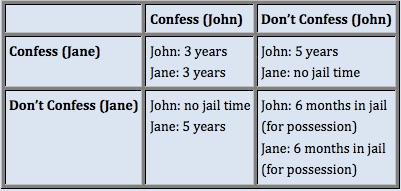
Assume two burglary suspects have just been arrested. Interrogated separately at the police station, each one knows that the sentence depends on who confesses.

As you can see in the following diagram, if both confess, they each get three years. And if both don’t confess then the sentence is 6 months. However, denial could bring the longest jail time if the other person tells all:

holiday shipping


Because oligopolies like Novo Nordisk and Eli Lilly have considerable market power, each one can determine a competitive strategy. However, like our prisoners, the outcome of the decision also depends on the other party.

My sources and more: Thanks to The Journal’s podcast for inspiring today’s post. From there, for more detail, we looked at Yahoo Finance for our facts. We also looked back to our previous post on competition and the prisoners’ dilemma.

Please note that several of today’s sentences were in a past econlife post.

The post How To Fight a Weight Loss War appeared first on Econlife.


Source link

Leave a Reply

Subscribe to Our Newsletter

Get our latest articles delivered straight to your inbox. No spam, we promise.

Recent Reviews


When your car needs service, you’re probably going to turn to the place that’s most convenient, most trustworthy, and most affordable. Everybody has their favorites, but more often than not, people tend to end up at one of the popular auto shop chains on every corner. Two of the most recognizable are Firestone and Pep Boys. These chains have built reputations for dependable service across hundreds of locations coast to coast.

But while both brands do business in similar industries, they don’t have a whole lot in common beyond that. From their business models to their ownership structures to their customer offerings, these two auto shop chains have plenty of differences drivers need to know about. Their tires, their warranties, their in-store selection… Firestone and Pep Boys are far from identical. Looking at the biggest differences between the two might just influence your decision on where to take your car the next time you’re in a bind.

Pep Boys used to be an auto parts retailer and a service center

What makes Pep Boys unique is the fact that it used to double as both a retailer and a service center. It was like an AutoZone and a Firestone combined. This two-part approach meant customers could either buy the parts and do the repair themselves or have them installed on-site. It was a shop that appealed to both DIY car owners and those who’d rather have a professional do it instead. Alas, the company has all but shut down its retail side in recent years to focus on the more lucrative part of the business, which is the service center.

Firestone has never had that kind of flexibility. It’s always been an auto shop and an auto shop alone. There’s no retail component like Pep Boys used to have, where customers can walk into any location and browse a wide range of automotive parts and accessories without needing to commit to service. You won’t get that at Firestone.

Firestone is owned by Bridgestone

You can learn a lot about a company by looking at who owns it. In fact, it’s a big reason why Firestone is so different from Pep Boys: it’s owned by Bridgestone, one of the best tire brands in the world. This ownership shapes nearly every aspect of its business, from its product offerings to its service priorities. Funny enough, Bridgestone also tried to buy Pep Boys in 2015 but ended up being outbid.

For one, it tells you the auto shop chain puts a lot more emphasis on its tire-related services than Pep Boys. It also means that Firestone shops are more beholden to Bridgestone’s product ecosystem than other auto shop chains. (More on that next.) Its Bridgestone ownership also influences how Firestone positions itself in the market. Rather than trying to be multiple things like Pep Boys, Firestone leans more into its identity as a knowledgeable service provider instead.

Pep Boys has more tire variety

Because Pep Boys isn’t owned by a top tire brand, it’s able to offer a much wider variety of tire options to their customers. Firestone, by comparison, puts a lot more focus on parent company Bridgestone’s tires and its in-house exclusive brands. You might not find much else beyond that, except maybe a select few tire brands it just so happens to have in stock. Pep Boys is different: The company has all the top tire brands, from Cooper to Pirelli to Michelin to Goodyear and beyond.

Yeah, that’s convenient, but it also helps you understand what kind of deal you’re getting. When a major tire service company pushes its own tires on you, it can be hard to know if you’re paying a fair price because you can’t make a proper comparison. Because Pep Boys has multiple brands available in one place, you can see your options side-by-side and decide from there, though availability can vary by location. Firestone tires are still quality, but Pep Boys gives you more of a choice.

Firestone has better warranties

One last point: Firestone has a lot more generous warranties than Pep Boys has to offer. Many parts and services are covered for 12 months or 12,000 miles, whichever comes first. Pep Boys, by comparison, only has a 90-day or 3,000-mile warranty on parts and services installed. That’s a pretty stark difference, which means Firestone definitely has the advantage here.

Keep in mind, though: Bridgestone’s limited warranty doesn’t apply to tires, batteries, wheels, or anything bought through the Firestone Off-Road Shop program. Specific tire warranties will vary from brand to brand, but all Bridgestone or Firestone tires come with a 90-day “Buy & Try Guarantee.” If you aren’t happy with your purchase, you can take them back and get credit for different tires instead. Another note: Pep Boys also has an extended warranty available for purchase. This extends things to 12 months with no mileage limit.


Source link