What Does SpaceX Get Paid For?


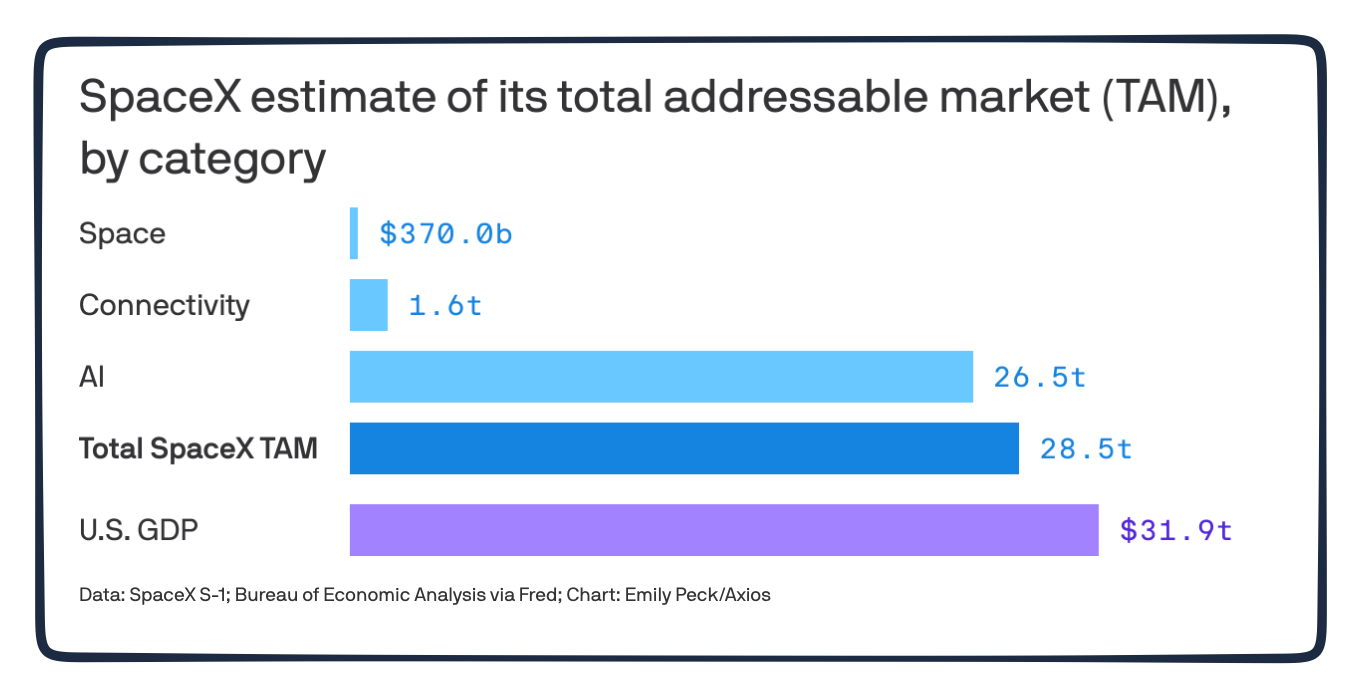
With the SpaceX IPO launching on June 12th, Axios Markets looked at its total addressable market (TAM). Saying it was “galaxy math,” they cited the U.S. GDP as only slightly less. Excluding China, Russia, and colonizing Mars, they predicted a whopping $26.5 trillion from AI:
SpaceX IPO TAM

SpaceX Revenue

The sources of SpaceX revenue range from the International Space Station to the U.S. Space Force, to you and me:

By the end of 2030, astronauts on the International Space Station will no longer be saying, “Today’s urine is tomorrow’s coffee” because then, the International Space Station (ISS) will be trashed. For as much as $843 million, SpaceX will be guiding the station into the Pacific Ocean. At a deep water dumping spot called Point Nemo, the ISS will join other space junk.

In addition, SpaceX is the launch of choice for the U.S. Space Force. For a warfare systems satellite communications network and satellites that track missiles and aircraft, SpaceX won 2 contracts that total $6.5 billion. Called Customer A in its security filings preceding its IPO, the federal government is SpaceX’s largest client.

But it’s Starlink that can be called the SpaceX cash cow. Ranging from my WIFI during a recent flight to Florida to Ukraine’s troop connectivity, Starlink has 10.3 million subscribers. As a global broadband internet service from space, it uses more than 9,600 satellites in low-earth orbit. Then, according to Yahoo!Finance, they add 70 satellites per week. And, on the other end, SpaceX plans to produce a whopping 15,000 Starlink kits each day.

For our summary, Markets.com helped us out:
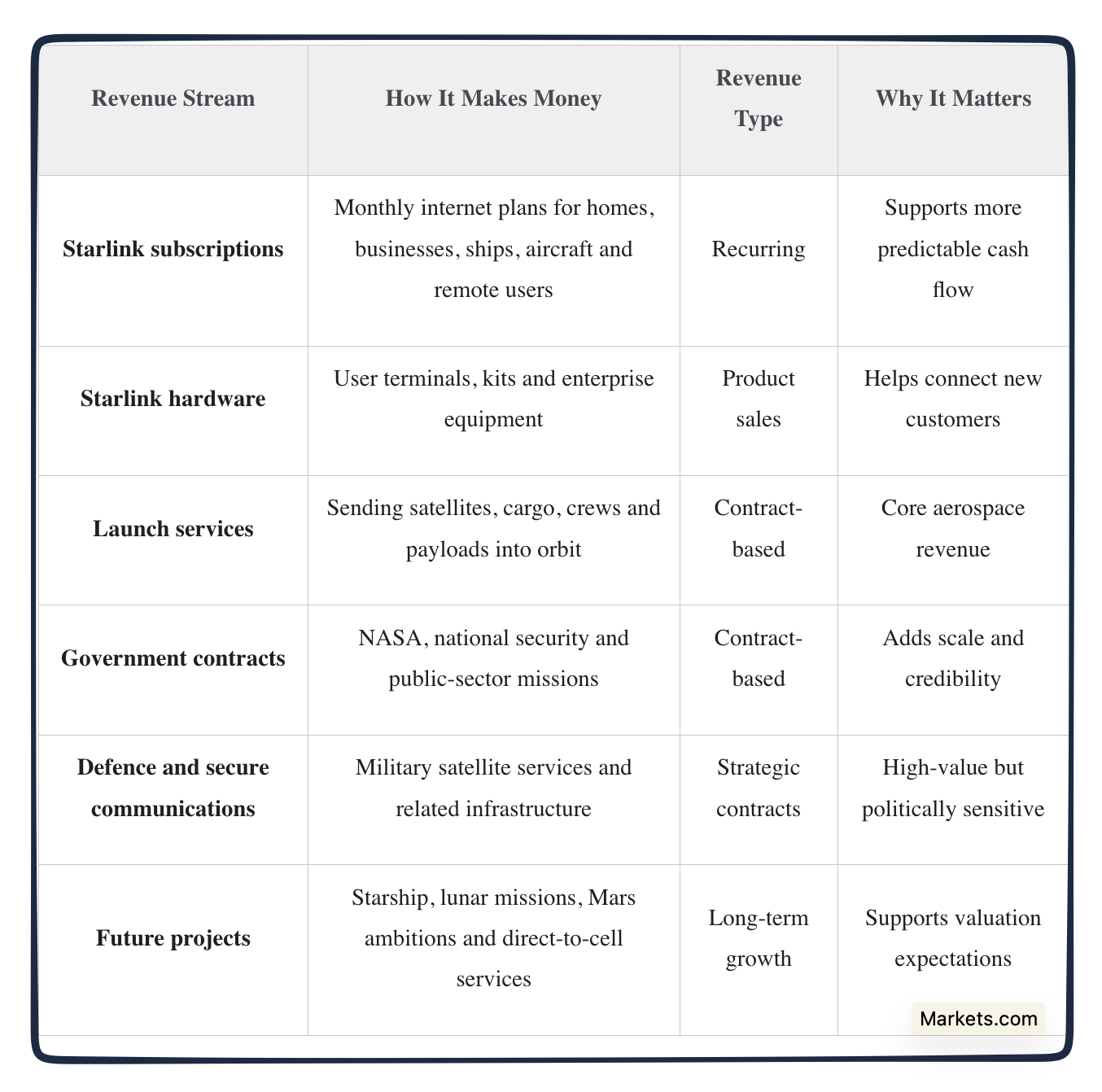
SpaceX revenue

Our Bottom Line: Financial Intermediaries

Like all IPOs, the SpaceX Initial Public Offering moves private ownership of a company to the public. Purchasing shares from a group that (usually) includes the original owners, the company, and Venture Capital investors, buyers become owners of the company. But someone has to connect sellers and buyers. And that is why we need financial intermediaries.

Financial institutions play a hidden role in our everyday lives. Called intermediaries by economists, they link the people with money to those who need it. They include the stock markets that are a place and a process through which companies can connect to investors. Similarly, banks eliminate the need to find an individual who will pay for your house, your car, or your new factory. Banks are one of the go-to places for storing your money, paying your bills, and funding your business ventures.

Financial intermediaries have been compared to a beating heart. Like a heart keeps nutrient-laden blood flowing around our bodies, banks, stock markets, and other similar entities and institutions pump money around our economy. Whether talking about a healthy body, a healthy economy, or the SpaceX IPO, a heartbeat and a financial intermediary are crucial.

My sources and more: Thanks to Emily Peck’s Axios Markets email for inspiring today’s post. From there, searching for SpaceX, we discovered this Smithsonian article. But the best summaries of their revenue and the IPO were at Yahoo!Finance and Markets.

Please note that several of today’s sentences were in a past econlife post.

The post What Does SpaceX Get Paid For? appeared first on Econlife.


Source link

Leave a Reply

Subscribe to Our Newsletter

Get our latest articles delivered straight to your inbox. No spam, we promise.

Recent Reviews


When your car needs service, you’re probably going to turn to the place that’s most convenient, most trustworthy, and most affordable. Everybody has their favorites, but more often than not, people tend to end up at one of the popular auto shop chains on every corner. Two of the most recognizable are Firestone and Pep Boys. These chains have built reputations for dependable service across hundreds of locations coast to coast.

But while both brands do business in similar industries, they don’t have a whole lot in common beyond that. From their business models to their ownership structures to their customer offerings, these two auto shop chains have plenty of differences drivers need to know about. Their tires, their warranties, their in-store selection… Firestone and Pep Boys are far from identical. Looking at the biggest differences between the two might just influence your decision on where to take your car the next time you’re in a bind.

Pep Boys used to be an auto parts retailer and a service center

What makes Pep Boys unique is the fact that it used to double as both a retailer and a service center. It was like an AutoZone and a Firestone combined. This two-part approach meant customers could either buy the parts and do the repair themselves or have them installed on-site. It was a shop that appealed to both DIY car owners and those who’d rather have a professional do it instead. Alas, the company has all but shut down its retail side in recent years to focus on the more lucrative part of the business, which is the service center.

Firestone has never had that kind of flexibility. It’s always been an auto shop and an auto shop alone. There’s no retail component like Pep Boys used to have, where customers can walk into any location and browse a wide range of automotive parts and accessories without needing to commit to service. You won’t get that at Firestone.

Firestone is owned by Bridgestone

You can learn a lot about a company by looking at who owns it. In fact, it’s a big reason why Firestone is so different from Pep Boys: it’s owned by Bridgestone, one of the best tire brands in the world. This ownership shapes nearly every aspect of its business, from its product offerings to its service priorities. Funny enough, Bridgestone also tried to buy Pep Boys in 2015 but ended up being outbid.

For one, it tells you the auto shop chain puts a lot more emphasis on its tire-related services than Pep Boys. It also means that Firestone shops are more beholden to Bridgestone’s product ecosystem than other auto shop chains. (More on that next.) Its Bridgestone ownership also influences how Firestone positions itself in the market. Rather than trying to be multiple things like Pep Boys, Firestone leans more into its identity as a knowledgeable service provider instead.

Pep Boys has more tire variety

Because Pep Boys isn’t owned by a top tire brand, it’s able to offer a much wider variety of tire options to their customers. Firestone, by comparison, puts a lot more focus on parent company Bridgestone’s tires and its in-house exclusive brands. You might not find much else beyond that, except maybe a select few tire brands it just so happens to have in stock. Pep Boys is different: The company has all the top tire brands, from Cooper to Pirelli to Michelin to Goodyear and beyond.

Yeah, that’s convenient, but it also helps you understand what kind of deal you’re getting. When a major tire service company pushes its own tires on you, it can be hard to know if you’re paying a fair price because you can’t make a proper comparison. Because Pep Boys has multiple brands available in one place, you can see your options side-by-side and decide from there, though availability can vary by location. Firestone tires are still quality, but Pep Boys gives you more of a choice.

Firestone has better warranties

One last point: Firestone has a lot more generous warranties than Pep Boys has to offer. Many parts and services are covered for 12 months or 12,000 miles, whichever comes first. Pep Boys, by comparison, only has a 90-day or 3,000-mile warranty on parts and services installed. That’s a pretty stark difference, which means Firestone definitely has the advantage here.

Keep in mind, though: Bridgestone’s limited warranty doesn’t apply to tires, batteries, wheels, or anything bought through the Firestone Off-Road Shop program. Specific tire warranties will vary from brand to brand, but all Bridgestone or Firestone tires come with a 90-day “Buy & Try Guarantee.” If you aren’t happy with your purchase, you can take them back and get credit for different tires instead. Another note: Pep Boys also has an extended warranty available for purchase. This extends things to 12 months with no mileage limit.


Source link