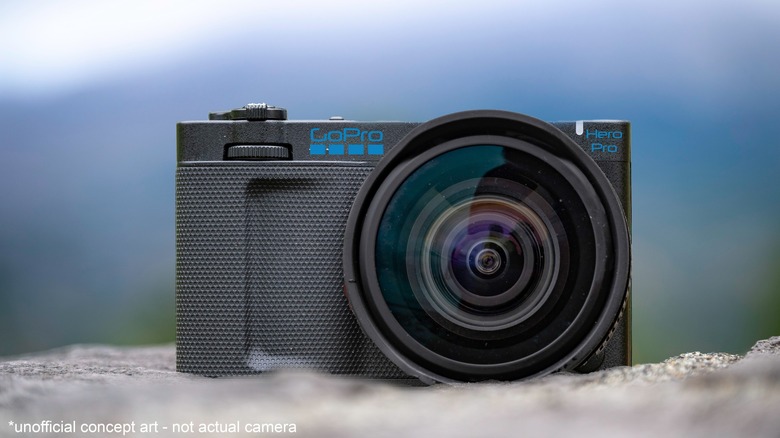

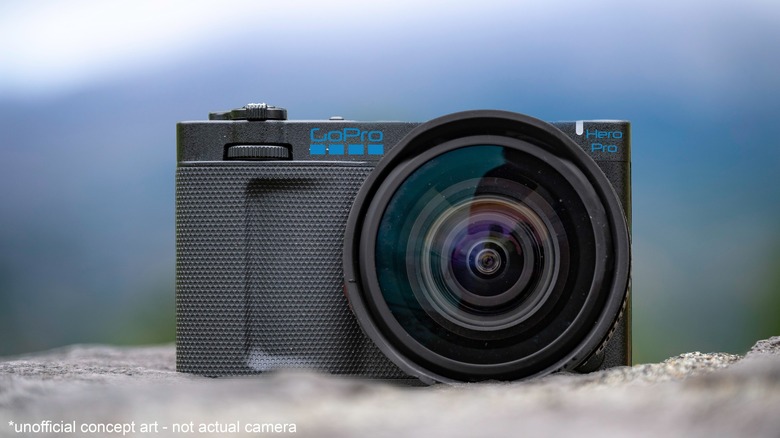
GoPro seems to be cooking up something special for spring. As much as I love the GoPro Max 2, the GoPro Hero 14 was conspicuously absent in 2025, marking the first year to go without a new entry in the Hero line in almost two decades. With new information beginning to trickle out, there seems to have been a very good reason for this, and the new tech which GoPro is now strongly hinting at is exciting to say the least.
I speculated heavily about what we might see in future action cameras back in February 2025. Some of my predictions came to fruition, while others have yet to find the light of day. Now, one of those yet-unrealized products seems tantalizingly close to reality, and what we may soon see from GoPro could potentially exceed my expectations. However, it’s important to temper that excitement, and analyze what we’ve been shown so far.
I’ve been covering action cameras for the better part of a decade, and now more than ever it is vital that GoPro launch something that sets it apart in an increasingly crowded market.
The GP3 processor and its implications
One of the key factors holding back recent GoPro cameras while its competitors were pulling ahead was an aging processor. The GP2 processor debuted way back in September 2021 in the GoPro Hero 10 Black. While it delivered a bump in low light capabilities, I still noted at the time that the Hero 10 struggled once it started getting dark, and the same was true of its successors all the way up to the Hero 13 and Max 2 cameras.
Now, with GoPro’s reveal of the GP3 processor, the company is claiming to outperform the competition in just about every way possible, from low-light performance to resolution and frame rates. According to GoPro, the GP3 delivers twice the pixel-processing power of the GP2, as well as an AI Neural Processor Unit.
If we’re assuming that by the “competition,” GoPro is referring to the Insta360 Ace Pro 2 and the DJI Osmo Action 6, and we also assume that the camera the GP3 will be powering is a new Hero 14, then if that camera does outperform the Action 6 and Ace Pro 2 in low light, that will indeed be an enormous leap forward from where things stand today.
Breaking down the teaser trailer
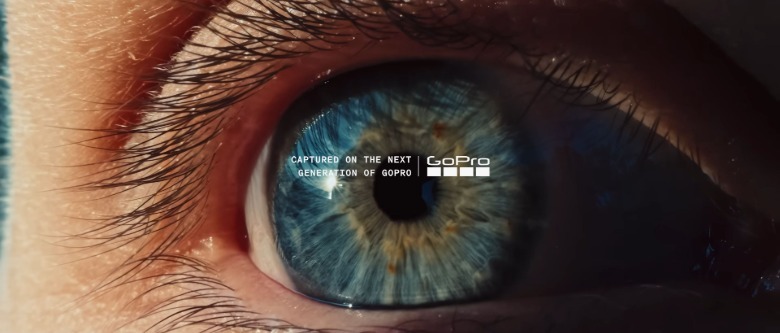
The “Previewing a New Generation of GoPro” teaser trailer may is brief and may seem vague, but it reveals some tantalizing capabilities from which we can infer likely aspects of upcoming GoPro cameras.
 GoPro
GoPro
The first scene shows an extreme close-up of an eye with a startling level of detail, more than I’d ever expect to see from an action camera. However, what’s really interesting to me is the sun-star reflected in the eye, which appears to have 14 points. That probably implies that that the camera in question has 14 aperture blades, and likely a variable aperture.
 GoPro
GoPro
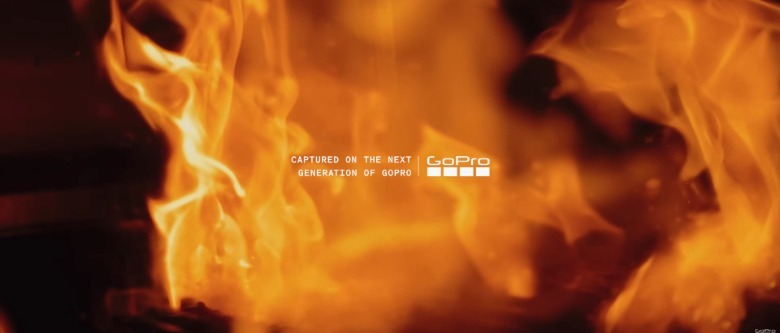
The next scene shows what looks to be a closeup of a campfire, and there are two important things to note here. The detail in the bright flames and in the shadowed portions of the image demonstrate a high dynamic range. It’s also extremely slow motion, and seemingly high resolution. I think we’re looking at a 4K 240fps clip here, as other 240fps video recordings of flames look very similar in terms of the rate of movement — that’s a big step up from the 4K 120fps of the Hero 13.
 GoPro
GoPro
Next is another closeup shot of dripping water and melting ice on evergreen pine branches. This shot shows crisp detail, good dynamic range again, and a deeply out-of-focus background. The bokeh effect screams “wide-aperture,” and might indicate quite a large sensor as well.
 GoPro
GoPro
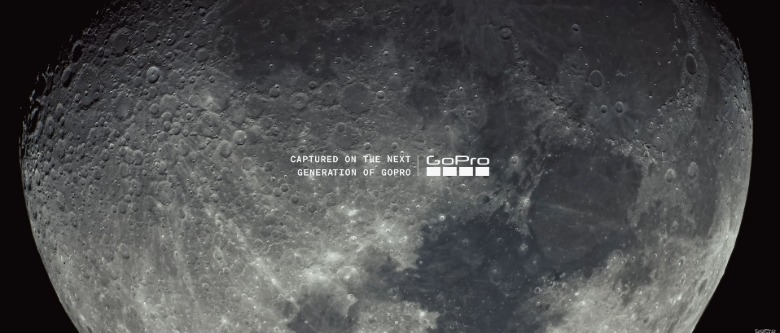
The third scene is a super telephoto shot of the moon. At a guess, I’d estimate it to be shot at a 1000mm equivalent focal length. It could be that this was shot with a new super-tele lens mod for the Hero 14.
So what is GoPro cooking?
The tricky thing about figuring out exactly what GoPro is hiding behind the curtain is that it has multiple cameras in the works. The GP3 press release mentions “action cameras, 360 cameras, vlogging cameras, and ultra-premium, compact cinema-grade cameras.”
“Action cameras” likely refers to the GoPro Hero 14, while “360 cameras” likely means a GoPro Max 3. “Vlogging cameras” probably means an integrated gimbal-camera similar to the DJI Pocket 3. I expect that the Hero 14 will be able to do 4K 240fps, and likely 8K 60fps (likely much higher at 2.7k, 1080p, and 720p). The same goes for the potential vlogging camera, which is the one camera in GoPro’s likely lineup which will probably face the steepest uphill battle.
The “ultra-premium, compact cinema-grade cameras” is most mysterious and exciting. I believe that whatever this might be is what was used to film the teaser. Realistically, the teaser could only have been filmed with a super zoom camera, or with multiple lenses. The intense out of focus areas and high level of image quality almost certainly rule out a super zoom camera like the Nikon P1000, so the conclusion I am forced to reach is that GoPro is likely about to release an interchangeable lens camera with a large sensor.
What might a Cinema-Grade GoPro actually be?
It’s difficult to imagine GoPro actually wading into the incredibly competitive mirrorless camera market. Photographers and videographers already have access to a wealth of fantastic options from brands that have impressive pedigrees in this market, and huge lens libraries to boot. Instead, I think GoPro is going to step into a niche which has remained essentially vacant since Nikon’s Nikonos line of cameras was discontinued in 2001.
One of the coolest things GoPro has done with its cameras has been to introduce and gradually expand its lineup of “Lens Mods,” lenses that clip into place over top of an interior, fixed lens element. This allows a camera to use different lenses, while remaining waterproof and preventing exposure of the delicate sensor. The Hero 13 is even able to recognize which lens mod is attached and automatically adjust settings to match.
I expect the mainline Hero 14 to retain a similar size sensor (albeit with significant upgrades) in order to maintain backwards compatibility with the brand’s existing lens mods. I think that the compact cinema camera it’s working on will use a more advanced lens mod system, paired with a large sensor, and use the same sort of fixed interior lens to retain its waterproof status. A Micro 4/3 sensor would make a lot of sense, but it’s entirely possible that GoPro has decided to go all the way and create a compact, waterproof, full frame cinema camera with interchangeable lenses.
For many filmmakers, such a tool would be of immense value, enabling shots which otherwise might have been nearly impossible to pull off. It’s the sort of thing I could see carrying with me everywhere I go.
Conclusion
I’m doing a lot of speculating here, of course, and it could be that GoPro has something very different in mind. What we know for sure is that these cameras are purported to have some exciting and much requested capabilities, and that at least one of them seems able to record some pretty amazing looking video footage.
Regardless, it seems we will soon find out for sure what GoPro has been working on, and I’m glad to learn that it seems to have taken the need to innovate to heart. The brand is looking to leapfrog the competition, diversify its product line, and take back the crown. GoPro has a great, distinctive color science that many people still seek out, and it is an absolute master of camera design. If it can pair that with new imaging technology to its performance apart, then the company may well make a startling comeback.

Stephan is the sports journalist for the Maple Grove Report.