What Those Little Scoops On Top Of Traffic Lights Are For


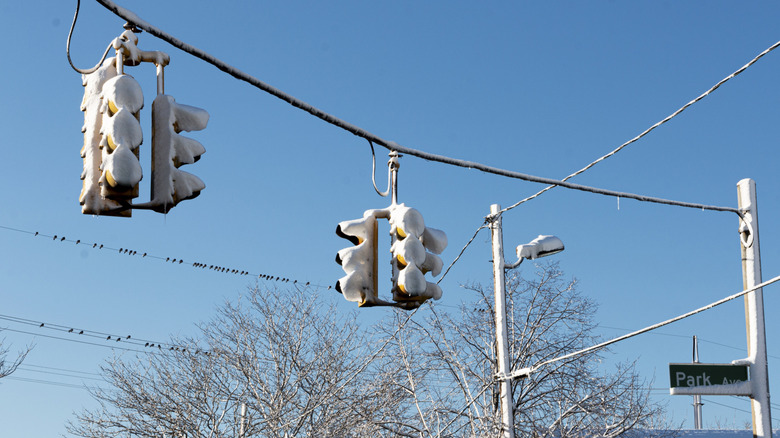
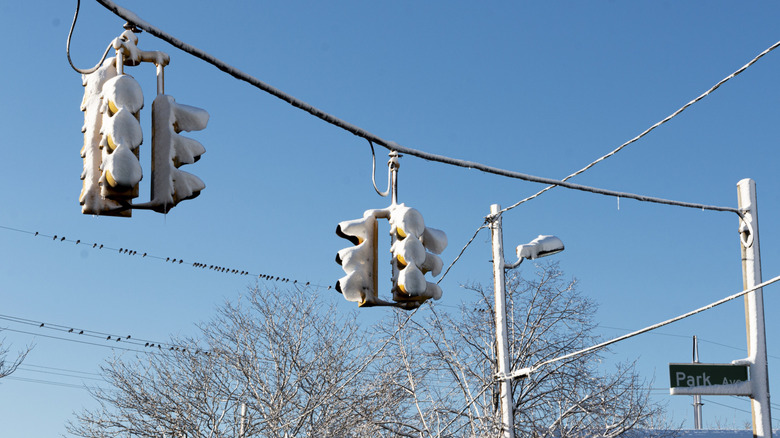
Unless you live in a climate where snow is a regular occurrence during the winter months, chances are you have no idea what those scoopy-looking things atop traffic lights are. The fact is, stoplights have gone through a long and strange evolution, first appearing in London, England, in 1868 (some 20 years before cars were even a thing). Today’s modern traffic control systems are infinitely more complex than you probably realize. 

From odd-shaped “bells” to black boxes and white squares, there is now an assortment of gadgets attached to or located near virtually every traffic signal that we either never notice or don’t have the foggiest notion about what they do. Most signal units now come with fully enclosed hoods that really help make them more visible to drivers, but that wasn’t always the case. Those now-standard hoods (aka visors) do a great job at blocking the sun’s glare, much the same way a baseball cap shields the sun from a person’s eyes.

They work perfectly fine in areas where snow isn’t a concern, but do the exact opposite when Old Man Winter acts up, turning them into snow catchers that ultimately block them from the driver’s view. Enter the snow scoop visor, which features two rather simple tweaks to the otherwise normal visor. One version (made by SWARCO McCain, Inc.) features a louvered vent at the top of the hood and a portion of the bottom removed, which work in tandem to increase the vertical movement of air across the lens face and help keep snow from building up inside the hood.

Snow scoops and snow cones

Very early traffic lights were illuminated by flames fed by natural gas. As technology advanced, so too did the way they were brought to life. When electricity became prevalent, incandescent bulbs filled with a nitrogen-argon mixture became the go-to lighting method. These inert gases prevented the tungsten filaments from evaporating and helped keep the inside of the bulbs from becoming blackened. Incandescent bulbs were very hot, which was great for melting snow, but had relatively short lifespans and thus needed to be replaced fairly often.

Halogen bulbs eventually replaced the old incandescent ones, but far more energy-efficient LEDs are all the rage today. There is one problem, though: these light-emitting diodes don’t give off nearly enough heat to melt snow, so a new method was needed to rid the nasty-to-drive-in white stuff. As such, the scoop tunnel visor was devised as a simple yet effective way to prevent stoplights from becoming obscured. Typically made from powder-coated aluminum to resist corrosion over time, they’re unfazed by harsh climates and don’t require any electricity. Equally important, maintenance crews don’t need to go around and remove built-up snow from inside every single visor, all of which saves both time and money.

But it’s not the only method used to beat back Old Man Winter’s wily ways. Manufactured by Snow Proof Signals LLC, snow cones are exactly what they sound like — a clear, shatter-resistant, cone-shaped piece of UV-resistant polymethyl methacrylate acrylic thermoplastic placed directly over the light. Adapted from New York’s Department of Transportation, it too sits passively (inside a standard hood) and, like the louvered snow-scoop visor, prevents snow from building up.


Source link

Leave a Reply

Subscribe to Our Newsletter

Get our latest articles delivered straight to your inbox. No spam, we promise.

Recent Reviews


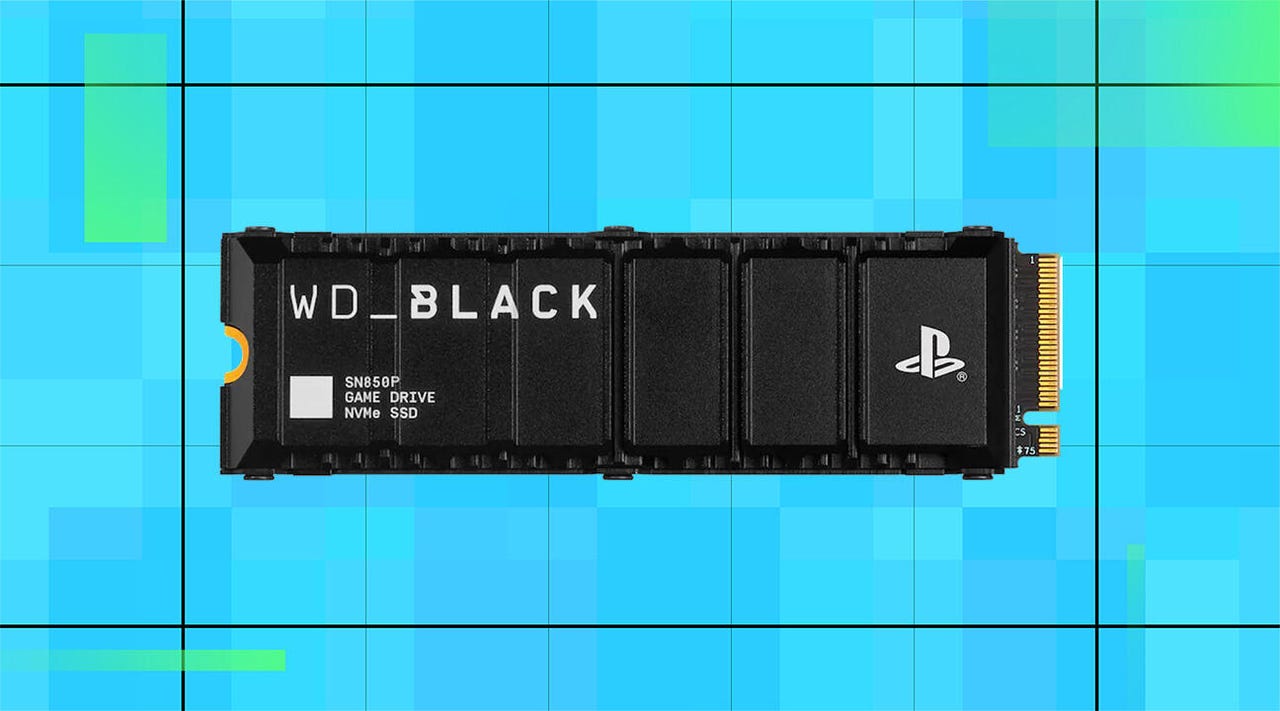
A WD Black SN850P SSD on a blue background

WD/ZDNET

High SSD prices got you down? Right now during Best Buy’s Tech Fest sale, you can save up to $2,800 on the WD Black SN850P storage drive. And while it’s officially licensed for use with PlayStation 5 consoles, it’s easy to reconfigure for use in gaming laptops and desktops for a boost in storage capacity. 

Also: The best Amazon Spring Sale deals: Save on streaming, Apple, Samsung, and more

Available in capacities from 1TB to 8TB, the WD Black SN850P can double, or even quadruple, your available storage space, giving you plenty of room for large game downloads, save files, screenshots, highlight reels, and more. With read and write speeds up to 7300 and 6600 MB/s, respectively, you’ll get much faster loading times than traditional HDDs as well as quicker access to your favorite apps, games, and programs.

Also: SSD vs HDD: What’s the difference, and which should you buy?

The integrated heatsink helps keep everything running at optimal temperatures to prevent data loss or corruption due to overheating. It can also be removed for easier installation in smaller PCs. 

By using flash memory rather than traditional mechanical platters, the WD Black SN850P can provide you with years of reliable data access with much less risk of internal damage due to shocks and bumps.

How I rated this deal 

Prices for RAM and SSD storage drives have skyrocketed as AI companies buy up available stock to power LLMs. And while this particular model is licensed for use with the PS5, you can quickly reconfigure it for use in laptops and desktop PCs. The 2TB model is marked down to $400, bringing it closer to pre-AI pricing, and the 8TB version is almost $2,800 off. While it’s still very expensive, it’s the lowest price I’ve seen on a high-end SSD in a long time. That’s why I gave this deal a 5/5 Editor’s rating.

Deals are subject to sell out or expire anytime, though ZDNET remains committed to finding, sharing, and updating the best product deals for you to score the best savings. Our team of experts regularly checks in on the deals we share to ensure they are still live and obtainable. We’re sorry if you’ve missed out on this deal, but don’t fret — we’re constantly finding new chances to save and sharing them with you at ZDNET.com


Show more

We aim to deliver the most accurate advice to help you shop smarter. ZDNET offers 33 years of experience, 30 hands-on product reviewers, and 10,000 square feet of lab space to ensure we bring you the best of tech. 

In 2025, we refined our approach to deals, developing a measurable system for sharing savings with readers like you. Our editor’s deal rating badges are affixed to most of our deal content, making it easy to interpret our expertise to help you make the best purchase decision.

At the core of this approach is a percentage-off-based system to classify savings offered on top-tech products, combined with a sliding-scale system based on our team members’ expertise and several factors like frequency, brand or product recognition, and more. The result? Hand-crafted deals chosen specifically for ZDNET readers like you, fully backed by our experts. 

Also: How we rate deals at ZDNET in 2026


Show more


Source link