
The Nothing Phone 4a Pro is the London-based startup’s fourth-generation mid-range device – but how does it compare to the full-fat Nothing Phone 3?
While you might assume that, with the Phone 4a Pro coming in at £499/$499 and the Nothing Phone 3 coming in at £699/$799, the flagship would have the upper hand – but that’s not always the case.
Instead, the cheaper Phone 4a Pro actually outpaces the Phone 3 in important areas like screen tech, and while it’s not the perfect phone, it could make for the smarter buy – for some people, anyway.
We’ve spent time with both the Nothing Phone 4a Pro and the Nothing Phone 3, and here’s how the two stylish Androids stack up in real-world use.
Design
Neither the Nothing Phone 4a nor the Nothing Phone 3 really look like any other phone on the market right now – but whether that’s a good or bad thing will depend on your personal taste.
While most manufacturers seem to prioritise sleek, simplistic designs, Nothing has gone in the total opposite direction and easily stands out from the crowd as a result – though it has switched it up in surprising ways with the two newer phones.

Gone is the totally transparent rear panel laden with LED strips found on early Nothing phones; instead, with the Phone 3, you’ll get a much more refined experience. It’s still sporting that classic Nothing see-through rear panel with very stylised internals beneath, but it now sports what Nothing calls the Glyph Matrix in the upper-right corner.
Much like the outgoing glyph lighting, the Matrix can alert you to incoming calls, notifications and more when the phone is face-down on a table, as well as double up as a (very low-res) rear camera preview window, and can even be used to play simplistic games. It’s certainly a novelty, but one that we appreciated in day-to-day use.
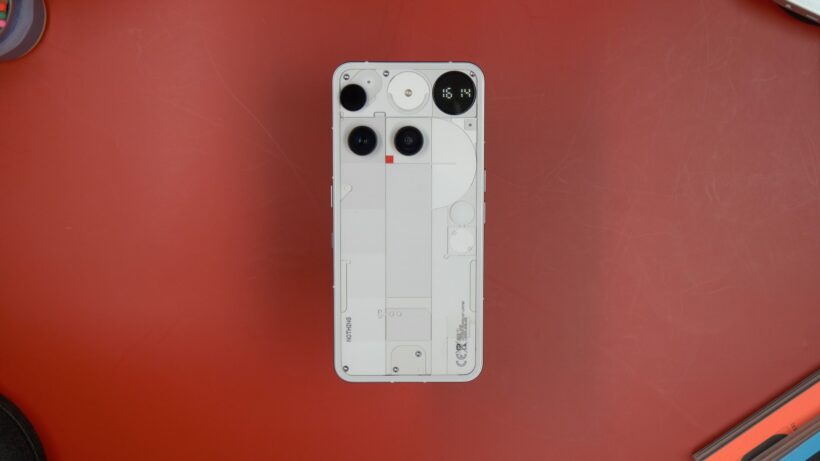
The Nothing Phone 4a Pro, on the other hand, ditches the transparent rear panel present on every Nothing Phone model to date for a (mostly) metallic rear, with the only hint of transparency in the large rear camera module.

It remains starkly different to most phones around, which tend to use a glass rear, and it feels great in the hand as a result, but it’s undoubtedly much more toned down than its predecessor.
It also gets the signature Glyph Matrix, this time mounted within the large rear camera bar, capable of displaying notifications and the like. However, without the little button that comes along with it on the Phone 3, it can’t be used for more advanced things like mini games – though how much you’d actually use it day-to-day is hard to say.
Despite a mostly aluminium build, the Phone 4a Pro isn’t quite as durable as the Phone 3, sporting IP56 splash resistance compared to the full IP68 protection of the flagship model.
Winner: Nothing Phone 3
Screen
When it comes to screen tech, the cheaper Nothing Phone 4a Pro seems to have the upper hand. The 4a Pro sports not only a larger panel than its more premium sibling, measuring 6.83 inches compared to 6.67 inches, but also more advanced underlying tech.
Take the refresh rate for example; the Phone 3 sports the standard 120Hz you’ll find on most flagships, albeit without the premium LTPO tech that lets it drop down to as little as 1Hz, while the Phone 4a Pro can go up to 144Hz.

LTPO would’ve helped the Phone 3 stand out a little more in this regard, but as it stands, the 4a Pro is faster, smoother in everyday use and can display more frames per second when gaming too.
It’s also noticeably brighter than its premium sibling, measuring 5000nits in terms of peak brightness compared to the Phone 3’s 4500nits, though that is limited to HDR viewing.
In more general use, the two panels aren’t quite as different, with neither particularly struggling even in bright outdoor conditions. But if you watch a lot of HDR content on YouTube and Netflix, you’ll find the 4a Pro has the edge.
The Phone 4a Pro should also be a little easier on the eyes, with faster 2160Hz PWM dimming tech compared to the 960Hz of the Phone 3 – though this is something that’s hard to quantify in real-world use. That said, if you’re prone to eyestrain when using phones for longer periods, especially in dim conditions, the 4a Pro should serve your needs well.

With that all in mind, it shouldn’t come as much of a surprise to learn that the Phone 4a Pro offers a pretty stellar screen experience for the price; it’s bright, colourful, fast and smooth, making it great for games and doomscrolling alike, with slimmer bezels than you often see at the mid-range price point.
The Phone 3’s screen is still excellent, with the same AMOLED tech and pixel-packed resolution delivering plenty of detail and vibrant colours well suited for most mobile tasks, but if you really want the best, the 4a Pro is the one to go for. Weird, right?
Winner: Nothing Phone 4a Pro
Cameras
You might assume that, with both the Phone 4a Pro and Phone 3 sporting a 50MP main camera that they’d be the same – but that’s not the case. Instead, the Phone 3 sports a larger (1/1.3-inch) sensor and a wider f/1.7 aperture compared to the 4a Pro’s alternative main snapper – and there are plenty of differences when it comes to the secondary lenses too.

The 50MP 3.5x periscope is much more similar, with both sporting the same-size sensor and offering up to 140x digital zoom – though with a slightly wider f/2.7 aperture, the Phone 3 has a slight edge, especially when it comes to low-light performance.
The Phone 4a Pro’s 8MP ultrawide is easily the weakest area of the experience, especially when compared to the Phone 3’s high-res 50MP alternative that also happens to have a larger 1/2.76-inch sensor.
That said, while both can deliver decent point-and-shoot results, neither can be described as having the best cameras around. While it can deliver good sharpness and decent HDR results, we found that neither Phone 4a Pro’s camera quality, nor the colour profile, were consistent among the three lenses – especially when it comes to that low-res ultrawide.

Even when bumping up the spec with the full-fat Phone 3, the results aren’t overwhelmingly positive. Similar issues with colour consistency, even when switching between 3x and 6x despite using the same lens, are easily noticeable, with an overly contrasty look in most images.
Again, it’s fine for everyday use and casual users likely won’t notice or care, but if you really want the best camera performance for your money, it’d be best to take a look at our selection of the best camera phones instead.
Winner: Nothing Phone 3
Performance
Neither the Phone 4a Pro or Phone 3 can be described as having the very best processing tech available, but the Phone 3, with its higher price tag, offers the more performance-focused chipset of the two.
Despite the Phone 3 being Nothing’s full-fat flagship, it doesn’t run on the same Snapdragon 8 Elite as most of the 2025 competition; instead, it sports the next step down, the Snapdragon 8s Gen 4.
It’s still a very powerful chipset as we found in our review, with the phone rarely struggling to keep up with whatever we threw at it, and it’s more than capable of delivering a top-notch gaming experience too, especially when paired with either 12- or 16GB of RAM.

In reality, you won’t notice much difference between it and the 8 Elite found in much of the 2025 flagship competition, and that’s likely just as true when compared to newer Snapdragon 8 Elite Gen 5-equipped phones.
That said, we wouldn’t describe the Snapdragon 7 Gen 4 within the Nothing Phone 4a Pro as disappointing – just like the flagship variant, it’s not the very best you’ll see at the price point. It’s essentially a distinctly mid-range offering that suits the cheaper phone’s price tag.

Paired with either 8 GB or 12GB of RAM, it’s more than fine for day-to-day use, offering a similar lag-free experience with decent sustained performance in testing, but those who want to do some serious gaming or video editing will want to look towards the more capable Nothing Phone 3.
Winner: Nothing Phone 3
Software
As with the overall design, software is where both the Nothing Phone 4a and Nothing Phone 3 stand out compared to the wider Android market, featuring a heavily stylised take on Android that you’ll either love or hate – it’s all a matter of taste.
Regardless of the option you go for, you’ll be getting the same Nothing OS 4 based on Android 16, sporting a strong retro-futuristic aesthetic that ties hardware and software together in a way that’s only usually matched by the likes of Apple.

It features monochrome visuals, a flat design with dot-matrix style fonts, along with a rich suite of custom icons, unique widgets and folders, all with a consistent Nothing styling. The widgets are particularly impressive, both the suite of Nothing-designed widgets and the range of community-designed widgets that bring new styles of clock – and even a mini Pokémon game – to your home screen.
There’s also the Essential Space that lets you save screenshots and voice memos into a dedicated app, with built-in AI transcribing voice memos, generating to-do lists and analysing screenshots for easier resurfacing later on.
It’s also pretty much completely free of bloatware, with only the apps you’ll need pre-installed – no third-party apps like Booking.com or Netflix here.

Instead, where the two differ is in long-term support. Nothing has committed to three OS upgrades and six years of security patches for the more affordable Phone 4a Pro, while the full-fat Phone 3 gets an extended five OS upgrades and seven years of security patches.
Neither offers the best long-term support around, with the likes of Google offering seven OS upgrades, but the Phone 3’s long-term support means it’ll get new features a little longer than the 4a Pro.
Winner: Nothing Phone 3
Battery life
When it comes to battery life, there’s very little difference between the Phone 4a Pro and Phone 3 – though that’s not too surprising when you consider they use a similar-sized battery, with the former clocking in at 5080mAh while the latter measures in at 5150mAh.
Sure, the Phone 3’s cell is marginally bigger, but not enough to have any noticeable effect in day-to-day use.

That said, you likely won’t struggle to get through the day with either phone; we found that, even on more demanding days with lots of travel, photo-taking and map use, we still went to bed with around half a charge remaining. Neither is quite a full two-day phone, but depending on your usage, you could get well into a second day of use before scrambling for a charger.
Instead, where the two differ is in the charging department; the more premium Phone 3 sports faster 65W wired charging along with 15W wireless charging – the former managed a 50% charge in 23 minutes in our testing.
The Phone 4a Pro, on the other hand, sports slightly slower 50W wired charging, and there’s no wireless charging here at all. That said, the phone managed slightly faster charge times – 50% in 18 minutes – than its ‘faster’ sibling in our testing, so don’t put too much weight into the top speed claims. Instead, it should come down to whether you want the extra niceties like wireless charging.
Winner: Nothing Phone 3
Verdict
Nothing’s Phone 3 and Phone 4a Pro both offer that signature blend of bold design and clean software, but they ultimately cater to different audiences.
The Phone 3 is the better choice if you care about camera quality, extra durability, wireless charging and longer support, while the cheaper 4a Pro outpaces it in areas where many people spend most of their time – on the screen – and still delivers smooth everyday performance, a stylish software experience and impressive battery life.
This makes the newer, cheaper Phone 4a Pro the better-value option for most users, as long as you’re happy to compromise a little on photography and premium extras.
To see how they compare to the wider Android smartphone market, take a look at our hand-picked selection of the best Android phones.
Full Specs
| Nothing Phone 4a Pro Review | Nothing Phone 3 Review | |
|---|---|---|
| UK RRP | £499 | £799 |
| USA RRP | $499 | $799 |
| CA RRP | – | CA$-2 |
| Manufacturer | Nothing | Nothing |
| Screen Size | 6.8 inches | 6.67 inches |
| Storage Capacity | 128GB, 256GB | 256GB, 512GB |
| Rear Camera | 50MP + 50MP + 8MP | 50MP + 50MP + 50MP |
| Front Camera | 32MP | 50MP |
| Video Recording | Yes | Yes |
| IP rating | IP65 | IP68 |
| Battery | 5000 mAh | 5150 mAh |
| Wireless charging | – | Yes |
| Fast Charging | Yes | Yes |
| Size (Dimensions) | 76.6 x 8 x 163.7 MM | 75.6 x 9 x 160.6 MM |
| Weight | 210 G | 218 G |
| Operating System | Nothing OS 4.1 (Android 16) | Nothing OS 3.5 (Android 15) |
| Release Date | 2026 | 2025 |
| First Reviewed Date | 19/03/2026 | 08/07/2025 |
| Resolution | 1260 x 2800 | 1260 x 2800 |
| HDR | Yes | Yes |
| Refresh Rate | 144 Hz | 120 Hz |
| Ports | USB-C | USB-C |
| Chipset | Snapdragon 7 Gen 4 | Snapdragon 8s Gen 4 |
| RAM | 12GB, 8GB | 12GB, 16GB |
| Colours | Black, Silver, Pink | Black, White |
| Stated Power | 50 W | – |
Test Data
| Nothing Phone 4a Pro | Nothing Phone 3 | |
|---|---|---|
| Geekbench 6 single core | 1315 | 2073 |
| Geekbench 6 multi core | 4169 | 6531 |
| Geekbench 6 GPU | 4701 | – |
| 1 hour video playback (Netflix, HDR) | – | 6 % |
| 3D Mark – Wild Life | 2076 | – |
| 3D Mark – Wild Life Stress Test | 97.2 % | – |
| GFXBench – Aztec Ruins | – | 60 fps |
| GFXBench – Car Chase | – | 60 fps |

Stephan is the sports journalist for the Maple Grove Report.