
The OnePlus 15 and OnePlus 15R are very similar phones, making the decision of which to buy all the more challenging.
Do you go for the full-fat flagship OnePlus 15 or save a bit of cash with the almost-flagship OnePlus 15R? Is there really a difference in how they perform day-to-day? And what about elements like camera hardware, screen tech and the all-important battery life?
While it’s easy to compare the two on paper, we’ve used both the OnePlus 15 and OnePlus 15R in day-to-day use – and here’s how they compare in the real world.
Pricing and availability
The OnePlus 15 is the more expensive smartphone of the two, though at £849/$899 with 256GB of storage, it’s still more affordable than many competing flagship Android phones.
That said, if budget is a primary concern, the 256GB OnePlus 15R is the one to go for at £649 – as long as you’re in the UK, that is, with no US availability for the more affordable model.
Design
- Near-identical flat-edged, modern designs overall
- OnePlus 15 offers premium, tougher, fibreglass finishes
- OnePlus 15R sticks to simpler matte glass
The OnePlus 15 and OnePlus 15R are certainly cut from the same cloth; put both side-by-side and you might struggle to tell the differences at a glance – but look a little closer, and there are a few telltale signs.
Both phones sport an entirely new flat-edged, rounded-cornered design compared to their curvy predecessors, offering a much cleaner look, though one that looks almost too similar to parent company Oppo’s Find X9 Pro. It’d be nice to see OnePlus-branded smartphones have their own separate identity, but that’s neither here nor there when comparing the two OnePlus phones specifically.

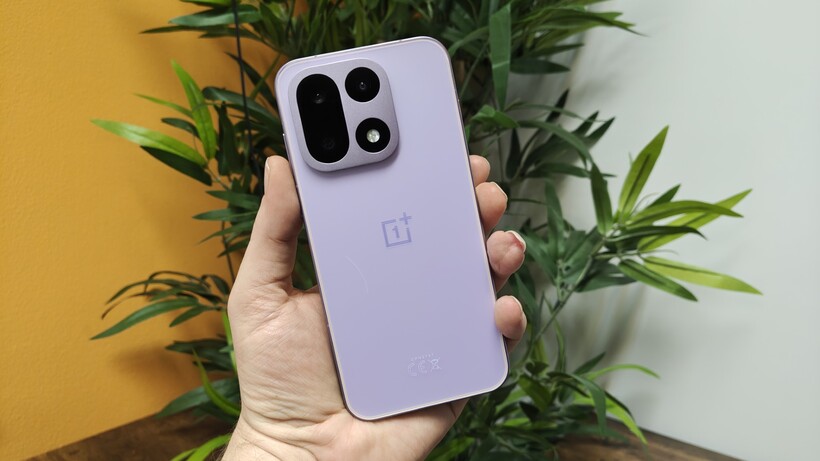
The large, centrally placed circular camera housing on the back has been replaced by a more modern rectangular module in the upper-right corner on both models, but the rear finish differs between the two.
The flagship OnePlus 15 is available in a new Sandstorm finish that uses an MAO-processed mid-frame and camera housing, along with a fibreglass back, delivering something that’s noticeably cool to the touch while being more durable than both aluminium and titanium, complete with a nice textured sandstone finish.
There’s also what OnePlus calls Infinite Black, an ultra-deep matte black that reduces reflectivity for a near-Vantablack experience, along with a more standard Ultra Violet (lavender) finish with flashes of bright blue. These two are available with a matte-finish glass that reduces the look of fingerprints and other smudges.

The OnePlus 15R’s back panels are a little less exciting; it’s available in Mint Breeze, Electric Violet and Charcoal Black, available only with a matte-finished glass panel – none of the fancy fibreglass material or advanced colour shades here. The glass isn’t as durable as the flagship alternative either, using Gorilla Glass 7i in place of Crystal Shield Glass.
The two are more evenly matched when it comes to dust and water resistance however, with both models offering the same IP68/IP69K rating – though the 15 can be dunked down to 2m for up to half an hour, while the 15R can go down to 1.5m for the same amount of time. In reality, that doesn’t really matter – both will survive a stint in the rain, a dunk in the pool and a drop or two.
Screen
- Both deliver big, bright, vibrant AMOLEDs
- Matching 165Hz refresh and strong outdoor brightness
- OnePlus 15 benefits from LTPO tech
The OnePlus 15 and 15R look pretty similar, and that’s also the case when it comes to screen tech – though the flagship takes a win in one key area.
The OnePlus 15R is actually the bigger of the two, though at 6.83 inches compared to 6.78 inches, there really isn’t that much in it in real-world use. These are both big, vibrant AMOLED panels that look great whether you’re scrolling through social media or bingeing on Netflix.

They’re equally matched when it comes to brightness too; both panels clock in at 1800nits in high brightness mode, while HDR-enabled peak brightness caps out at 3600nits. The latter is actually lower than last year’s alternatives, which clocked in at 4500nits, but the HBM is higher – and that’s what you’ll actually see more often.
As a result, they’re perfectly suited for use outdoors, even on bright, sunny days, and they can drop to as low as 0.5 nits for late-night use, too.

They both also share the same 165Hz refresh rate, though this is also where the two diverge. The flagship OnePlus 15 has LTPO tech that lets it drop to as little as 1Hz to offer a more responsive yet still battery-friendly experience – a feature not present on the 15R, despite being present on last year’s OnePlus 13R.
In fact, last year’s OnePlus 13R had more advanced LTPO 4.1 tech than the then-flagship OnePlus 13, making it a notable step back for this year’s ‘R’ variant.
Cameras
- Shared 50MP main camera with a smaller sensor
- OnePlus 15 offers better camera versatility
- OnePlus 15R has had a serious camera downgrade
Camera tech is one area where the two phones diverge greatly, with the cheaper 15R’s focus on performance meaning camera tech has fallen to the wayside, even compared to last year’s 13R.
That said, both phones sport the exact same main sensor – a 50MP affair with OIS and a wide f/1.8 aperture, though the sensor is rather small at 1/1.56 inches, the same size as the telephoto lens in the Oppo Find X9 Pro. That’s actually a downgrade for the flagship OnePlus 15, whose predecessor sported a larger 1/1.43-inch sensor – and it’s noticeable in everyday use.

While the main sensor delivers sharp, detailed images with pleasing colours and good dynamic range in ideal shooting conditions – outdoors, during the day – things start to take a downturn at night. The phone can handle low-light shots with ambient lighting, but things get much softer and muddier in very dark scenes. This is somewhat forgivable on the 15R, but not so much with the flagship alternative.
That said, the OnePlus 15’s secondary cameras are a damn sight more capable than those of the 15R.
The flagship sports a 50MP 3.5x periscope zoom lens that offers very good quality to around the 7x mark, with acceptable results until the 20-30x mark when those telltale signs of digital enhancement appear, and a 50MP ultrawide that matches the other lenses closely in terms of both colour and overall detail – something that isn’t a given, even at the high end of the market.

The 15R, on the other hand, sports an 8MP ultrawide and… not much else. That’s a big change compared to last year’s 13R, which also sported a 50MP telephoto lens for better zoom capabilities – and as such, the 15R has to rely on a digital crop of the main sensor to get closer to the action.
The 8MP ultrawide is, to put it nicely, a disappointment for the price, with many rivals sporting higher-res, more capable ultrawide sensors. The 8MP hardware here can handle daylight well, but as soon as light levels drop, it really struggles.
Simply put, not only is the OnePlus 15 better for photography than the OnePlus 15R, but the OnePlus 13R is too.
Performance
- OnePlus 15 runs Snapdragon 8 Elite Gen 5
- OnePlus 15R uses Snapdragon 8 Gen 5, slightly behind
- Both feel essentially flagship-fast in daily use
In terms of performance, the two smartphones are fairly evenly matched – though the full-fat OnePlus 15 does come out on top by the skin of its teeth.
That’s because, while the OnePlus 15 features the Snapdragon 8 Elite Gen 5 found in most 2026 flagships, the OnePlus 15R features the Snapdragon 8 Gen 5 – just a single step down from the Elite chipset in terms of power output. That’s paired with 12GB of LPDDRX5 RAM on the 15R, and a boosted 16GB on the 15.

With specs like those, you’re not going to run into many issues with either smartphone on a day-to-day basis. The OnePlus 15, with its flagship chipset and rapid screen, is particularly well-suited to gaming, especially with a new Cryo-Velocity cooling system helping keep things stable even during longer sessions.
However, the cheaper 15R also features the same cooling system, so it can match its bigger brother in most regards.
In fact, you’re only really going to notice a difference in performance when benchmarking the two phones, with the 15 scoring slightly higher than the 15R in most GPU and CPU tests – but not by as big a margin as some might assume given the difference in price here.
In reality, both of these phones can handle just about anything you can throw at them, from media-heavy timelines to demanding AAA mobile games – a real achievement for the 15R in particular – with only the most demanding users needing the extra power from the 15.
Software
- Identical OxygenOS 16 on top of Android 16
- Deep customisation, smooth animations and capable AI tools
- Only four OS upgrades and six years of security
Regardless of the phone you opt for, you’ll get the same software experience. Both the OnePlus 15 and 15R run OxygenOS 16 based on Android 16, and while some may prefer the stock experience of Pixels, there’s a lot to appreciate about OnePlus’s custom UI.

OxygenOS 16 has a massive focus on customisation, with pretty much every element of the software able to be tweaked in one way or another. That ranges from features like lock screen customisation, complete with a very Apple-esque UI, to smaller elements like tweaking the size and shape of app icons on the home screen.
It also feels fast in use, thanks to OxygenOS’ Parallel Processing and Flow Motion, technologies that make transitions between apps feel smoother and more responsive – especially if you toggle on the fastest animation speeds in the Settings app.
There’s also a slew of AI features across both models, including pretty standard features like AI writing tools, photo editing tools and voice recording transcription, along with what OnePlus calls Mind Space. It’s essentially a space where you can store screenshots and other information, with AI processing for easier resurfacing later. It’s a handy way to store important screenshots you know you’ll need later, but it’s not a game-changer.

The only downside is the long-term software support; both phones are slated to receive only four OS upgrades and six years of security updates, well behind the likes of Google, Samsung and Honor, which offer seven years of OS upgrades at similar prices.
Battery life
- OnePlus 15’s 7300mAh comfortably delivers all-day stamina
- OnePlus 15R’s 7400mAh matches endurance in real-world use
- OnePlus 15 boasts faster wired and convenient wireless charging
One area where neither the OnePlus 15 nor 15R is left wanting is battery life; these phones have some of the largest cells on the market right now, and the day-to-day use reflects this.
The OnePlus 15 has a massive 7300mAh cell that’s not only a big boost over the OnePlus 13’s 6000mAh alternative, but it makes it one of the biggest around right now, leaving the likes of the 5000mAh Galaxy S26 Ultra in the dust.

That extra slice of battery is noticed in everyday use too; the phone is a comfortable all-day phone regardless of what you’re up to, with less busy times seeing the phone push close to two full days before needing a top-up.
The OnePlus 15R, rather inexplicably, has an even bigger battery – though only 100mAh more at 7400mAh, and that’s not enough of a difference to notice in day-to-day use. That said, just like its more expensive sibling, the 15R has the legs to just keep on going, with easy one-day use and the possibility of two days with lighter use.
Where the two differ is in the charging department: the OnePlus 15 gets the full 120W SuperVOOC charging experience, while the 15R is limited to (still rather rapid) 80W. It might not sound like much of a difference, but it meant the OnePlus 15 reached full charge in 45 minutes, while the 15R took slightly longer at 56 minutes.

The OnePlus 15 also has 50W SuperVOOC wireless charging for speedy wireless top-ups – a convenient feature missing from the 15R.
Verdict
Overall, the OnePlus 15 is the better buy for most people, even though the 15R offers impressive performance and battery life for less cash.
Both phones share a very similar design, bright 165Hz AMOLED displays, near-flagship Snapdragon 8-series performance, and huge batteries that comfortably last a full day or more. However, the OnePlus 15 justifies its higher price with a tougher, more premium build, LTPO display tech for smoother and more efficient refresh rate changes, vastly superior camera hardware, faster 120W wired charging, and the bonus of 50W wireless charging.
The 15R is excellent value if you care primarily about speed and stamina and can live with weaker cameras and slower charging, but if you want a genuinely flagship experience that balances performance, photography and features, the OnePlus 15 is the clear winner.
To see how they compare in the wider market, take a look at our hand-picked selection of the best Android phones.

Stephan is the sports journalist for the Maple Grove Report.