On a recent Sunday morning at Yoga Center Retreat in St. Louis Park, I rested on a mat with my feet up the wall, listening to instructions from a familiar voice. I had never met Mark Wheat in person, but his British accent and brassy timbre were unmistakable after listening to him for years as a DJ on the Current.

That soothing voice – missing from Minnesota’s airwaves since 2020 – is returning to the stage this month for a reboot of the Making Music live discussion series Wheat helped launch more than 20 years ago. 

At its start in 2005, the idea for Making Music was live conversations with notable musicians – some local, some national. Wheat developed it in part with Dave Hill, who ran the Whole, the music club in the basement of the U of M’s Coffman Union. Hosting duties went to composer and producer JG Everest, another early collaborator.

At venues like the Whole and later the Walker Art Center, the series featured guests like David King from The Bad Plus, Dessa, and Slug from Atmosphere.

It contributed to a sort of continuity in the Twin Cities’ music scene, Everest said – something he worries is at risk with dwindling coverage of local music, fewer hubs like record stores, and the increasing dominance of streaming platforms.

But Wheat’s return to the scene was hardly a given. 

His radio ambitions started as a teenager in England, where he listened to legendary British DJ John Peel spin bands like the Sex Pistols and the Clash. Later, Wheat got into Minnesota bands like the Replacements and Babes in Toyland. It was his love of the Replacements, he said, that brought him to Minneapolis in the early 1990s.

Wheat built his career at KFAI and the now-defunct Rev 105. Later, he DJed and mentored students at the University of Minnesota’s Radio K. When the Current launched in 2005, Wheat was one of its first hires.

In many ways, DJing was his dream job. But by the time he turned 50, his physical health demanded attention. His spouse, ceramicist Maren Kloppmann, and others he knew well, practiced yoga. Soon, Wheat developed a practice of his own incorporating a style of yoga called Avita, focused on joint health and circulation.

man sitting in yoga position with others doing yoga in the background
After leaving his job as a DJ for the Current in 2020, Mark Wheat became a yoga instructor focused on the Avita practice. Credit: courtesy of Mark Wheat

“I know it sounds corny, but I kind of fell in love with it right away,” Wheat said.

Early in 2020, Wheat asked the Current for some time off. He planned to spend one weekend a month, for six months, in Boulder, studying and developing his yoga practice. His bosses agreed, but then COVID-19 hit.

By June 2020, Wheat announced he had decided to take a buyout. “I knew no one else from the Current wanted to leave, and I kind of did,” he said. 

After finishing his yoga training in Boulder, Wheat stayed on as a teacher for about 18 months. He moved home to Minneapolis in 2022, where he continues to teach five classes per week.

Still, plenty of people have hoped to coax Wheat’s voice out of the studio and back onto the music scene. Earlier this year, Cecilia Johnson, a former colleague at the Current, gave it a shot. Johnson, who books acts at the North Loop’s Berlin music club, asked Wheat if he’d DJ a live version of the Valentine’s Day show he made popular at the Current.

Wheat declined, but he was intrigued. He sent Johnson some old YouTube videos of the Making Music series. 

Now on Monday, April 6, at 7:30 p.m., Making Music’s first host, JG Everest, will pass the baton to its newest one, Wheat. Their conversation, billed as a talk about Everest’s varied career, the creative process and the show’s legacy, will take place at Berlin, 204 North 1st. St. ($15).

On Sunday, May 10, Wheat will interview Channy Leaneagh, the lead singer of Poliça, at the Southern Theater, 1420 S. Washington Ave., Minneapolis ($15-$40). 

Making Music’s relaunch is supported by The Minnesota Music Archive, which is celebrating a launch of its own on Thursday, April 2, at the Hennepin, 900 Hennepin Ave. ($15-$100). It’s a project of the Diverse Emerging Music Organization, working to digitize and secure Minnesota’s musical legacy – including original episodes of the Making Music series.

The archive’s launch party will feature live music by Dust of Suns Ensemble and Agnes Uncaged, sets curated by DJ Stage One and former Current DJ Mary Lucia, remarks by author and journalist (and another former Current DJ) Andrea Swensson, and of course, Mark Wheat. 


Source link

Leave a Reply

Subscribe to Our Newsletter

Get our latest articles delivered straight to your inbox. No spam, we promise.

Recent Reviews


In the ever-shifting geopolitical sphere, China’s growing military presence and the ongoing tensions over Taiwan and the South China Sea continue to be a closely watched topic — particularly in regard to China’s ambition for naval power. In recent years, much speculation has been made over the country’s rapid military development, including the capabilities of the newest Chinese amphibious assault ships.

While there’s no denying its military advancements and buildup, much has been made about the logistical and military difficulties that China’s People’s Liberation Army (PLA) would face if it launched an amphibious invasion of Taiwan. However, there’s growing concern that if a Taiwan invasion were to happen, it wouldn’t just be military vessels taking part in the action, but a fleet of commercial vessels, too — including a massive new car ferries that could quickly be repurposed into valuable military transports.

While the possibility of the PLA using commercial vessels for military operations has always been on the table for a potential Taiwan invasion, the scale with which China has been expanding its commercial shipbuilding industry has become a big factor in the PLA’s projection of logistical and military power across the Taiwan Strait. It’s also raised ethical concerns over the idea of putting merchant-marked ships into combat use.

From car ferry to military transport

The rapid growth of modern Chinese industrial capacity is well known, with Chinese electric vehicle factories now able to build a new car every 60 seconds. Likewise, China has developed a massive shipbuilding industry over the last 25 years, with the country now making up more than half of the world’s shipbuilding output. It’s from those two sectors where China’s latest vehicle-carrying super vessels are emerging. 

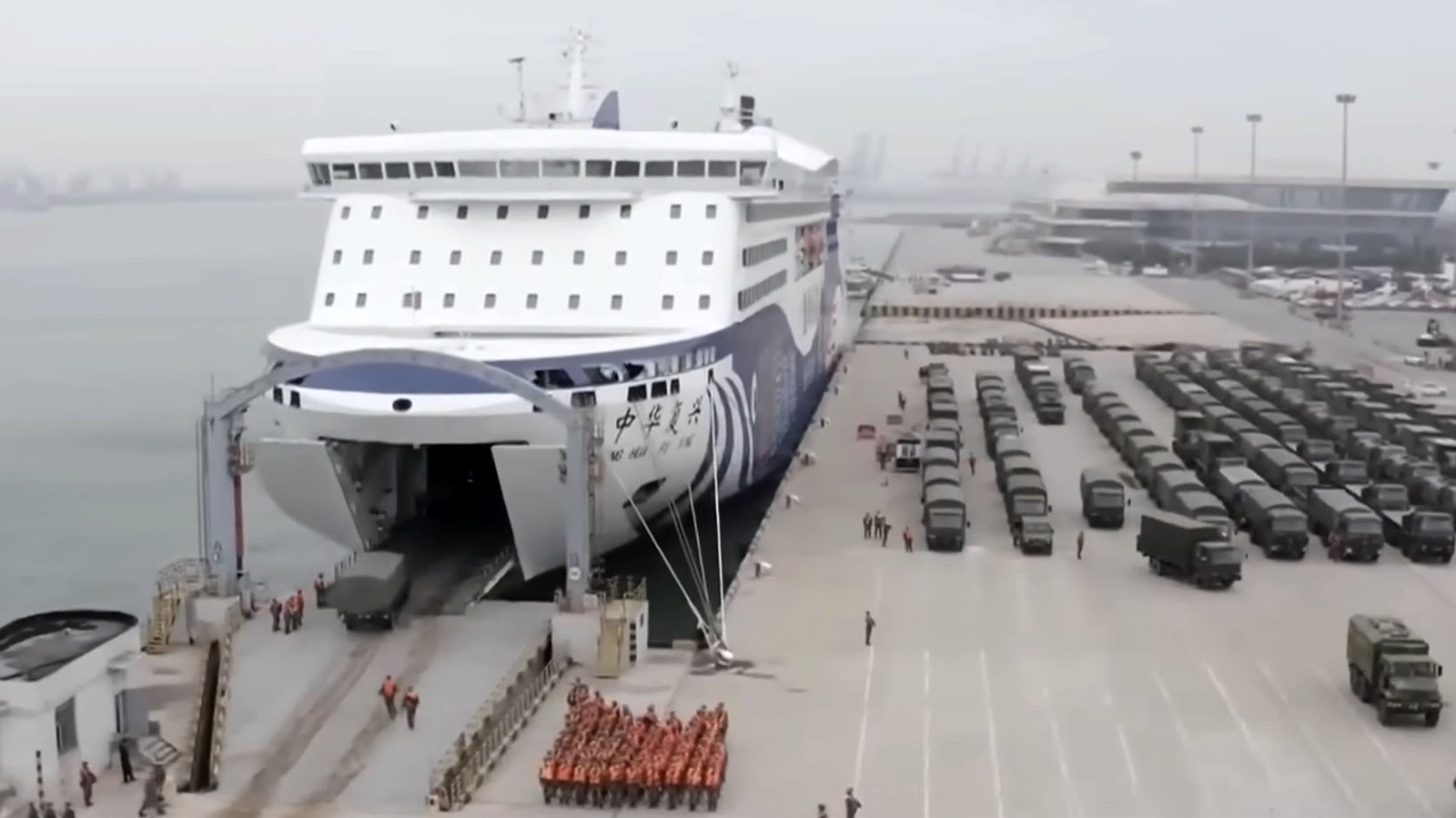
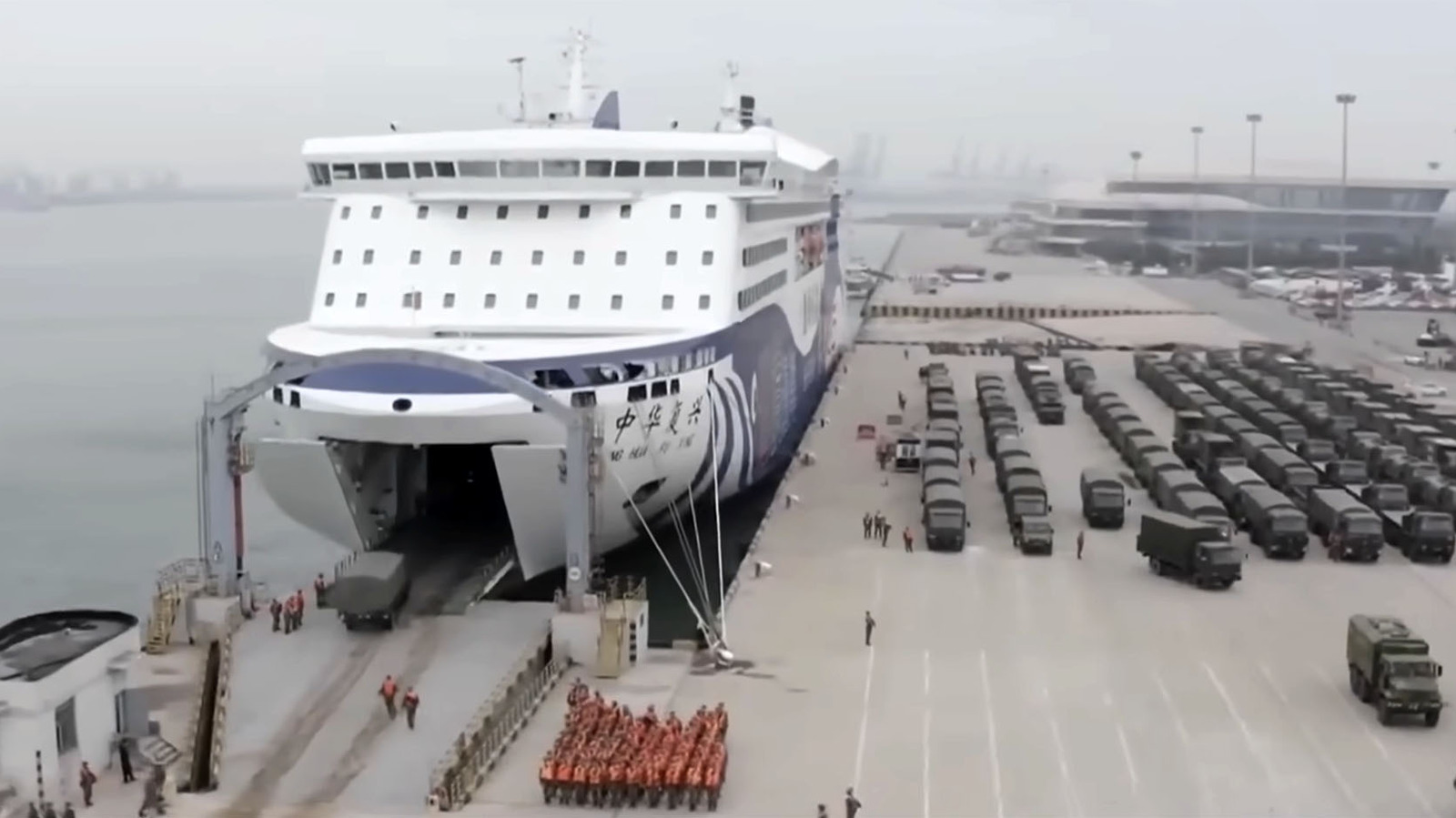
With a capacity to carry over 10,000 new vehicles for transport from factories in Asia to destinations around the world, these ships, known as roll-on/roll-off (Ro-Ro) ferries, are now the biggest of their type in the world. The concept of the PLA putting civilian ferries into military use is not a new one, or even an idea China is trying to hide. Back in 2021, China held a public military exercise where a civilian ferry was used to transport both troops and a whole arsenal of military vehicles, including main battle tanks.

The relatively limited conventional naval lift capacity of the PLA is something that’s been pointed out while game-planning a Chinese amphibious move on Taiwan, and it’s widely expected that the PLA would lean on repurposed civilian vessels to boost its ability to move soldiers and vehicles across the Taiwan Strait. With these newer, high-capacity Ro-Ro ferries added to the fleet, the PLA’s amphibious capacity and reach could grow significantly.

A makeshift amphibious assault ship

However, even with the added capacity of these massive ferries, military analysts have pointed out that Ro-Ro ships would not be able to deploy vehicles and soliders directly onto a beach the way a purpose-built military amphibious assault ship can. Traditionally, to deploy vehicles from these ships, the PLA would first need to capture and then repurpose Taiwan’s existing commercial port facilities into unloading bases for military vehicles and equipment.

However, maybe most alarming is that satellite imagery and U.S. Intelligence reports show that, along with increasing ferry production output, the PLA is also working on a system of barges and floating dock structures to help turn these civilian ferries into more efficient military transports. With this supporting equipment in place, ferries may not need to use existing port infrastructure to bring their equipment on shore.

Beyond the general military concern over China’s growing amphibious capability, there are also ethical concerns if China is planning to rapidly put a fleet of civilian merchant vessels into military service. If the PLA were to deploy these dual-purpose vessels into direct military operations, the United States and its allies would likely be forced to treat civilian-presenting ships as enemy combatants. On top of all the other strategic challenges a Taiwan invasion would bring, the U.S. having to navigate the blurred legal lines between military and merchant vessels could potentially give China a strategic advantage amidst the fog of war.


Source link