
As Sonos has added the Play to its speaker line-up, we’re keen to see how it measures up to the 4.5-star Era 100.
To help you decide which of Sonos’ offerings will suit you best, we’ve compared our experiences with the Play to the Era 100 and noted the key differences below.
Still not sure which Sonos speaker to go for? Check out our Sonos Play vs Roam 2 and Play vs Move 2 comparisons too. Otherwise, we’ve rounded up the best Bluetooth speakers we’ve reviewed in the past year.
Price and Availability
The Sonos Play is available to buy now and has an RRP of £299/$299.
The Sonos Era 100, on the other hand, is slightly cheaper with an RRP of £199/$199. Not only that, but the speaker has seen various price drops since its launch, which means it’s not impossible to find a bargain.
Design
- Both come in just two colour choices: Black or White
- Sonos Play is lighter, at just 1.3kg compared to 2.02kg
- Sonos Play has an IP67 rating
Although the Sonos Era 100 has a thicker, more squat design than the Sonos Play, when the two are put next to each other there’s no denying they’re part of the Sonos family. Both retain that classic Sonos design, with a mesh surrounding and flat-top that houses the buttons. Plus, both come in just two colour choices: Black or White.
The Sonos Play, however, is designed specifically for both indoor and outdoor use and weighs just 1.3kg compared to the Sonos Era 100’s 2.02kg. Sure, the Play isn’t as light as the Roam 2, but aided by its carry loop at the back, it’s fairly easy to carry around from room to room.
As the Sonos Play is designed for both indoor and outdoor use, it comes with a reassuring IP67 rating which means it’s dust-tight and can survive short-term water immersion. In comparison, the Sonos Era 100 doesn’t have a specific IP rating, and instead just promises to be “humidity resistant”.
Otherwise, both speakers have a simple button layout on top and a button to turn the microphone off too – although doing so will stop Trueplay tuning from working.
Winner: Sonos Play
Features
- Sonos app is better but still not as good as it once was
- Although both support Stereo pairing, the Sonos Era 100 is better suited
- Both have built-in Alexa and Sonos Voice Control
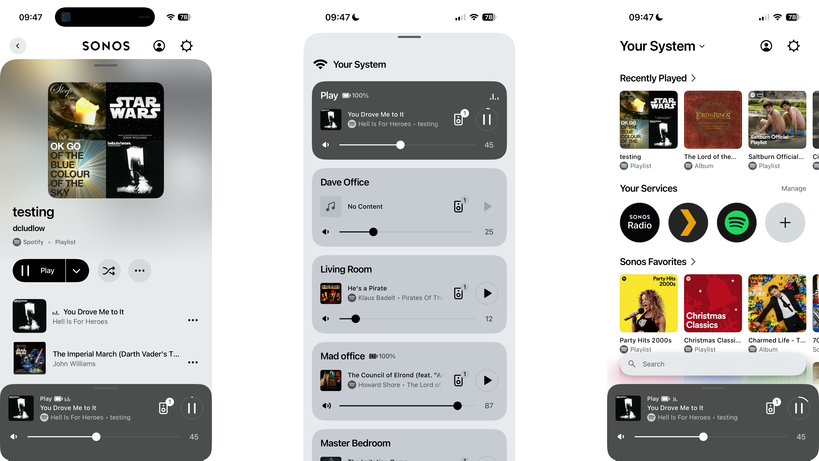
Sonos has fortunately fixed its disastrous app revamp of 2024, and it’s now more reliable and faster to load too. Sure, it’s not as good as the old app but there aren’t any major issues to report.
In fact, the Sonos app does boast numerous useful features including the ability to use a single music subscription to play music on different speakers at the same time, and the ability to sync music across multiple rooms for a party.

While both the Play and Sonos Era 100 support stereo pairing, we noted a few issues with the former as both speakers to be connected to the same Wi-Fi. In addition, both speakers need to be kept together at all times or the audio won’t sound quite right. With this in mind, if you want speakers specifically for stereo pairing, we’d recommend opting for two Sonos Era 100s instead as they’re fixed.
Otherwise, both are fitted with Amazon Alexa and Sonos Voice Control, and support Automatic Trueplay too which uses the integrated microphone to adjust the audio according to where the speaker is located.
Winner: Sonos Era 100
Sound Quality
- Sonos Era 100 handles bass levels brilliantly
- Sonos Play sports a balanced audio with solid stereo pairing
- Trueplay works well with both speakers
Although Sonos is notoriously secretive when it comes to revealing the specs of its speakers, what we do know is the Play is fitted with three Class-H amplifiers, two angled tweeters and a mid-range woofer. The Era 100 is almost the same, except it has three Class-D amplifiers instead of Class-H.
The difference is that although the Class-H is less power-efficient, it does promise to provide a finer audio experience.

We found that the Play performs well, with tightly balanced audio but does sometimes suffer with distortion. In addition, we found its bass isn’t quite as powerful as the likes of the Move 2. While its stereo pairing is also solid, do keep in mind the issues we mentioned earlier.
In comparison, the Era 100 has a weightier performance across the frequency range with more hefty bass and thicker treble too. We also found that although its bass levels are powerful, it’s not at the expense of vocal clarity either.

Having said that, we’d still recommend you play around with the EQ to alter the bass and treble levels as, out of the box, we noted the Era 100 sounded rather limp. However, this was adjusted quickly.
Winner: Sonos Era 100
Verdict
Deciding between the Sonos Play and Sonos Era 100 will come down to your preferences. If you want a speaker that can easily be carted between rooms and outdoors, then the Sonos Play is a great choice for most. Plus, with a promise of up to 24 hours of battery life, you can even take it on camping trips and the like with relative ease.
In comparison, if you want more of a fixed speaker set-up at home, and don’t plan on moving the speakers around too much, then the Sonos Era 100 will likely suit you better.

Stephan is the sports journalist for the Maple Grove Report.