I Used AI to Help Me Stay Ahead of Home Maintenance. Here’s How


Your home can be a worthy adversary in the battle of time suckage: Gutters need clearing, railings need securing and walls need painting. But the worst home maintenance of all is the invisible kind. The leaky pipe in the crawl space that silently betrays you while you’re focused on increasing curb appeal.

AI Atlas

It’s not just that you don’t want to do it. You probably don’t, but anyone who’s ever snaked a clogged drain  knows the longer you wait, the messier the job gets. The good news? AI tools can give you a leg up, helping you use your elbow grease and rainy day fund wisely.

Here’s how to use AI to keep up with home maintenance.

Take your insurance seriously 

Homeowners insurance isn’t just there to cost a fortune. Theoretically, you should be able to make a claim and recoup certain costs, but wading through the jungle of legalese and policy inclusions can tax even the sharpest of homeowners’ minds. 

AI tools can help you crawl your homeowners insurance policy for benefits you might be missing out on. I used Microsoft Copilot to review a 29-page standard policy in Ohio and generate an easy-to-reference breakdown of what those large homeowner payments actually cover.

Microsoft Copilot's analysis of a homeowners insurance document.

Important documents such as homeowners insurance policies can be complicated, but an AI chatbot can help summarize them and point you to the parts you need to know. Just be sure to check what the AI says against the actual document.

Copilot/Screenshot by CNET

I was surprised to find volcanic eruptions listed as covered damage in an Ohio insurance policy — but anything is possible, I guess. The policy also covers damage from failing HVAC systems and spoiled food if the power goes out. That’s good to keep in mind as we head into what’s already shaping up to be a record-breaking heat season.

Microsoft Copilot's advice of insurance perks for home maintenance

A chatbot can pull out any potential insurance programs that can help you with home maintenance.

Copilot/Screenshot by CNET

The known unknowns

A lot of new homeowners aren’t yet hip to the potential horrors that come with the pillar of the American dream known as homeownership. You may have always dreamed of owning a house with a pool, but I’ll bet those fantasies didn’t include chlorine tablets and flooded water pumps.

AI can help you take stock of your home’s quirks, danger zones and risk factors. I asked Google’s Gemini to round up the trouble that might be waiting around the corner.

Gemini's answer to a prompt about likely home maintenance issues and risks for a 1940s Los Angeles home.

Gemini has some guesses about what problems a particular type of home might have.

Gemini/Screenshot by CNET

Gemini was spot-on when it came to the plumbing, which was mercifully replaced with copper in the early 2000s. The note about adding French drains was also accurate, as we had one installed just last winter, right in time for two straight weeks of heavy rain 

Copilot's suggestions for seasonal home maintenance.

Copilot/Screenshot by CNET

The note about the electrical panel was timely, and the termite inspection raised the hairs on the back of my neck. We’ve never had the house inspected for termites, and seeing “high-activity zone” definitely makes the need feel urgent.

Mountains to mole hills

Sometimes a gopher pile is just an isolated eyesore. Other times, it’s a sign of something way more serious happening right under your feet. Waiting to find out could be a recipe for a destroyed lawn and an expensive fix. 

I used AI to give me some tips about how to deal with a creature I assumed was a gopher I’d noticed in my garden. Claude AI was able to ID the little bugger from a few screenshots in a nighttime video I took, and told me it was most likely a vole and not a gopher.

A chatbot interface with some pictures of a rodent of some kind, with Claude identifying it as a vole.

I asked Claude to identify what I thought was a gopher and to come up with a strategy for keeping it away.

Claude/Screenshot by CNET

The tool also generated some options for deterring and dealing with the creatures so they don’t destroy my poppies and flowering plants. 

A plan for deterring voles, including barriers, habitat modification and repellents.

Claude/Screenshot by CNET

Spoiler alert: The only thing I’ve found that actually works on gophers and voles is underground mesh, but bless Claude’s heart for being optimistic about castor oil.


Source link

Leave a Reply

Subscribe to Our Newsletter

Get our latest articles delivered straight to your inbox. No spam, we promise.

Recent Reviews


In the ever-shifting geopolitical sphere, China’s growing military presence and the ongoing tensions over Taiwan and the South China Sea continue to be a closely watched topic — particularly in regard to China’s ambition for naval power. In recent years, much speculation has been made over the country’s rapid military development, including the capabilities of the newest Chinese amphibious assault ships.

While there’s no denying its military advancements and buildup, much has been made about the logistical and military difficulties that China’s People’s Liberation Army (PLA) would face if it launched an amphibious invasion of Taiwan. However, there’s growing concern that if a Taiwan invasion were to happen, it wouldn’t just be military vessels taking part in the action, but a fleet of commercial vessels, too — including a massive new car ferries that could quickly be repurposed into valuable military transports.

While the possibility of the PLA using commercial vessels for military operations has always been on the table for a potential Taiwan invasion, the scale with which China has been expanding its commercial shipbuilding industry has become a big factor in the PLA’s projection of logistical and military power across the Taiwan Strait. It’s also raised ethical concerns over the idea of putting merchant-marked ships into combat use.

From car ferry to military transport

The rapid growth of modern Chinese industrial capacity is well known, with Chinese electric vehicle factories now able to build a new car every 60 seconds. Likewise, China has developed a massive shipbuilding industry over the last 25 years, with the country now making up more than half of the world’s shipbuilding output. It’s from those two sectors where China’s latest vehicle-carrying super vessels are emerging. 

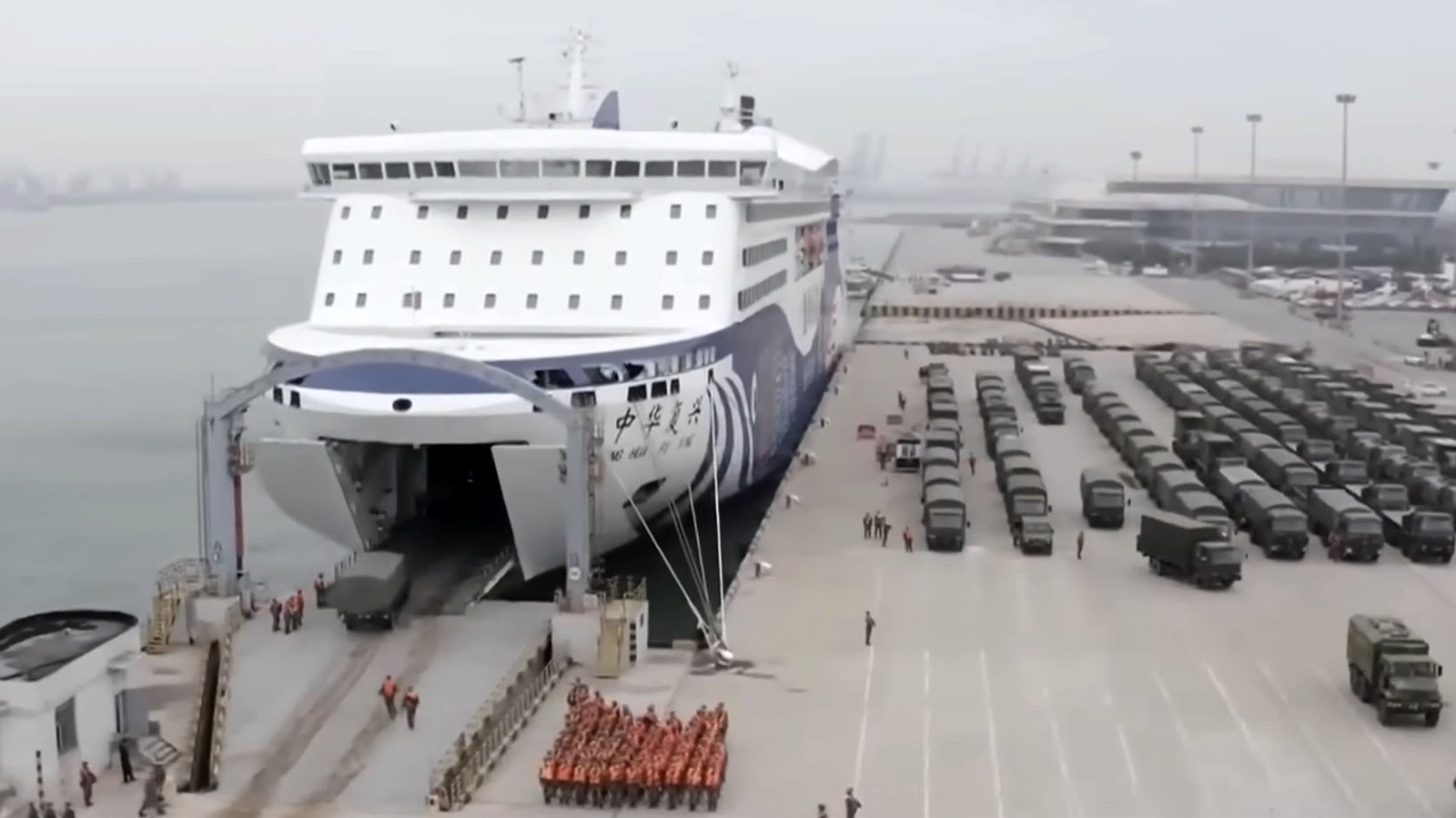
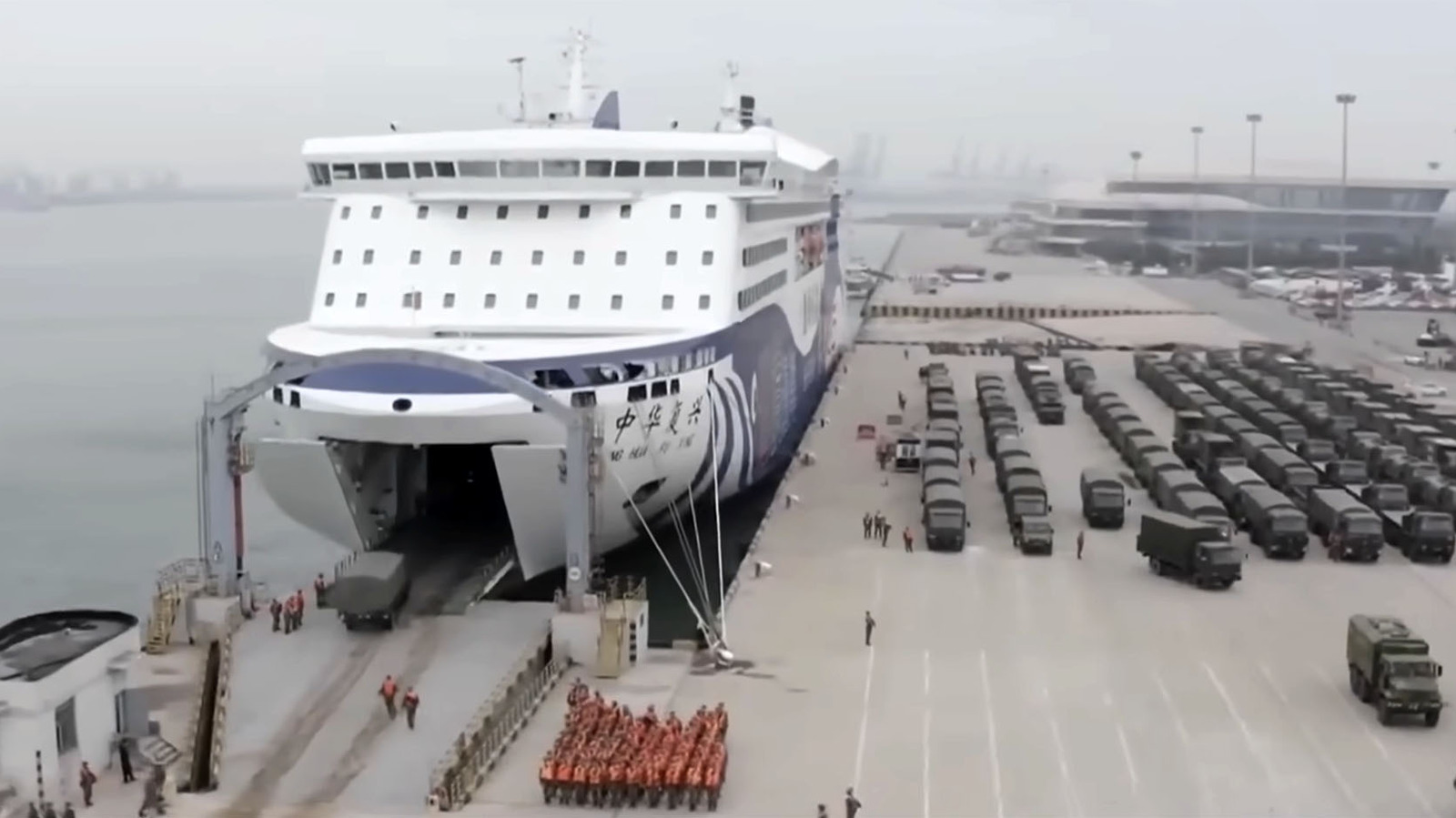
With a capacity to carry over 10,000 new vehicles for transport from factories in Asia to destinations around the world, these ships, known as roll-on/roll-off (Ro-Ro) ferries, are now the biggest of their type in the world. The concept of the PLA putting civilian ferries into military use is not a new one, or even an idea China is trying to hide. Back in 2021, China held a public military exercise where a civilian ferry was used to transport both troops and a whole arsenal of military vehicles, including main battle tanks.

The relatively limited conventional naval lift capacity of the PLA is something that’s been pointed out while game-planning a Chinese amphibious move on Taiwan, and it’s widely expected that the PLA would lean on repurposed civilian vessels to boost its ability to move soldiers and vehicles across the Taiwan Strait. With these newer, high-capacity Ro-Ro ferries added to the fleet, the PLA’s amphibious capacity and reach could grow significantly.

A makeshift amphibious assault ship

However, even with the added capacity of these massive ferries, military analysts have pointed out that Ro-Ro ships would not be able to deploy vehicles and soliders directly onto a beach the way a purpose-built military amphibious assault ship can. Traditionally, to deploy vehicles from these ships, the PLA would first need to capture and then repurpose Taiwan’s existing commercial port facilities into unloading bases for military vehicles and equipment.

However, maybe most alarming is that satellite imagery and U.S. Intelligence reports show that, along with increasing ferry production output, the PLA is also working on a system of barges and floating dock structures to help turn these civilian ferries into more efficient military transports. With this supporting equipment in place, ferries may not need to use existing port infrastructure to bring their equipment on shore.

Beyond the general military concern over China’s growing amphibious capability, there are also ethical concerns if China is planning to rapidly put a fleet of civilian merchant vessels into military service. If the PLA were to deploy these dual-purpose vessels into direct military operations, the United States and its allies would likely be forced to treat civilian-presenting ships as enemy combatants. On top of all the other strategic challenges a Taiwan invasion would bring, the U.S. having to navigate the blurred legal lines between military and merchant vessels could potentially give China a strategic advantage amidst the fog of war.


Source link