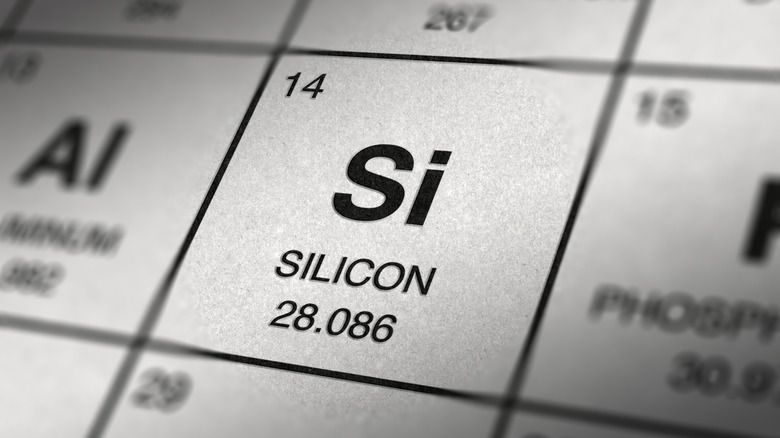

Science has achieved a lot of things that were once thought impossible. Splitting the atom, for instance. Thanks to a remarkable new breakthrough from Saarland University, in Saarbrücken, Germany, we can now add the creation of a silicon aromatic to the list.
The first thing to know about this compound is that it’s not simply aromatic in the same way that, say, a clove of garlic is. Though the earliest aromatic compounds were so named for their characteristic fragrances, another quality they have is now much more important to chemists. Saarland’s Professor of General and Inorganic Chemistry, David Scheschkewitz, explained to SciTechDaily: “To be classified as aromatic, a compound needs to have a particular number of shared electrons that are evenly distributed around the planar ring structure.” The planar ring of a compound is a structure in which each atom is on the same flat plane.
This makes the compound very chemically stable, because of the way that the electrons are spread evenly, and the whole structure bonded together. It’s one crucial property of aromatics that was thought to be impossible to replicate with metallic silicons, because their electrons don’t bond to the same degree. Nonetheless, the research team succeeded in building a silicon molecule, consisting of five atoms. The result was the snappily-named pentasilacyclopentadienide, adapted from the carbon-based Cyclopentadienide by replacing its atoms with silicon ones. Scientists have been seeking routes to such a silicon aromatic for half a century, and astonishingly, an independent team working in Japan, headed up by Takeaki Iwamoto of Tohoku University, arrived at one at around the same time. Even more impressive, though, is exactly what this might mean for the future of science.
The discovery and its incredible implications
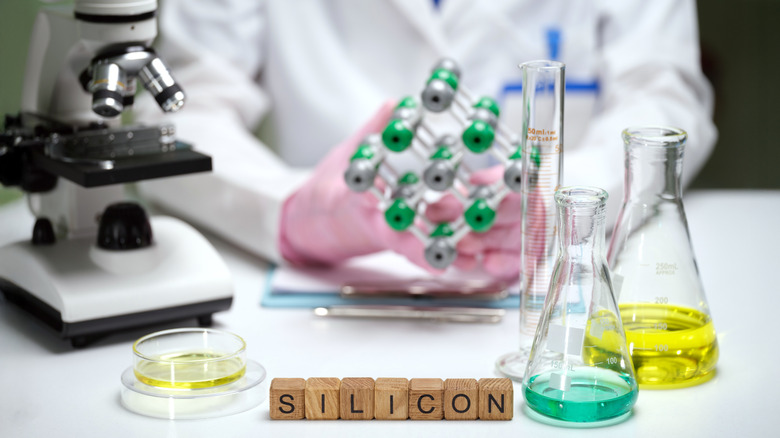
For those of us who aren’t chemists, it’s difficult enough to pronounce pentasilacyclopentadienide, let alone immediately grasp why it’s such a significant development. Scheschkewitz tells Chemical & Engineering News that it had been one of his “dream compounds.” Two decades of his experiments and those of his students had failed to produce it, before one, Ankur (who has no last name), tried using a dilithium compound and potassium graphite with triisopropylphenylsilyl trichloride, almost happening upon it by chance.
Takeaki Iwamoto and colleagues, meanwhile, developed a step-by-step approach to manipulating the molecules that arrived at the same product through different means. Iwamoto said, according to Tohoku University, that “Cyclopentadienide is a highly useful molecule used widely in catalysts that speed up reactions and materials science research,” and so the creation of what is its silicon counterpart has big implications for science and beyond. The university adds that it will surely lead to similar discoveries and the creation of other silicon compounds, in turn “unlock[ing] the latent physical properties, functions, and novel applications inherent in silicon – an abundant element with no risk of depletion.”
This last point may prove critical. After all, a substance may have a range of essential uses, but that might just mean that demand causes it to be expended too fast. Should more such silicon compounds be able to be created and stabilized, it opens up all kinds of new possibilities, from processes to the development of new materials (like Google’s self-healing road). We don’t yet know what pentasilacyclopentadienide and subsequent discoveries will lead to, but it has enormous potential. New substances that are far more sustainable, perhaps. All because some persistent scientists refused to accept something was impossible.

Stephan is the sports journalist for the Maple Grove Report.