Norman Ornstein on Lisa Demuth and Minnesota Republicans


Illustration of a headshot of a man. Norman Ornstein

This post comes from our Capitol Conversations newsletter. Sign up here to get Matthew Blake’s takes on the latest Minnesota state government news, delivered to your inbox Thursday mornings.

Dear Minnesotans, 

Norman Ornstein was born in Grand Rapids, Minnesota and was a child prodigy who graduated from the University of Minnesota at age 18 as a social science major.

In the 1970s and 80s, Ornstein became a fixture in Washington, D.C. as “The King of Quotes,” according to a 1986 Washington Monthly profile. He delivered pithy remarks on complex policy subjects to on-deadline reporters, while working at the American Enterprise Institute, a centrist think tank. 

“Almost by definition he is conventional wisdom,” Steven Waldman wrote in that Monthly profile.

How much, if at all, that’s still the case 40 years later is perhaps a litmus test for the Minnesota Republican Party.

I interviewed Ornstein Monday at the Humphrey School of Public Affairs at the University of Minnesota before he gave a talk titled, “It’s even worse than it looks: Donald Trump and America’s Future.”

In the last 20 years, Ornstein has become a tireless critic of Congressional gridlock, what he sees as creeping extremism in Republican policies and – most of all – the chaos and corruption of the Trump administration, which appears to viscerally sear Ornstein. By the time you finish reading this newsletter, Ornstein will have reposted multiple people on X purporting inconsistencies and injustices in the Trump White House.

What all this has to do with Minnesota Republicans is that at one time Ornstein was friendly with party leaders. He name-dropped several Republicans in our interview, including calling former state attorney general Doug Head “a man of tremendous integrity and intellect” and ex-governor Arne Carlson as someone “you could admire and work with, who cares about policy.”

In today’s Minnesota GOP, Ornstein said that some state legislative leaders like House Speaker Lisa Demuth, R-Cold Spring, who is running for governor, may be different in temperament than Trump, but have essentially adopted his approach.

“You look at how Demuth is handling her campaign,” Ornstein said. “They are not abandoning MAGA.”

Ornstein predicted that will not change unless “Trump’s standing falls significantly among his base.”

I can see Trump supporters arguing that the Ornsteins of the world are precisely the careful establishment figures their president is rebelling against. What I hope to learn during the gubernatorial campaign is how many Minnesota Republicans feel passionately about Trump, versus those who nervously navigate his actions. 

Demuth, meanwhile, is creating her own leadership record.

On Tuesday, the House reconvened after spring break and chose to spend hours debating legislation that would ban males who have transitioned to females from playing women’s sports. House DFLers opposed the legislation, which was discussed a week after the Trump administration sued Minnesota for letting transgender females play women’s sports. 

“Opponents would rather cry hate than acknowledge that there are measurable differences between boys and girls, even after hormone therapy,” Demuth stated. “This is common sense – we need to pass this bill to restore fairness and safety for Minnesota girls.”

Complaints from actual Minnesota girls are not exactly clogging up the courts or the Minnesota Commission on Civil Rights, though a lawsuit filed last year by the Texas group Female Athletes United on behalf of three Minnesota softball players is in federal appeals court. 

Lawmakers have six more weeks of legislating before they go into full campaign mode.

Questions, comments, stories about state lawmakers drinking on the job? Email me at mblake@minnpost.com

Sincerely,
Matthew Blake


Source link

Leave a Reply

Subscribe to Our Newsletter

Get our latest articles delivered straight to your inbox. No spam, we promise.

Recent Reviews


In the ever-shifting geopolitical sphere, China’s growing military presence and the ongoing tensions over Taiwan and the South China Sea continue to be a closely watched topic — particularly in regard to China’s ambition for naval power. In recent years, much speculation has been made over the country’s rapid military development, including the capabilities of the newest Chinese amphibious assault ships.

While there’s no denying its military advancements and buildup, much has been made about the logistical and military difficulties that China’s People’s Liberation Army (PLA) would face if it launched an amphibious invasion of Taiwan. However, there’s growing concern that if a Taiwan invasion were to happen, it wouldn’t just be military vessels taking part in the action, but a fleet of commercial vessels, too — including a massive new car ferries that could quickly be repurposed into valuable military transports.

While the possibility of the PLA using commercial vessels for military operations has always been on the table for a potential Taiwan invasion, the scale with which China has been expanding its commercial shipbuilding industry has become a big factor in the PLA’s projection of logistical and military power across the Taiwan Strait. It’s also raised ethical concerns over the idea of putting merchant-marked ships into combat use.

From car ferry to military transport

The rapid growth of modern Chinese industrial capacity is well known, with Chinese electric vehicle factories now able to build a new car every 60 seconds. Likewise, China has developed a massive shipbuilding industry over the last 25 years, with the country now making up more than half of the world’s shipbuilding output. It’s from those two sectors where China’s latest vehicle-carrying super vessels are emerging. 

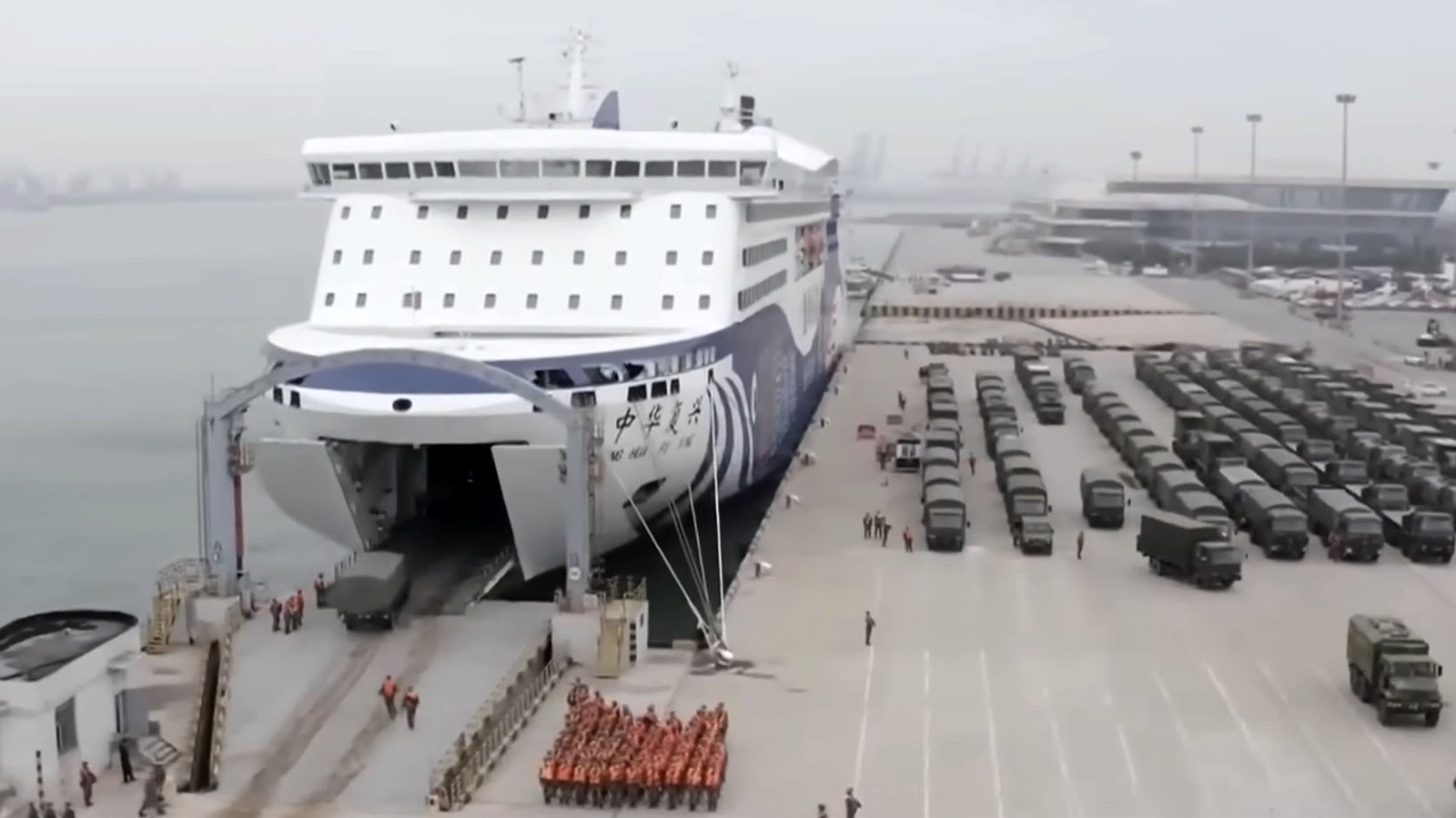
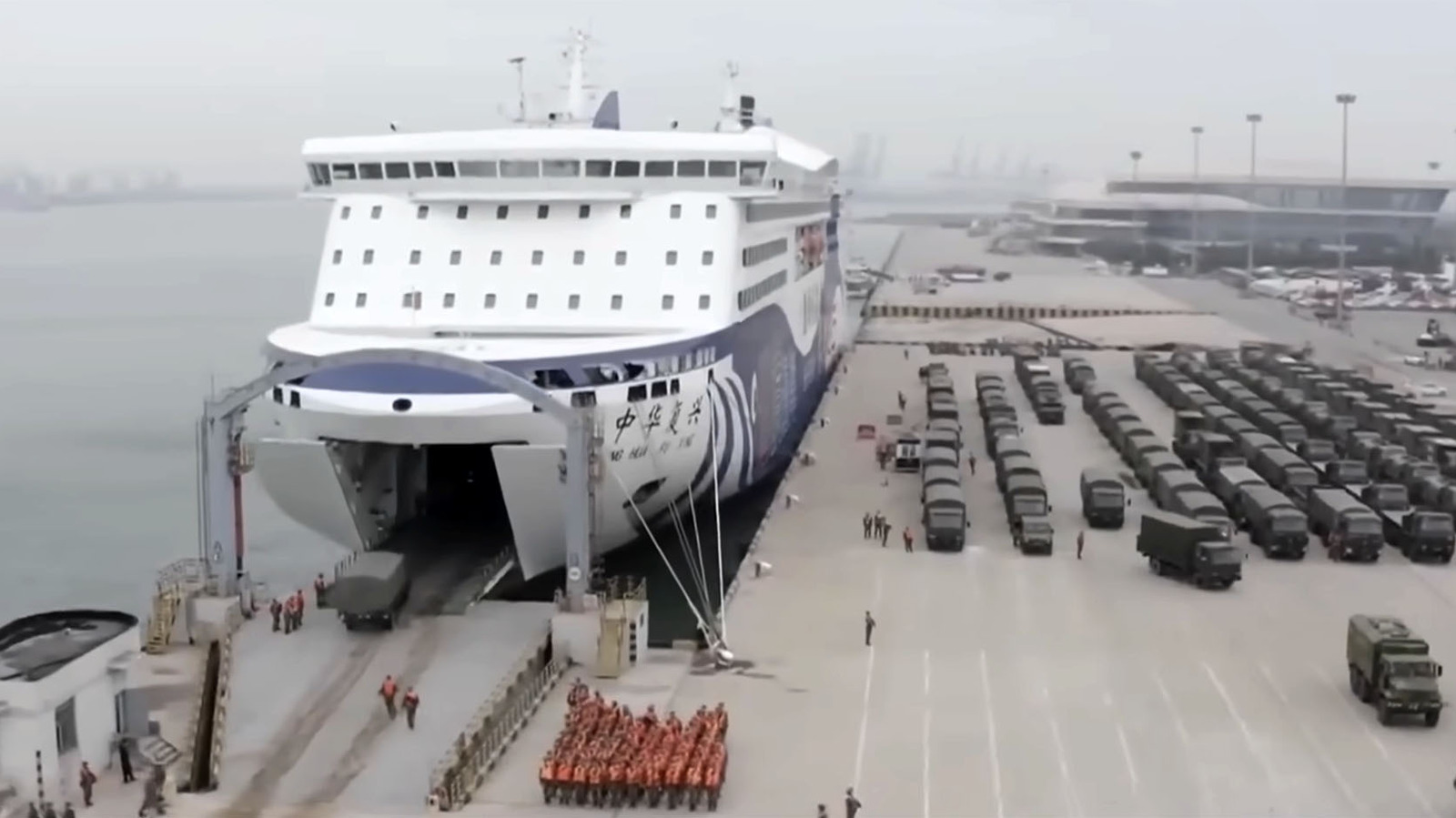
With a capacity to carry over 10,000 new vehicles for transport from factories in Asia to destinations around the world, these ships, known as roll-on/roll-off (Ro-Ro) ferries, are now the biggest of their type in the world. The concept of the PLA putting civilian ferries into military use is not a new one, or even an idea China is trying to hide. Back in 2021, China held a public military exercise where a civilian ferry was used to transport both troops and a whole arsenal of military vehicles, including main battle tanks.

The relatively limited conventional naval lift capacity of the PLA is something that’s been pointed out while game-planning a Chinese amphibious move on Taiwan, and it’s widely expected that the PLA would lean on repurposed civilian vessels to boost its ability to move soldiers and vehicles across the Taiwan Strait. With these newer, high-capacity Ro-Ro ferries added to the fleet, the PLA’s amphibious capacity and reach could grow significantly.

A makeshift amphibious assault ship

However, even with the added capacity of these massive ferries, military analysts have pointed out that Ro-Ro ships would not be able to deploy vehicles and soliders directly onto a beach the way a purpose-built military amphibious assault ship can. Traditionally, to deploy vehicles from these ships, the PLA would first need to capture and then repurpose Taiwan’s existing commercial port facilities into unloading bases for military vehicles and equipment.

However, maybe most alarming is that satellite imagery and U.S. Intelligence reports show that, along with increasing ferry production output, the PLA is also working on a system of barges and floating dock structures to help turn these civilian ferries into more efficient military transports. With this supporting equipment in place, ferries may not need to use existing port infrastructure to bring their equipment on shore.

Beyond the general military concern over China’s growing amphibious capability, there are also ethical concerns if China is planning to rapidly put a fleet of civilian merchant vessels into military service. If the PLA were to deploy these dual-purpose vessels into direct military operations, the United States and its allies would likely be forced to treat civilian-presenting ships as enemy combatants. On top of all the other strategic challenges a Taiwan invasion would bring, the U.S. having to navigate the blurred legal lines between military and merchant vessels could potentially give China a strategic advantage amidst the fog of war.


Source link