State environmental regulators are offering the public more time to weigh in on a proposed dairy expansion in western Minnesota after receiving hundreds of comments about the planned 19,000-head operation.
Riverview Farms, a Stevens County business headquartered near Morris, operates 13 dairies in Minnesota that range in size from 2,800 to more than 8,570 head, with a total of more than 92,000 cows.
The company is pitching the expansion as a reasonable response to demand, noting that Americans consume 40 pounds of dairy products each year, a nearly three-fold increase since the 1970s.
“Growing consumption trends and growing world population in the future cause us to be bullish,” said Brady Janzen, a partner in the operation.
The sheer size of the project, however, has added to growing concerns about large-scale farming and its impact on the environment and rural communities, including here in western Minnesota where in the past small dairies have long dotted the landscape.
Related: Can Minnesota save its dairy farms?
Under the plan, Riverview’s West River Dairy would expand from milking 7,855 cows to 18,855, becoming by far the largest dairy in the state.
A required Environmental Assessment Worksheet (EAW) review process for the proposal is also generating large numbers. As of April 8, 821 comments had been received from citizens and organizations about the proposed expansion south of Morris in Stevens County.
On Tuesday, the Minnesota Pollution Control Agency (MPCA), which regulates feedlot permits, announced a second extension of the public comment period to May 7. In addition, a public meeting has been scheduled for 6-8 p.m. Tuesday, April 28, at the South Side Event Center and Reception Hall in Morris.

Differing views
Today, Riverview faces one less hurdle than it did more than a decade ago. In 2014, the MPCA’s Citizens Board voted to require a more intensive Environmental Impact Statement (EIS) for Riverview’s proposed Baker Dairy in Stevens County. Riverview withdrew the proposal, and in 2015 the Legislature dissolved the board due to lobbying efforts by “Big Agriculture,” according to the legislative reference library citing news reports.
The Citizens Board, which had decision-making authority about permits and reviews, was replaced by an advisory committee, which was disbanded in 2020. Now, the authority lies with MPCA Commissioner Katrina Kessler.
The proposed expansion is the latest in a series of large dairies appearing in western Minnesota over the past two decades. Riverview’s 13 dairy farms are located in Chippewa, Grant, Kandiyohi, Norman, Stevens, Swift, Traverse and Wilkin counties. A 14th in Traverse County, has been approved for 8,571 cows but not yet built.
Comments appear to be proportionately divided among supporters, requests for the more intensive EIS, or denial of the permit. Concerns range from impacts on the environment to philosophical views about large agricultural businesses.
“Having been a small family dairy farmer and still helping daily on family dairies I am strongly against the expansion of the large dairy CAFOs (Concentrated Animal Feeding Operation),” stated one commenter. “Water usage and manure application are some of the more troubling aspects. Also, there is currently an oversupply of milk driving prices down to all dairy farmers.”
Comments in support of the project cite economic benefits and Riverview’s reputation for having a clean operation. A local farmer wrote: “Riverview is super beneficial to all local farmers. On our farm we haul about 300,000 bushels of corn to them every year for grinding. We also have them chop 800 acres of corn. We are very pleased with having them in our local area.”
MPCA feedlot program staff will review and respond to all comments, said Dan Ruiter, MPCA assistant communications director, calling 800-plus a “healthy number” of comments. The final decision whether or not an EIS is necessary lies with Commissioner Kessler.
MPCA’s most recent inspection at West River Dairy on July 25, 2023, “found no requirements to be out of compliance,” Ruiter said in an email message. “The MPCA will use information in the EAW and comments received to make a decision on the need for an EIS. MPCA staff will strive to meet that deadline. This is a time-intensive but important step. The comments inform staff by bringing new information.”
The project has been in the works for three years, Janzen said. “We take environmental stewardship, protection and regulations very seriously. We want to be good neighbors. We do much community outreach in the local area, and we have a lot of local support. Area farmers encourage the expansion,” he said. In 2015, an open house at Riverview’s Meadow Star Dairy near Willmar, which has more than 7,000 cows, drew thousands of visitors.
“I have heard no complaints about Riverview,” said Bill Kleindl, Stevens County Environmental Services Director and county feedlot officer. The expansion at West River Dairy will need an amendment to its Conditional Use Permit with the planning commission and then go before the county board, he said.
“An EIS would be unusual,” Janzen said. “Our permits are robust. Environmental protection is well understood and mitigates the need for an EIS.” While most large CAFOs operate with a general permit, Riverview will seek an individual permit with more stringent requirements, including enhanced manure storage, a thicker basin liner, notice and inspection requirements. “The site is designed for zero discharge,” Janzen said.
Environmental impacts
The proposed expansion would have three liquid manure storage basins covering 32.5 acres. That capacity would provide 14 months of storage, exceeding the required nine months. Nearly 17,000 acres of cropland available for manure application exceeds the required 13,200 acres, according to the EAW.
Water would be provided by a nearby existing well that is underused. However, in reviewing the EAW, the Department of Natural Resources said that it “did not consider impacts from the potential groundwater appropriation on the Pomme de Terre River … aquifer testing may be required to ensure sustainable water use.”
About 400 farmers in a 5-mile radius provide feed, consisting of 60% corn silage, haylage, corn gluten, distiller’s grains from ethanol plants and soybean meal from a plant in Dawson. “Having a local market helps offset global swings,” Janzen said. “Manure fertilizer is organic and helps offset global constraints.”
Driving into the parking lot at Riverview’s headquarters, the first thing a visitor notices is that all vehicles are parked facing outward. Janzen said that is intentional as statistics show fewer accidents. Similar attention to detail is evident at the dairy farms, which appear clean with well-ventilated barns and continuously scraped aisles.
Water comprises about 90% of the liquid manure scraped from the dairy barns. It first goes to a solids separator, then to a bioreactor, before being pumped into large covered storage basins. The solids are used for bedding, and the captured natural gas is sold to a gas company. In the fall, liquid manure is pumped from the basins and injected as fertilizer onto thousands of acres of surrounding cropland.

Riverview’s Minnesota operations employ about 850 workers, a majority of them Latino; however, that demographic is not officially tracked, Janzen said.
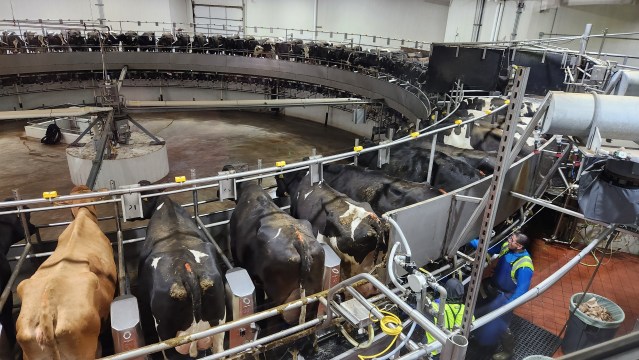
Observing the large, rotating 80-cow, 24-hours-per-day milking parlor at West River, a visitor will see about six or seven Latino workers rapidly operating the cleaning and milking equipment under the direction of Baldomero, a supervisor, and Carlos, the site manager. Immigration enforcement has not been an issue at Riverview, Janzen said. Kleindl also said that he has not seen activity in the area.
Supporting local products
If the West River Dairy expansion proceeds, it will create more than 40 permanent jobs, and hundreds of construction jobs, Janzen said. Currently under construction just south of Riverview’s first large dairy, its Stevens Milk Plant will create more than 60 jobs. The plant will use milk from about 60,000 dairy cows, processing it into milk powder, and the cream will go to butter makers, Janzen said. “Expanding processing here can support local products, and reduce transportation costs of liquid milk,” he said.
Related: Got Milk? Only if it’s from a dairy, say Minnesota farmers
The Riverview partners include fifth-generation members of the Fehr family, which moved to the area in 1939 to raise crops and beef cattle. Looking to expand opportunities, the family opened the first large dairy, Riverview, in 1995 not far from the Pomme de Terre River. In 2012, nearby Wulf Cattle Company merged into Riverview LLP. Janzen said he began working at Riverview in 2008 as a college intern while attending the University of Minnesota Morris.
In addition to dairy, cattle and crops, another bond among Riverview partners is provided by the Apostolic Christian Church, which has three congregations in the Morris area. This is reflected in the “About” section of the company’s website, listing five core values based on Bible verses.
Related