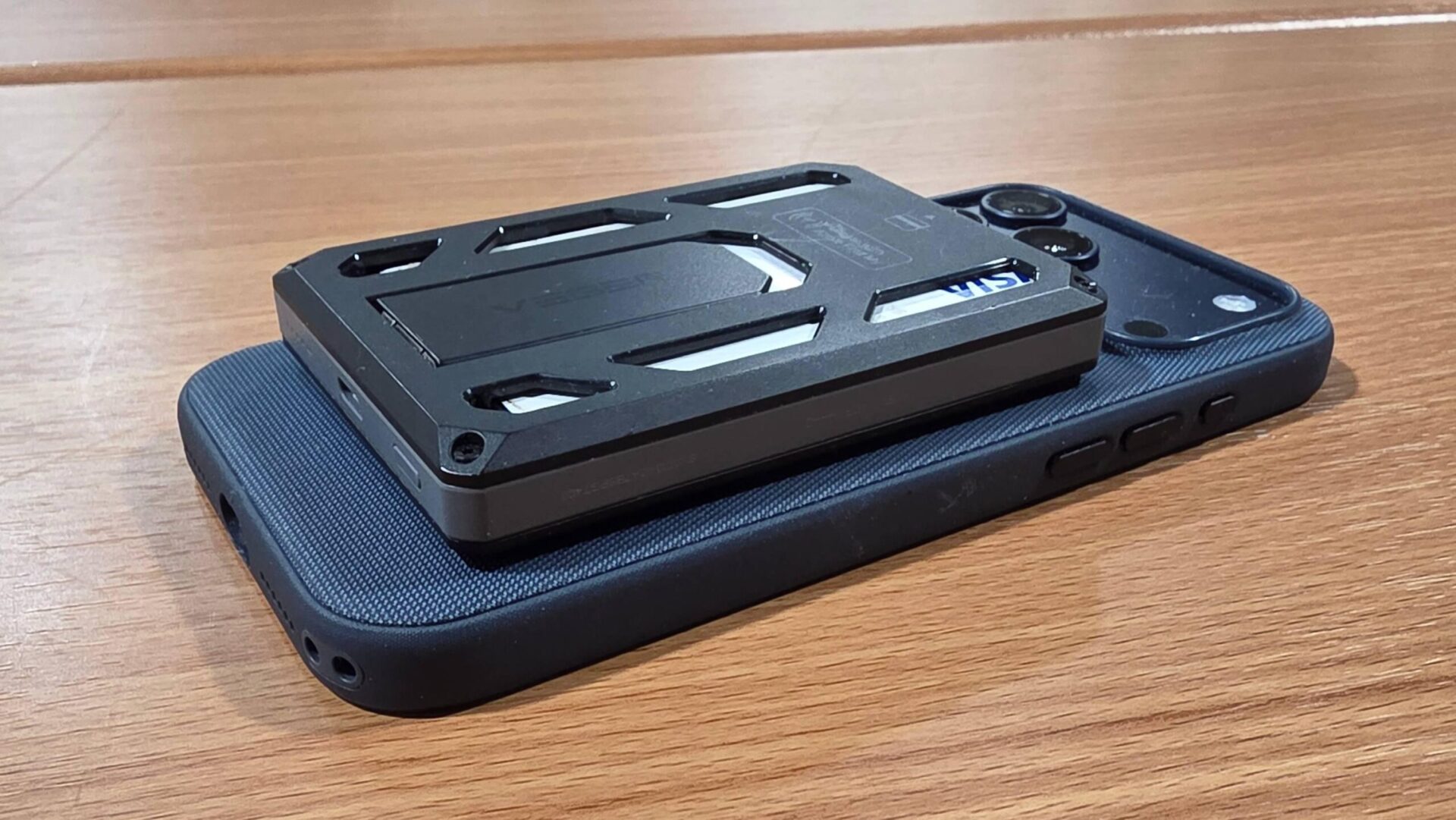

Veger X5 5000mAh MagSafe wallet
ZDNET’s key takeaways
- The Veger X5 is available now for $59.
- It’s a MagSafe charger, wallet, and tracker with Find My in one.
- It can only hold a few cards at a time.
Follow ZDNET: Add us as a preferred source on Google.
I am an unapologetic MagSafe fanatic. If it has a circular magnet on it, I want it. I’ve used many MagSafe accessories in my time, including wallets, batteries, and other devices with tracking. But I’ve never used one with all three until now.
Also: These are the closest things to AirTags for Android users (and better in some ways)
The Veger X5 MagSafe wallet and battery is a great match for someone like me. It has a 5,000 mAh MagSafe battery, a kickstand, a wallet that can hold two or three cards (more on that in a moment), and support for Apple’s Find My. I used the Veger X5 for about a week, and it’s like the mother ship calling me home. Except for one complaint — and it’s a big one.
The wallet’s design is pretty straightforward. The battery pack has the familiar circle of magnets on it for the magnets, there’s a USB-C port on the bottom, a power button, and five pips to show you the charge level.
Best generators deals of the week
Deals are selected by the CNET Group commerce team, and may be unrelated to this article.
The backplate is attached to the battery with four T5 screws. It has a neat design with a kickstand that can adjust to any angle. When you open the kickstand, you can use the slot where it was as a thumb hole to slide your cards up and out. Overall, it’s a simple and effective design, except for one flaw.
When you attach the Veger X5 to the back of your phone, the battery starts powering your phone (at a max of 20W by the way). But I wonder if merging the functionality of something like a wallet, that’s always there, with a charger — a device you only need sometimes — is a mistake.
What ended up happening was that my iPhone 17 Pro Max never discharged below 100%, and the charger ran out of juice because it was on all day. This point isn’t very intuitive, but if you press the battery’s button twice, it turns off charging until you actually need it.
Initially, the wallet only held two cards — my credit card and my driver’s license. There are four T5 screws that hold the backplate of the wallet on the battery. I loosened those screws and then re-tightened them, and just like that, I could add my insurance card to the mix. But that wasn’t the biggest problem.
Also: The wireless charger I recommend to hardcore Apple fans costs just $20 (but can do a lot)
The problem I ran into was that the MagSafe magnets on the wallet are extremely weak. When you put it on your phone, it spins pretty freely and tends to slip off. Put your phone in your pocket, and it’s a virtual certainty it’ll slip off. When it does, whether it corrects itself in your pocket or you fix it yourself, the phone starts charging again. I was constantly trying to re-affix the battery to my phone.
Regardless of this issue, the Veger X5 is proof that Android makers need to get it together with embedding Qi2 magnets for such accessories. The convenience of snapping on a MagSafe charger, kickstand, wallet, or everything all at once is a joy that, currently, only iPhone and some Google Pixel users can enjoy. Now, Samsung, OnePlus, and others need to join the fray.
ZDNET’s buying advice
Ultimately, I couldn’t continue using the Veger X5, which is a shame. It did basically everything I wanted it to, except hold all the cards I like to carry. If you only need to carry one or two cards, however, it could be a lot more practical. Just keep an eye on whether or not it’s draining the battery. Fortunately, there are thousands of other MagSafe chargers on the market for you to consider.