The Best Microcurrent Devices of 2026 for Lifted, Radiant Skin


Skin Gym Microcurrent Wand: Unfortunately, this device is not FDA-approved, so I wouldn’t feel comfortable recommending it. If you do purchase it, I would be careful about the intensity and around the eyes, since it caused brief spots across my vision during use. The instructions for this device do not mention using it on the sides of the neck, so I avoided that area. It also requires batteries and cannot be recharged, which I personally don’t find to be ideal. The device itself felt lighter and cheaper than the others, which makes sense given its $120 price. As with many of the others I tested, the gel did not last throughout the entire treatment.

Medicube Age-R Booster Pro: Though I enjoyed using the device and think it has a great design, it is not FDA-approved. That is likely because it’s made in Korea, not the US. It is designed to create a glass-skinned appearance. It has four modes, each with five levels of intensity: Booster (electroporation for glowing skin), MC (microcurrent for volumizing lines), Derma Shot (electrical muscle stimulation for facial contouring) and Air Shot (electric needles for tightening pores). It also provides LED light therapy. I wish the device had more information about what specifically happens in each mode. Instead, I had to do my own research to feel safe and confident when using the device.

For the microcurrent specifically, it says you don’t need a conductive gel and can use regular skin care, but I didn’t find this to be the case. If I used my regular moisturizer, it was not long-lasting and slick enough for the treatment. I started at the level one intensity and worked my way up, but I found the sensation intense sufficient to warrant a conductive gel, so I used my Ziip one. I would be cautious around the eyes with the higher intensities.

As for the AGE-R app, it offers a tracking calendar, visual progress tracking, guided videos and personalized device settings. However, the guided videos called “Shorts” felt more like social media videos, and I wish they were more curated and included specific voice instructions.

I liked the device’s design with its screen and found it easy to hold and maneuver over the face. There is also a voice that states which mode you’re on, the intensity and how many minutes have passed during the treatment, which is a great accessibility feature. No stand is needed since the device can stand upright on its own, and I like that the charger connects to the top of the device so that it can still stand on a countertop when being charged.

A recent viral TikTok video has said that this device can cause Bell’s palsy, which is paralysis or weakness on one side of the face caused by nerve damage. Medicube has responded, calling the claim “misleading” and stating that the device’s electrical stimulation cannot cause nerve damage because it operates at a low output between 7mA and 14mA, which is lower than other devices and cannot cause nerve damage or paralysis.


Source link

Leave a Reply

Subscribe to Our Newsletter

Get our latest articles delivered straight to your inbox. No spam, we promise.

Recent Reviews


In the ever-shifting geopolitical sphere, China’s growing military presence and the ongoing tensions over Taiwan and the South China Sea continue to be a closely watched topic — particularly in regard to China’s ambition for naval power. In recent years, much speculation has been made over the country’s rapid military development, including the capabilities of the newest Chinese amphibious assault ships.

While there’s no denying its military advancements and buildup, much has been made about the logistical and military difficulties that China’s People’s Liberation Army (PLA) would face if it launched an amphibious invasion of Taiwan. However, there’s growing concern that if a Taiwan invasion were to happen, it wouldn’t just be military vessels taking part in the action, but a fleet of commercial vessels, too — including a massive new car ferries that could quickly be repurposed into valuable military transports.

While the possibility of the PLA using commercial vessels for military operations has always been on the table for a potential Taiwan invasion, the scale with which China has been expanding its commercial shipbuilding industry has become a big factor in the PLA’s projection of logistical and military power across the Taiwan Strait. It’s also raised ethical concerns over the idea of putting merchant-marked ships into combat use.

From car ferry to military transport

The rapid growth of modern Chinese industrial capacity is well known, with Chinese electric vehicle factories now able to build a new car every 60 seconds. Likewise, China has developed a massive shipbuilding industry over the last 25 years, with the country now making up more than half of the world’s shipbuilding output. It’s from those two sectors where China’s latest vehicle-carrying super vessels are emerging. 

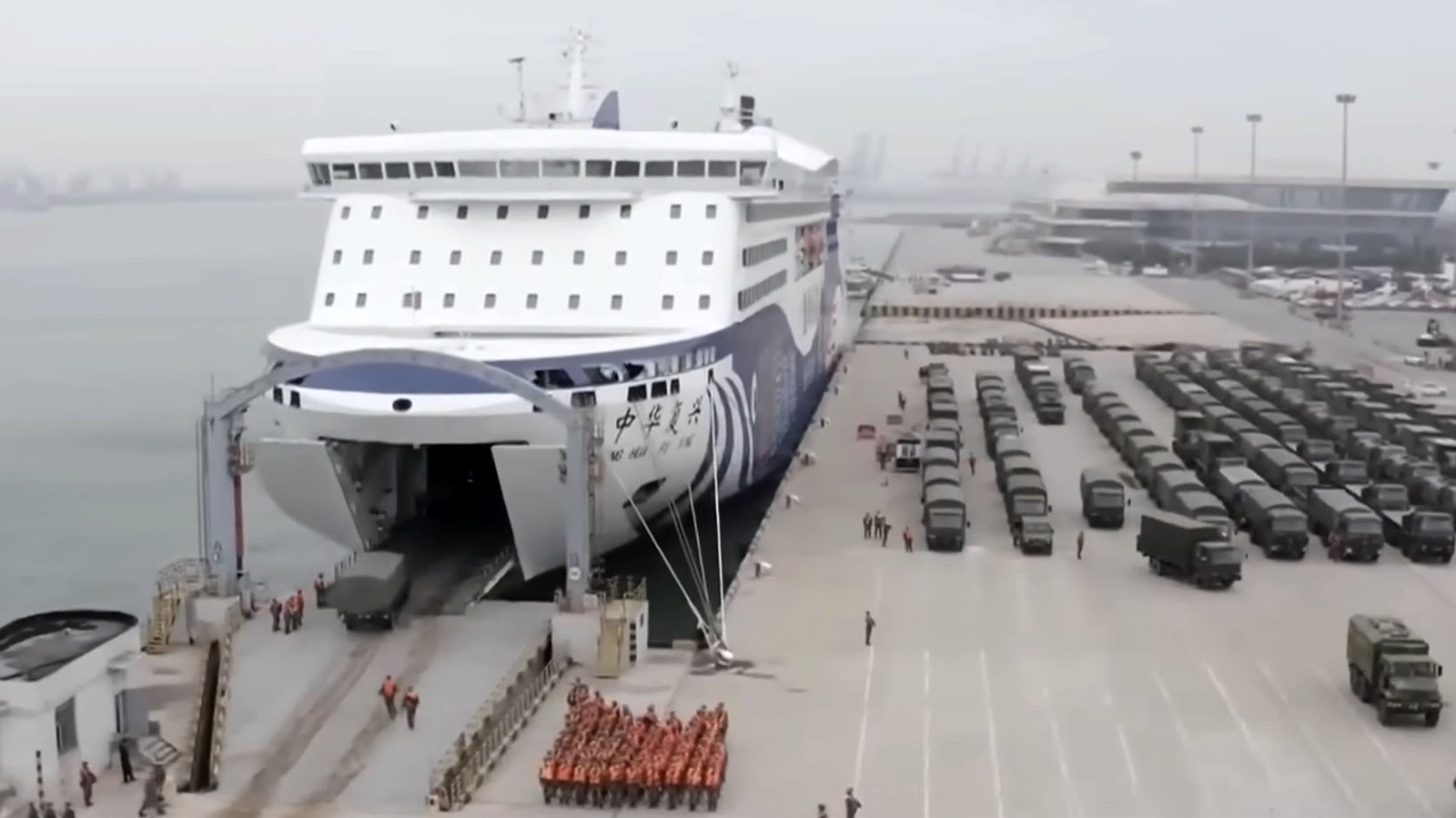
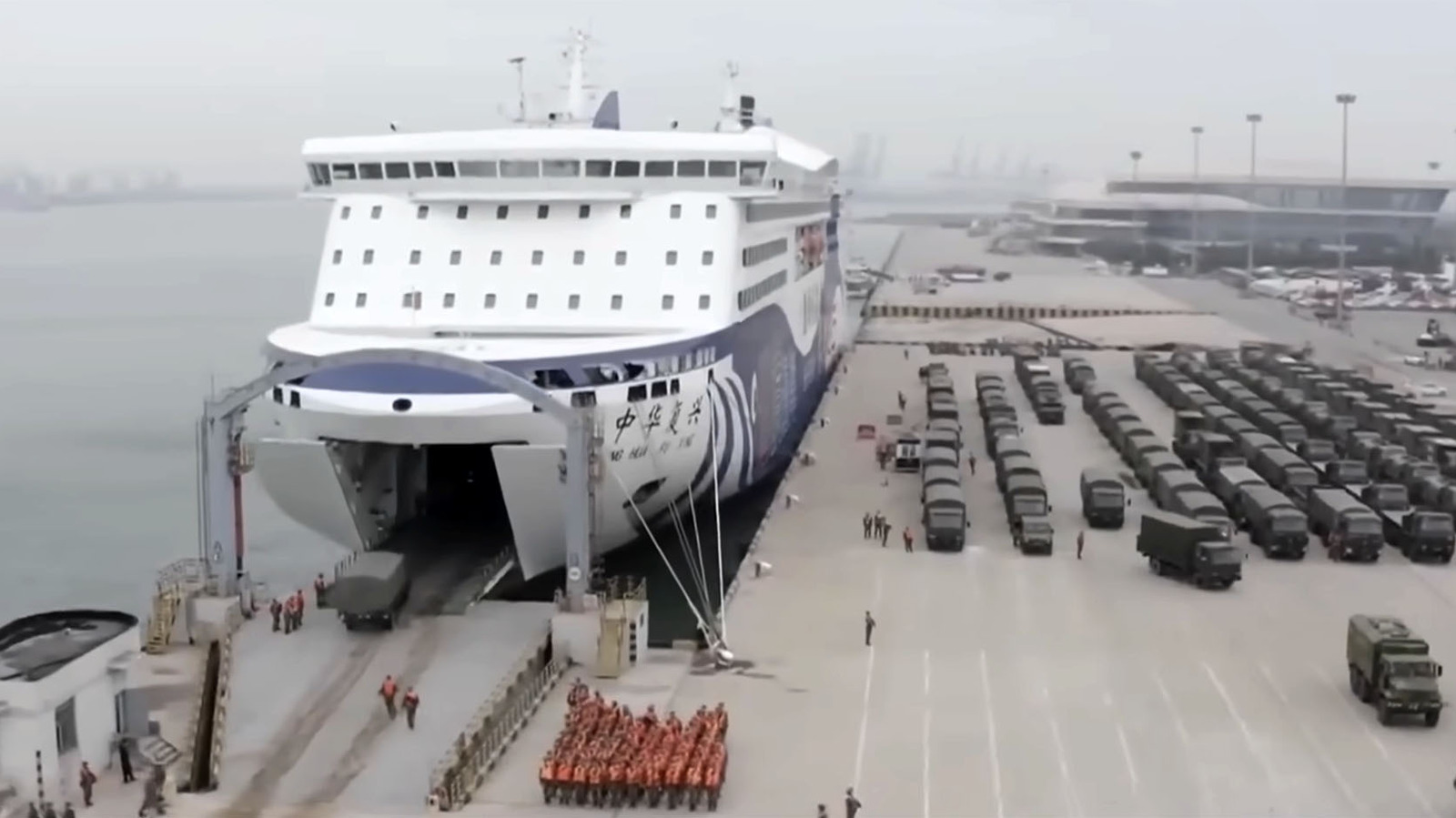
With a capacity to carry over 10,000 new vehicles for transport from factories in Asia to destinations around the world, these ships, known as roll-on/roll-off (Ro-Ro) ferries, are now the biggest of their type in the world. The concept of the PLA putting civilian ferries into military use is not a new one, or even an idea China is trying to hide. Back in 2021, China held a public military exercise where a civilian ferry was used to transport both troops and a whole arsenal of military vehicles, including main battle tanks.

The relatively limited conventional naval lift capacity of the PLA is something that’s been pointed out while game-planning a Chinese amphibious move on Taiwan, and it’s widely expected that the PLA would lean on repurposed civilian vessels to boost its ability to move soldiers and vehicles across the Taiwan Strait. With these newer, high-capacity Ro-Ro ferries added to the fleet, the PLA’s amphibious capacity and reach could grow significantly.

A makeshift amphibious assault ship

However, even with the added capacity of these massive ferries, military analysts have pointed out that Ro-Ro ships would not be able to deploy vehicles and soliders directly onto a beach the way a purpose-built military amphibious assault ship can. Traditionally, to deploy vehicles from these ships, the PLA would first need to capture and then repurpose Taiwan’s existing commercial port facilities into unloading bases for military vehicles and equipment.

However, maybe most alarming is that satellite imagery and U.S. Intelligence reports show that, along with increasing ferry production output, the PLA is also working on a system of barges and floating dock structures to help turn these civilian ferries into more efficient military transports. With this supporting equipment in place, ferries may not need to use existing port infrastructure to bring their equipment on shore.

Beyond the general military concern over China’s growing amphibious capability, there are also ethical concerns if China is planning to rapidly put a fleet of civilian merchant vessels into military service. If the PLA were to deploy these dual-purpose vessels into direct military operations, the United States and its allies would likely be forced to treat civilian-presenting ships as enemy combatants. On top of all the other strategic challenges a Taiwan invasion would bring, the U.S. having to navigate the blurred legal lines between military and merchant vessels could potentially give China a strategic advantage amidst the fog of war.


Source link