What Those Yellow Flaps On The Road Are Actually For


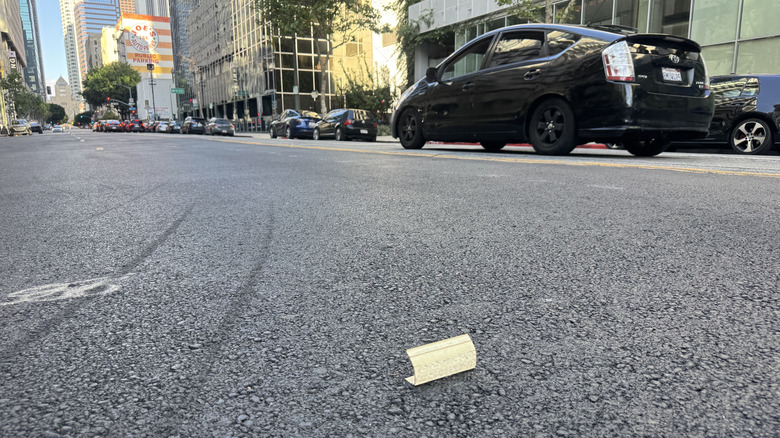
There is a lot of stuff to keep an eye on while driving, from signs to orange lines on the freeway to other vehicles. A few things are very straightforward –  ike the markings you almost definitely saw on that driver’s test you took as a teenager, but some you’ll see less often and are not really common knowledge. One example is the yellow flaps you sometimes see on the road. 

You will most likely come across these yellow flaps — which look a bit like plastic Post-It Notes — on roads that are or were under construction. They act as temporary lane markers for roads that are not fully repaired in place of the painted lines you’d usually see. The State of California Department of Transportation Division of Engineering Services (SCDTDES) states that these flaps can be used for “temporary pavement delineation on bituminous seal coat projects.” In California, these yellow flaps should only be used short-term, while other temporary lane markers, like raised yellow dots, may be used for long-term road repairs. 

Which U.S. states have the best and worst road conditions?
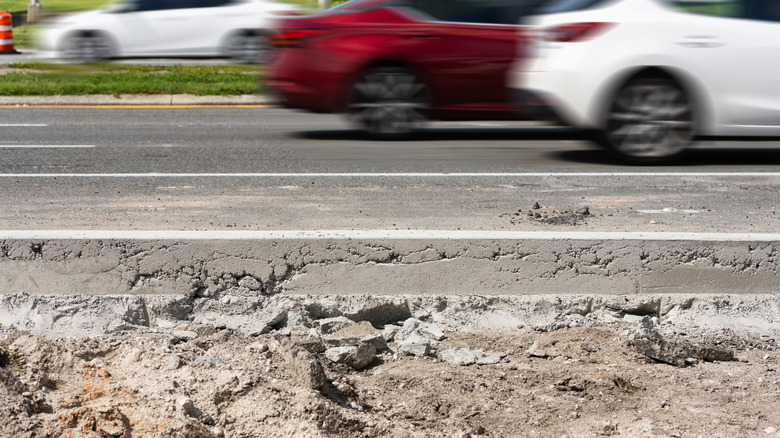
Running into all these roads that are under construction with confusing line replacements can get frustrating — but at least you know the roads are being worked on. Some U.S. states have better road conditions than others, although the country as a whole has many roads in need of repair. 

Orlando, Florida, is considered one of the cities with the worst roads in the country, with poor conditions that continue to damage vehicles. States with the most roads in bad shape include Rhode Island, Massachusetts, New York, Maryland, and Connecticut due to aging roadways and winter weather. California is also a state known for its poor road conditions due to how heavily the population relies on cars for transportation. Los Angeles is a highlighted city within the state, where many drivers have noticed that the roadways are getting worse because they aren’t repaved as often as needed. 

In contrast, states in the Midwest and the South have some of the best road conditions. This includes Kansas, Wyoming, and Indiana. These states have far less traffic, making it easier to maintain their highway infrastructure. 


Source link

Leave a Reply

Subscribe to Our Newsletter

Get our latest articles delivered straight to your inbox. No spam, we promise.

Recent Reviews


A new class-action lawsuit, filed on Monday by three teenage girls and their guardians, alleges that Elon Musk’s xAI created and distributed child sexual abuse material featuring their faces and likenesses with its Grok AI tech.

“Their lives have been shattered by the devastating loss of privacy, dignity, and personal safety that the production and dissemination of this CSAM have caused,” the filing says. “xAI’s financial gain through the increased use of its image- and video-making product came at their expense and well-being.”

From December to early January, Grok allowed many AI and X social media users to create AI-generated nonconsensual intimate images, sometimes known as deepfake porn. Reports estimate that Grok users made 4.4 million “undressed” or “nudified” images, 41% of the total number of images created, over a period of nine days. 

X, xAI and its safety and child safety divisions did not immediately respond to a request for comment.

The wave of “undressed” images stirred outrage around the world. The European Commission quickly launched an investigation, while Malaysia and Indonesia banned X within their borders. Some US government representatives called on Apple and Google to remove the app from their app stores for violating their policies, but no federal investigation into X or xAI has been opened. A similar, separate class-action lawsuit was filed (PDF) by a South Carolina woman in late January.

The dehumanizing trend highlighted just how capable modern AI image tools are at creating content that seems realistic. The new complaint compares Grok’s self-proclaimed “spicy AI” generation to the “dark arts” with its ease of subjecting children to “any pose, however sick, however fetishized, however unlawful.”

“To the viewer, the resulting video appears entirely real. For the child, her identifying features will now forever be attached to a video depicting her own child sexual abuse,” the complaint reads.

AI Atlas

The complaint says xAI is at fault because it did not employ industry-standard guardrails that would prevent abusers from making this content. It says xAI licensed use of its tech to third-party companies abroad, which sold subscriptions that led abusers to make child sexual abuse images featuring the faces and likenesses of the victims. The requests ran through xAI’s servers, which makes the company liable, the complaint argues.

The lawsuit was filed by three Jane Does, pseudonyms given to the teens to protect their identities. Jane Doe 1 was first alerted to the fact that abusive, AI-generated sexual material of her was circulating on the web by an anonymous Instagram message in early December. The filing says she was told about a Discord server by the anonymous Instagram user, where the material was shared. That led Jane Doe 1 and her family, and eventually law enforcement, to find and arrest one perpetrator.

Ongoing investigations led the families of Jane Does 2 and 3 to learn their children’s images had been transformed with xAI tech into abusive material.


Source link



