It couldn’t be a worse time for MN to reduce its investment in transit


President Donald Trump’s war against Iran is triggering an unstable oil supply for the foreseeable future, a destabilizing event that will likely linger for years.

This third major U.S. war in the Persian Gulf in my lifetime underlines again the need for reducing the use of fossil fuels, and like it or not that means creating alternatives to urban driving in the Twin Cities. In my experience, this is a bitter pill to swallow for people whose vision of the future is predicated on the unending expansion of highways into the exurbs.

But such is the state of affairs. The Strait of Hormuz has eclipsed much of the world’s geographic map, and so we need an alternative vision for the Twin Cities. We must focus on walkable density, reducing vehicle miles traveled, and public transit; together they create mobility fundamental to high-tech, 21st century life. 

And yet, as reported by Erik Noonan last week, the supplemental budget proposal released last month by Minnesota’s Democratic Gov. Tim Walz slashes state transit funding. Given the geopolitics, cuts to support for Metro Transit could not come at a worse time, and state lawmakers should reject this idea. On the contrary, the global crises suggest putting more funding toward transit into the state budget, money that would directly help people in the Twin Cities who are facing high gas prices.

For the second year in a row, Walz suggests using the new transit sales tax as an ATM for budget cuts elsewhere, slashing state general fund dollars for urban transit operations by over $40 million in the next biennium  (2028-2029). This comes on top of last year’s transit cuts by the Legislature after a last-minute negotiation fell through

A transit retreat from 2023

These cuts undermine the generational investment of the 2023 legislative session that saw, after years of stagnation, the first meaningful change in transit funding in my lifetime. At that time, a .75-cent metro sales tax was levied for transit funding after decades of short-term fixes for a long-term shortfall. 

The promise of that sales tax legislation was that our transit system would finally be able to invest in improved service and geographic expansion, starting to balance decades of inaction where, for almost a century, regional transportation spending had been heavily weighted in favor of private automobiles. To take but one example, the new overpass interchange on Highway 36 in Lake Elmo, saving a small amount of time for only 5,000 cars a day, will cost the Minnesota Department of Transportation over $50 million. These kinds of projects pile up every year, while state funding for transit stagnates. 

The promise of the 2023 sales tax for transit was that it would add new money into the transit system, allowing it to catch up with other cities like Seattle or Denver, and putting the Twin Cities back in the conversation with national leaders. Instead, the new funding stream is proving to be an excuse for cost shifts, allowing the state and counties to walk away from their commitments. I wrote about this last year, when the governor again used this gimmick to cut transit funding. At the time, I argued that “using the groundbreaking transit sales tax as an ATM for cost shifts” was a bad sign. 

For Hennepin and Ramsey counties, the new sales tax facilitated walking away from commitments to fund light-rail operations, representing over $20 million in annual savings for Hennepin County alone. Walz’s gimmick shifts statewide commitments to transit out of the general fund, essentially neutering the changes from 2023.

U.S. cities fall further behind

Every year I teach a class at the University of Minnesota called Fundamentals of Transit. I ask students to pick cities anywhere in the world, reporting to the class a bit about their history, ridership statistics, governance and funding, and other quirks. The resulting talks are usually fascinating; even after years, they repeatedly illustrate how U.S. cities are far behind their global peers. 

Just some illustrations from this semester: Auckland, New Zealand, has half the population of the Twin Cities, but six rail lines and twice the transit ridership. Manila, the capital of the Phillipines, has half of the Twin Cities GDP but is building a subway. Frequencies on main transit lines of cities like Dublin, Ireland; Santiago, Chile; and Chongqing, China, are routinely under 10 minutes, something that does not exist anywhere in the Twin Cities metro. I was astonished to learn from a student last week that Dnipro, Ukraine, is expanding its heavy-rail transit system in spite of the fact that the front lines of a years-long war with Russia lie only a few miles away.

Meanwhile, the Twin Cities still struggle with transit service. Even the Southwest Light-Rail Extension, over budget and behind schedule, barely begins to offset the massive amount of money spent on highway expansion over the generations. We need to accelerate the important arterial bus rapid transit program while investing in other basics of the system, like shelters, security and affordable fare programs.

All of that requires state funding, and the Legislature should reject Walz’s supplemental budget salvo. Instead, leaders should take 2026 as an opportunity to increase, not shrink, the state’s commitment to transit funding. The oil shock spurred by Trump’s attack on Iran is only beginning. Meanwhile, warm weather blanketing the western half of the United States this March shattered long-standing April temperature records.

Faced with ratcheting gas prices, state money spent on transit goes directly to help working-class people struggling with inflation. Not having to buy, insure, fuel and maintain a first, second or third car is a huge financial windfall for people of any background. 

Transit funding offers a lifeline, and liberation, from the gas pump. State lawmakers should see transit funding as the solution to the acute, interlinked crises of oil prices and climate change. Now’s not the time to make more cuts.


Source link

Leave a Reply

Subscribe to Our Newsletter

Get our latest articles delivered straight to your inbox. No spam, we promise.

Recent Reviews


We may receive a commission on purchases made from links.

Michelin is a French multinational company that many consumers consider to be one of the most satisfying major tire brands. This firm makes several tire models that offer comfort, performance, all-terrain prowess, and everything in between — including cutting-edge products like the $42,000-per-set Michelin Pilot Sport PAX that it developed specifically for the Bugatti Veyron. Aside from its own tires, Michelin also owns other tire brands that you might be familiar with, including BFGoodrich, Achilles, and Corsa.

While tires are what Michelin is known for, the company has put its name to more than the rubber that wraps around your car’s rims. In fact, the company sells several other products that aren’t tires. So, we’re listing a few Michelin-branded items that you can buy online and in retail stores. While they might not all be made of rubber or even related to vehicles, these tools and accessories can come in handy when keeping your car — and even yourself — in good shape.

Michelin tire inflator

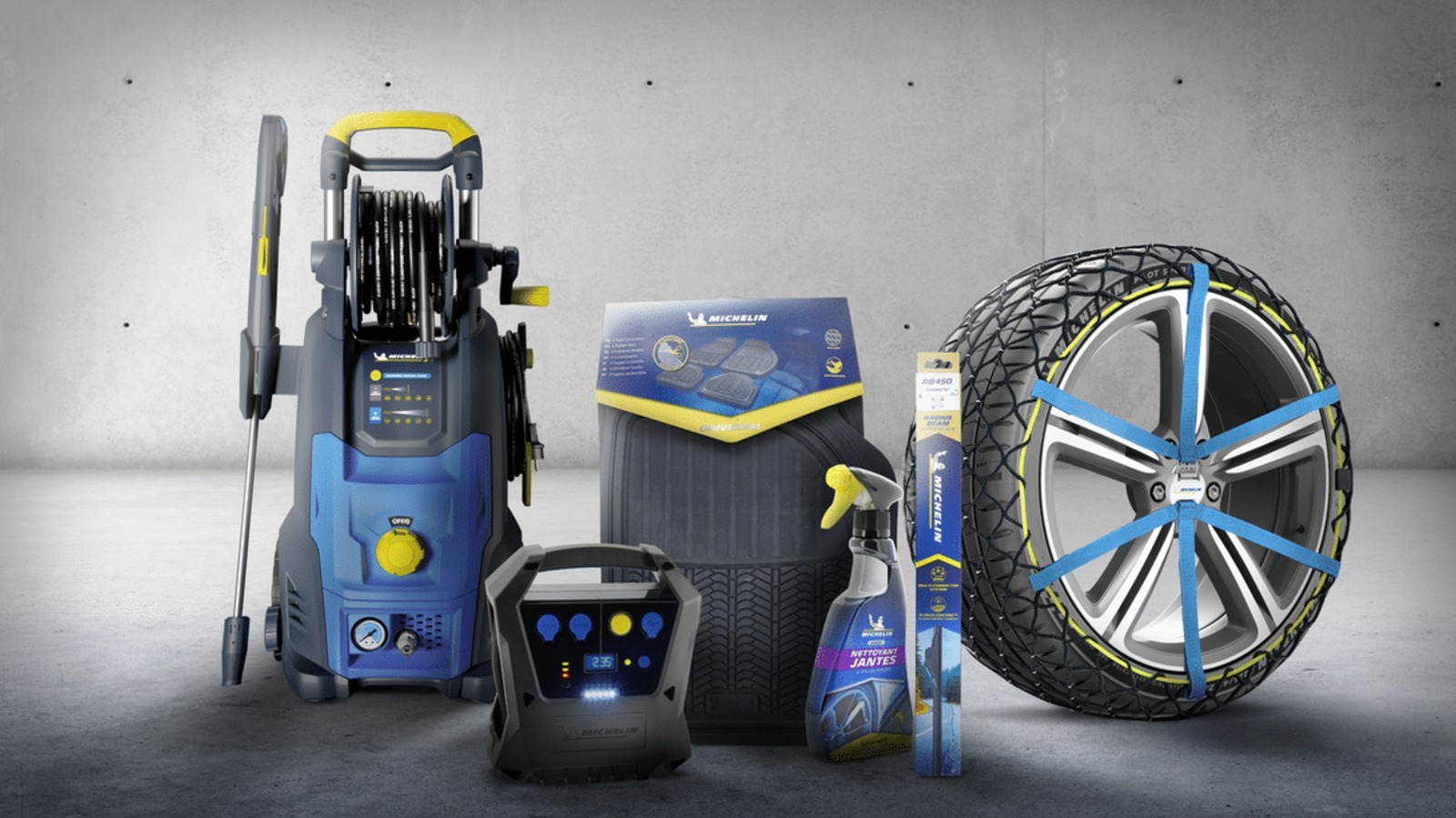
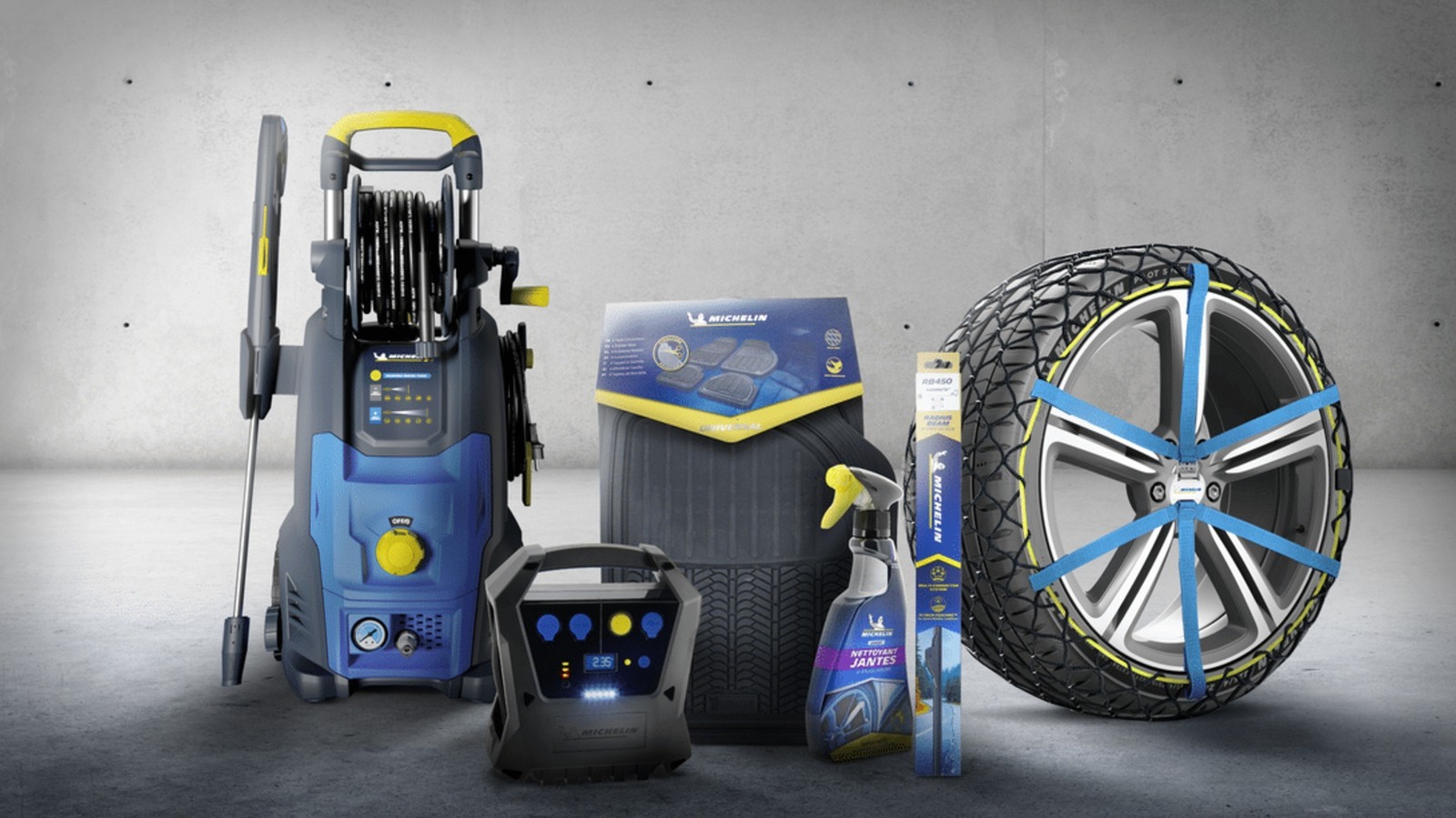
Since Michelin is primarily known for its tires, it makes sense for the company to sell a Michelin-branded tire inflator as well. That way, if you get a flat on one of the Michelin tires on your car or want to regularly top up your car’s tire pressure to maintain optimum performance, you can use a Michelin-branded pump to fill up your tires. The company actually sells several types of inflators on its Amazon page, but it only offers a single motorized unit — the Michelin Micro Tyre Inflator, which is available on Amazon for $98.99.

This little device is only slightly wider than an iPhone 17 and weighs about 400 grams, or 14 ounces. This means it’s easy to store in your car and to move to whichever tire needs topping up. More importantly, it takes power from a 12-volt socket, allowing you to run it using your car’s battery. It also has a USB port for charging your phone (or any other USB device) in case of an emergency.

Some users say that the device is slow, taking about 12 minutes to bring a tire from 10 to 32 PSI, but that’s not unexpected given its small size. Still, it should be good enough for regular weekly maintenance if you know your car’s proper tire pressure, or in case of an emergency. Its biggest downside is that you need a power source to run it, but having a dead battery and a flat tire simultaneously is likely a rare occurrence in many modern cars.

Michelin mini fridge

Taking a road trip during the summer can get you thirsty, and there’s no better way to quench that thirst than by drinking a cool can of soda (or your beverage of choice). If you want to ensure that you’ll always have a cold drink ready while you’re driving on the freeway, Michelin’s mini fridge will help you with that. This nifty little refrigerator is available on Amazon for just $99.99 and can be connected to either 110V AC or 12V DC power, ensuring that it will work on both your desk and in your car.

The mini fridge measures 6.9 x 9.45 x 10 inches (17.5 x 24 x 25.4 cm), meaning it can easily fit on a garage shelf or office desk. It should also be small enough to put on the floor of your car. Despite that relatively small size, it’s large enough to fit six 350-ml cans or four 500-ml bottles, and it will keep these items at a chilly 32 degrees Fahrenheit or 18 degrees Celsius. It also has an LED light on the door, so it can double as a night light if necessary.

Aside from keeping your drinks (and other food items) below room temperature, it also has a few other creature comforts. These include a removable shelf and door basket for flexibility and easy cleaning, as well as a retractable carry handle and a self-locking door to make transportation easier.

Michelin car floor mats

Heavy-duty car floor mats are often made from rubber for durability and water resistance, and since Michelin is in the business of rubber, it makes sense for the company to offer exactly that. So, if you want to protect your vehicle’s floor from dirt, dust, and mud, the company can help you with its Michelin all-weather car floor mats. This four-piece package is available on Amazon for $49.99 and comes in either black or tan.

The surface of these floor mats is specially designed to trap debris, snow, and water, preventing them from ruining the carpet on your vehicle. The mats have a cleat backing that grips your car’s floor and prevents them from slipping. The front row mats also come with what Michelin calls a Gripclip Retention System, allowing them to clip into your vehicle’s safety clips and adding even more reassurance that they won’t accidentally slip while you’re driving and pose a hazard to your safety.

These mats are universal and will work in most vehicles. However, they’re also easy to customize: If you find them a bit too large for the footwell of your tiny hatchback, you can use a pair of scissors to trim the edges for a perfect fit.

Michelin Stealth Ultra wiper blades

While Michelin’s Stealth Ultra wiper blades aren’t generally considered among the best windshield wipers, they appear to be a pretty good choice given their four-star rating on Amazon. These wipers cost $49.99 and are available in various size combinations for all sorts of cars. This ensures that no matter what vehicle you’re driving, you can probably find a set that will fit your needs.

These Michelin wipers are curved to conform to the shape of your windscreen for a clean, streak-free wipe. The company’s Amazon listing claims that these are designed to “withstand rain, wind, snow, mud, dust, or any other debris that might hamper your windshield’s visibility.” While you might think that windshield wipers are pretty simple items, and that you can just purchase any generic wipers off the internet, you must remember that they’re essential so that you have the best visibility possible during inclement weather. So, for your safety, consider investing in a set from a reputable brand like Michelin.

Michelin work boots

Michelin is known for making rubber tires to put on your car’s “feet,” but did you know it also makes shoes for the driver’s feet? The company makes sports & outdoor footwear, as well as shoes for work and safety. For this example, we have the Michelin HydroEdge Steel Toe waterproof work boot, listed for $210 on Amazon and at Georgia Boot. This shoe is available in U.S. sizes from 7.5 up to 14, ensuring that no matter what size you wear, you can get a Michelin work boot for yourself.

As the name suggests, this pair of shoes has steel toes to protect your feet from accidental impacts and is fully waterproof to help keep your feet dry, even in supposedly severe conditions. It also meets ASTM F2413 standards for electrical protection, meaning it has fully insulating soles to protect you from electrical hazards at work. Michelin also added what it calls an Advanced Rear Suspension system to its heel, ensuring proper shock absorption when you walk.


Source link