
Minivans are probably the ultimate expression of the idea that function matters more than form. They aren’t particularly sleek or aesthetically pleasing, no matter how hard they try. Instead, they’re functional. They carry passengers, do it in comfort, and provide more room than you might think possible. SUVs often make compromises like poor fuel economy to offer rugged looks, and trade poor ride quality in favor of increased off-road capability or towing capacity, but with minivans, those compromises are unnecessary in the pursuit of maximum space. For these family haulers, what a vehicle can provide in terms of utility is far more important than the way it looks or whether it can drive off-road. So, which minivan offers the most utility?
Legroom, headroom, and shoulder room are all important stats, but one of the best numbers for measuring maximum utility is overall cargo space. With passengers (and sometimes seats) removed, vans are serious hauling machines — often outclassing many SUVs when it comes to cargo space. To break down which minivan best tackles this task, we’ve compiled the top minivans by overall cargo space — whether that means folding their seats flat, lowering them into the floor, or removing them entirely.
Toyota Sienna – 101.0 cu ft.
The Toyota Sienna is basically the same size as the cargo-space leaders on this list. It’s within a few inches of the bumper-to-bumper length of both the Kia Carnival and Honda Odyssey, but it has 40-50 cubic feet less cargo space than those vans. Why? The Toyota’s seats aren’t designed to be removed. In most minivans these days, the second row seats are designed to be easily taken out and placed somewhere for storage, making way for more interior space — but the latest Sienna doesn’t do that trick. It does have basically the same overall passenger volume as its rivals, so things won’t be cramped when it’s full of passengers, but maximum cargo space is where it falls short.
Still, the Sienna has a lot to offer. It’s ultra-reliable, and under the hood, the Sienna’s 2.5-liter four-cylinder engine is paired with a hybrid system, putting out a total of 245 horsepower — enough for most minivan owners. And the hybrid is standard on all trims of the Sienna, so EPA-estimated fuel economy ranges from 35 to 36 mpg combined – impressive numbers for any van. Depending on which trim you choose, and whether you opt for front- or all-wheel drive (the Sienna offers both), prices for the Toyota minivan range between $41,915 and $59,305 (including $1,495 destination fee).
- Cargo space behind the first/second/third row: 33.5/75.2/101.0
- Total passenger volume: 162.5
Chrysler Pacifica: 140.5 cu ft.
The Chrysler Pacifica gets new styling for 2027, but what’s underneath the skin remains the same — a beating heart of family-friendly spaciousness. The Pacifica has a premium exterior vibe and an interior claim to fame known as “Stow n’ Go” seats in both the second and third row. To put it simply, the seats fold up quickly and stow away underneath the van’s floor. They pop right back up just as quickly, and they’re a utilitarian calling card that really helps the Pacifica stand out.
For 2027, the Pacifica gets the same powertrain from the previous year, Chrysler’s famous Pentastar 3.5-liter V6. The V6 produces a healthy 287 hp and 262 lb-ft, and it’s available with either front- or all-wheel drive. Unfortunately, that V6 returns some pretty disappointing fuel economy numbers, with the Pacifica offering just 22 mpg combined on FWD trims and 20 mpg combined on AWD trims, according to EPA estimates. Even with the V6 as the only available powertrain, though, the new Pacifica is pretty pricey. Base front-wheel drive LX models start at $43,490 (including $1,995 destination fee), while top-trim Pinnacle models start at $60,250.
- Cargo space behind the first/second/third row: 32.2/87.5/140.5
- Total passenger volume: 165.0
Kia Carnival: 145.1 cu ft.
Boxy, with big shoulders and an imposing front end, the Kia Carnival does its best impression of an SUV on the outside, but there’s no hiding just how functional it is as a minivan. More than functional and brooding, it’s versatile — the Carnival is available with either a 3.5-liter V6 or a hybrid powertrain that uses a 1.6-liter four-cylinder engine paired with a 1.49 kWh battery. The V6 puts out 287 hp and 260 lb-ft, while the Carnival hybrid produces 241 hp and 270 lb-ft. The power difference is significant, but the trade-off in fuel economy will certainly have you looking closer at the hybrid.
According to the EPA, the standard Carnival will return 21 mpg combined, while the hybrid achieves 32 mpg combined. That’s not quite as high as the Toyota Sienna, but it’s still one of the most efficient offerings in the class. With the two available powertrain setups, the Carnival’s pricing covers a pretty wide spread, so there’s potentially all sorts of budgets. The V6-powered Carnival starts as low as $38,935 (including $1,545 destination fee), and goes all the way up to $53,035. The hybrid starts and ends a bit higher, ranging between $42,935 and $55,035.
- Cargo space behind the first/third row: 40.2/86.9/145.1
- Total passenger volume: 168.2
Volkswagen I.D. Buzz: 145.5 cu ft.
Trading on a bit of nostalgia and sleek modern style, the Volkswagen I.D. Buzz is arguably the best-looking minivan you can get today, although some may argue whether or not it’s a minivan at all. The I.D. Buzz takes its styling cues from the original Bus, and it feels a bit like an upscale cargo van from some perspectives, but the Buzz functions basically like every other minivan on the market today. It has tons of space, sliding doors on the side, and a big, airy greenhouse feel from the cabin — so for our purposes, it qualifies.
Unlike the other vans on this list, though, the I.D. Buzz is all electric. It’s powered by a 91 kWh battery that produces 282 hp on rear-wheel drive models, and 335 hp on all-wheel drive 4Motion models. With the all-wheel drive model, those are class-leading numbers. EV enthusiasts will likely complain about the Buzz’s range, since it can only take you about 230 miles on a single charge. It’s also worth noting that the I.D. Buzz is taking the 2026 model year off. Low sales caused Volkswagen to pull the plug in 2026, allowing 2025 models to be sold off, with promises of the model returning in 2027. If you want to pick up this modern take on the old Bus, though, it’s probably best to act now.
- Cargo space behind the first/second/third row: 18.6/75.5/145.5
- Total passenger volume: 163.7
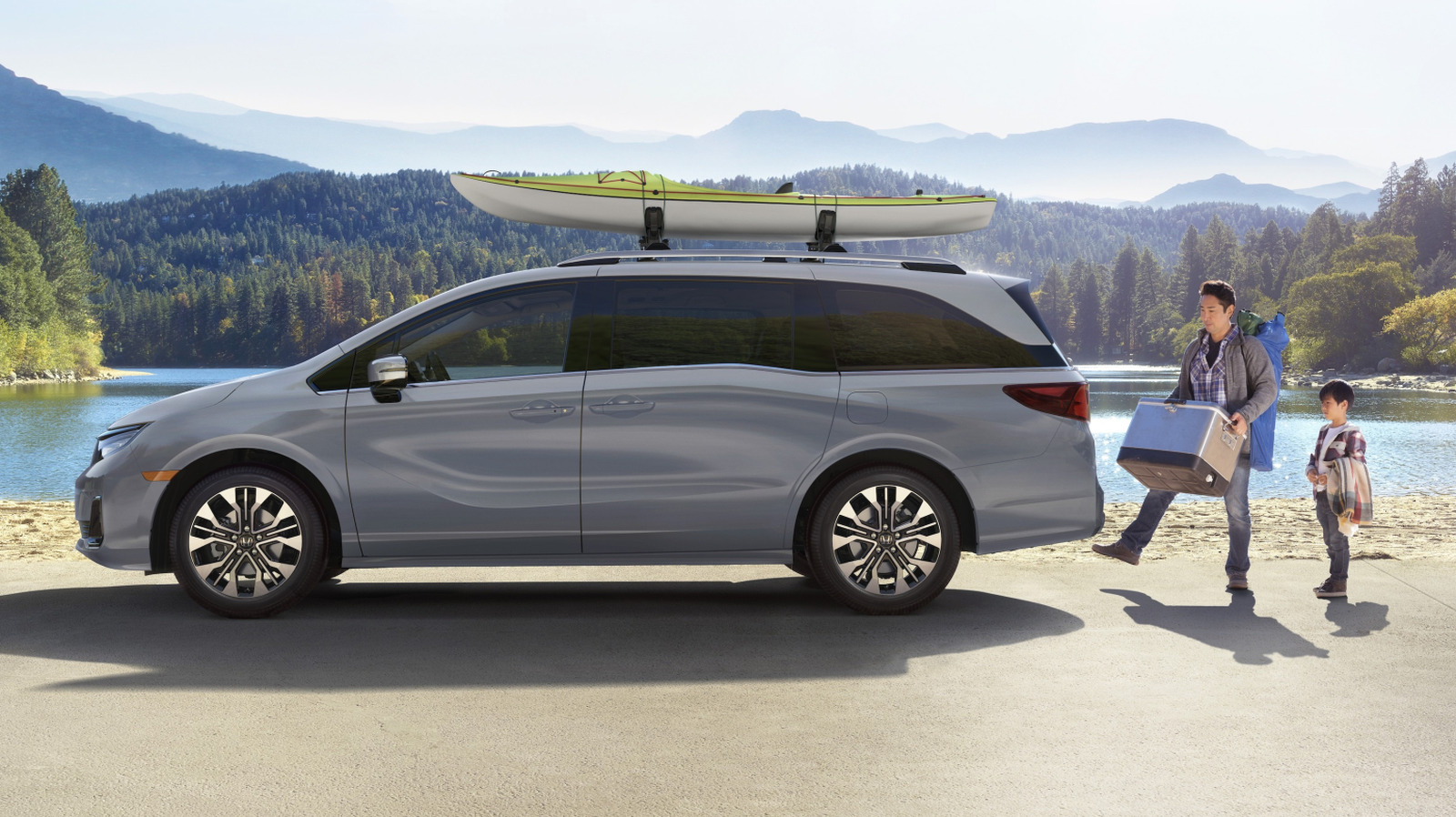
Honda Odyssey: 155.8 cu ft.
The Honda Odyssey is old school in its approach to power, and like the Pacifica, it’s one of the few minivans that’s still powered by a V6 engine. The V6 that powers the Odyssey puts out 282 hp and 260 lb-ft of torque, and on every trim level it’s paired with front-wheel drive and a 10-speed automatic transmission. That means the EPA fuel economy estimates for the Honda low for the class, at just 22 mpg combined across all trims. With other minivans offering hybrid setups, the Odyssey loses some appeal for buyers who want a fuel-sipper.
Whatever philosophy guides the Odyssey to retain that powertrain, is a good one for space too. With 155.8 cu ft. of cargo space, the Odyssey beats the I.D. Buzz by over 10 cu ft. of storage. That’s more than two trunk-fulls of Mazda Miata cargo space. Honda’s second-row seats, called Magic Slide seats, can move in multiple directions, allowing for better third-row access, and the seats can be folded and removed pretty quickly, too. Prices for the 2026 Honda Odyssey range between $44,290 and $53,190 (including $1,495 destination fee), so it’s a bit mid-range amongst vans. Considering that the Odyssey’s top trim is priced several thousand dollars below the top trims of some other vans, it might be worth the trade-off required for V6 levels of fuel economy.
- Cargo space behind the first/second/third row: 38.6/91.0/155.8
- Total passenger volume: 160.1 cu ft.
Methodology
Ranking these minivans by cargo space was a pretty basic endeavor. Simply take the highest number, and work your way down from there. Headroom, legroom, and shoulder room are all notable stats, as is total passenger volume, but this list used cargo space behind the first row as its guiding light. The numbers provided by the manufacturers are measured according to the guidelines established by the Society of Automotive Engineers (SAE).
It’s also worth mentioning that these are all the maximum cargo numbers available from the vans listed here. In some cases, changing a trim level to add different seats or other optional equipment can bring the cargo space numbers down. Even the seating position of the front seats can change how much space is available in the back. But to avoid a murky sea of statistics, we funneled things down to just one set of stats for each van — the maximum space they’ve got for cargo, and the total space available for passengers.

Stephan is the sports journalist for the Maple Grove Report.