‘The Boys’ Season 5: When Does Episode 4 Come Out?


Season 5 of The Boys is here and nearly halfway done. Amazon’s hit series, inspired by the Garth Ennis and Darick Robertson comic book run and created by Eric Kripke, is back for one final run. But who’s to say if this is really the end? The Boys’ cinematic universe has grown with spinoffs like Gen V, the short-lived Diabolical animated series, and another in-development spinoff, Vought Rising, which is set to follow Soldier Boy’s backstory.

But as things stand, it looks like this will be the last clash of Homelander, Billy Butcher and their respective teams. Amazon wanted to keep the party going, but Kripke kept the story arc to five seasons, as he had originally planned (unlike, you know, Supernatural). 

All the familiar faces are back, including Antony Starr, Karl Urban, Jack Quaid, Erin Moriarty, Chace Crawford, Jessie T. Usher, Laz Alonso and Tomer Capone. Jensen Ackles makes his return as Soldier Boy; his Supernatural co-stars Jared Padalecki and Misha Collins are also set to appear in the new season.

Scroll on to learn when and where to watch The Boys season 5 and more streaming details.

Read more: Prime Video: 24 of the Best Sci-Fi TV Shows You Need to Stream Right Now

When does The Boys season 5, episode 4 come out?

Episode 4 of the final season of The Boys, titled Thought the Heavens Fall, will drop on Wednesday at 12 a.m. PT (3 a.m. ET) on Prime Video. Each Wednesday after, a new episode will drop until the finale, which is scheduled to hit streaming on May 20.

Here’s the complete episode schedule:

  • Episode 1: Fifteen Inches of Sheer Dynamite — April 8
  • Episode 2: Teenage Kix  April 8
  • Episode 3: Every One of You Sons of Bitches — April 15
  • Episode 4: Though the Heavens Fall — April 22
  • Episode 5: One-Shots — April 29
  • Episode 6: King of Hell — May 6
  • Episode 7: The Frenchman, the Female and the Man Called Mother’s Milk — May 13
  • Episode 8: Blood and Bone — May 20

Prime Video is one of the membership perks of Amazon Prime, which costs $15 a month or $139 a year. If you’d like a membership but don’t want Amazon Prime, you can get it for $9 a month. 

James Martin/CNET

Prime Video’s standard service comes with ad breaks for US viewers. If you want to go ad-free, there’s an additional $5 monthly fee. This option is available to both Amazon Prime subscribers and those with a standalone Prime Video membership. For more information about the streamer, check out our review.

How to watch The Boys season 5 with a VPN

If you’re traveling abroad and want to watch The Boys while away from home, a VPN can help enhance your privacy and security when streaming. 

It encrypts your traffic and prevents your internet service provider from throttling your speeds. Additionally, it can be helpful when connecting to public Wi-Fi networks while traveling, providing an extra layer of protection for your devices and logins. VPNs are legal in many countries, including the US and Canada, and can be used for legitimate purposes such as improving online privacy and security. 

However, some streaming services may have policies restricting VPN use to access region-specific content. If you’re considering a VPN for streaming, check the platform’s terms of service to ensure compliance. 

If you choose to use a VPN, follow the provider’s installation instructions to ensure you’re connected securely and in compliance with applicable laws and service agreements. Some streaming platforms may block access when a VPN is detected, so verifying if your streaming subscription allows VPN use is crucial.

James Martin/CNET

ExpressVPN is our current best VPN pick for people who want a reliable and safe VPN, and it works on a variety of devices. Prices start at $3.49 a month on a two-year plan for the service’s Basic tier.

Note that ExpressVPN offers a 30-day money-back guarantee.

If you choose to use a VPN, follow the provider’s installation instructions, ensuring you’re connected securely and in compliance with applicable laws and service agreements. Some streaming platforms may block access when a VPN is detected, so verifying if your streaming subscription allows VPN usage is crucial.


Source link

Leave a Reply

Subscribe to Our Newsletter

Get our latest articles delivered straight to your inbox. No spam, we promise.

Recent Reviews


In the ever-shifting geopolitical sphere, China’s growing military presence and the ongoing tensions over Taiwan and the South China Sea continue to be a closely watched topic — particularly in regard to China’s ambition for naval power. In recent years, much speculation has been made over the country’s rapid military development, including the capabilities of the newest Chinese amphibious assault ships.

While there’s no denying its military advancements and buildup, much has been made about the logistical and military difficulties that China’s People’s Liberation Army (PLA) would face if it launched an amphibious invasion of Taiwan. However, there’s growing concern that if a Taiwan invasion were to happen, it wouldn’t just be military vessels taking part in the action, but a fleet of commercial vessels, too — including a massive new car ferries that could quickly be repurposed into valuable military transports.

While the possibility of the PLA using commercial vessels for military operations has always been on the table for a potential Taiwan invasion, the scale with which China has been expanding its commercial shipbuilding industry has become a big factor in the PLA’s projection of logistical and military power across the Taiwan Strait. It’s also raised ethical concerns over the idea of putting merchant-marked ships into combat use.

From car ferry to military transport

The rapid growth of modern Chinese industrial capacity is well known, with Chinese electric vehicle factories now able to build a new car every 60 seconds. Likewise, China has developed a massive shipbuilding industry over the last 25 years, with the country now making up more than half of the world’s shipbuilding output. It’s from those two sectors where China’s latest vehicle-carrying super vessels are emerging. 

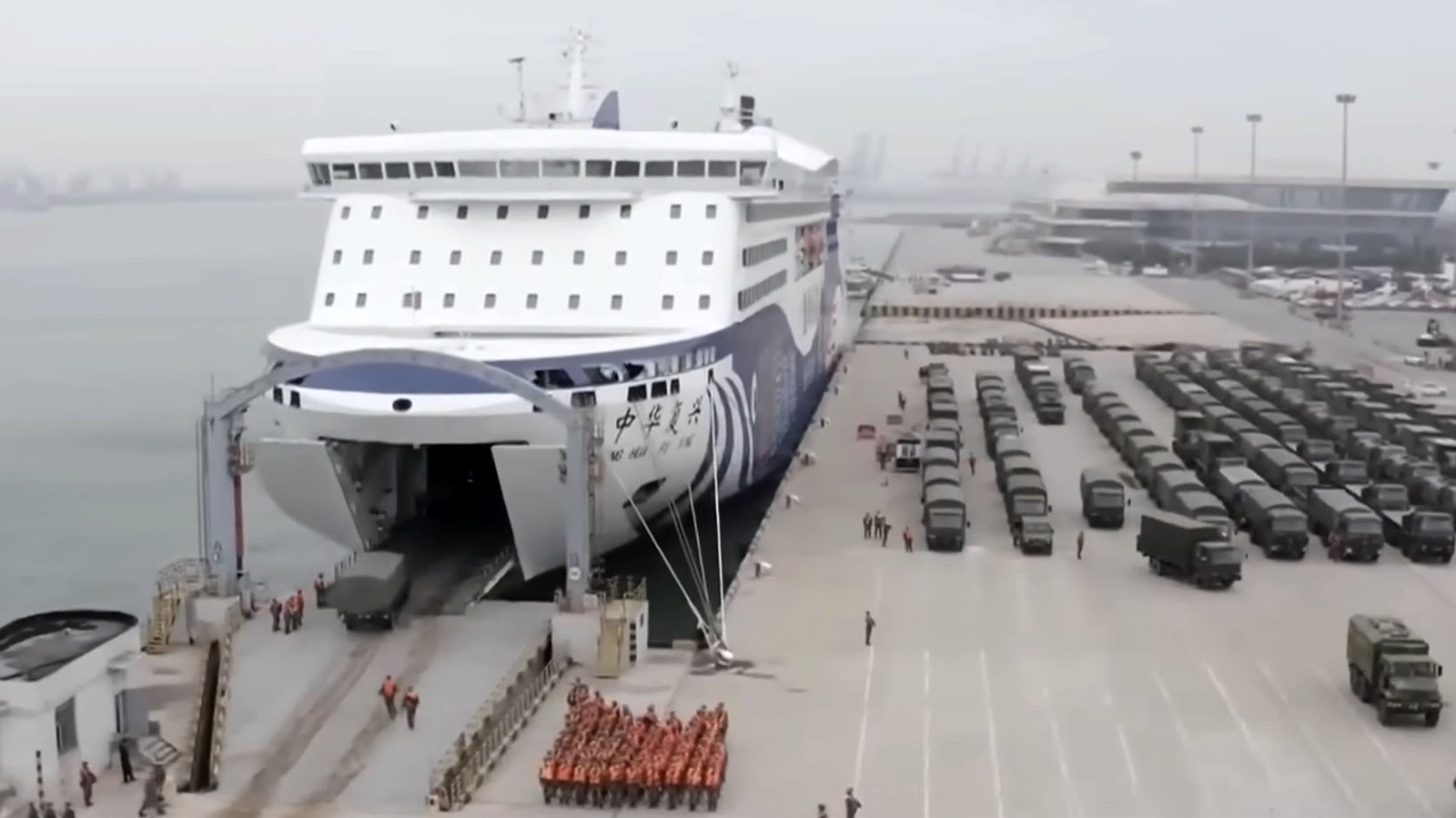
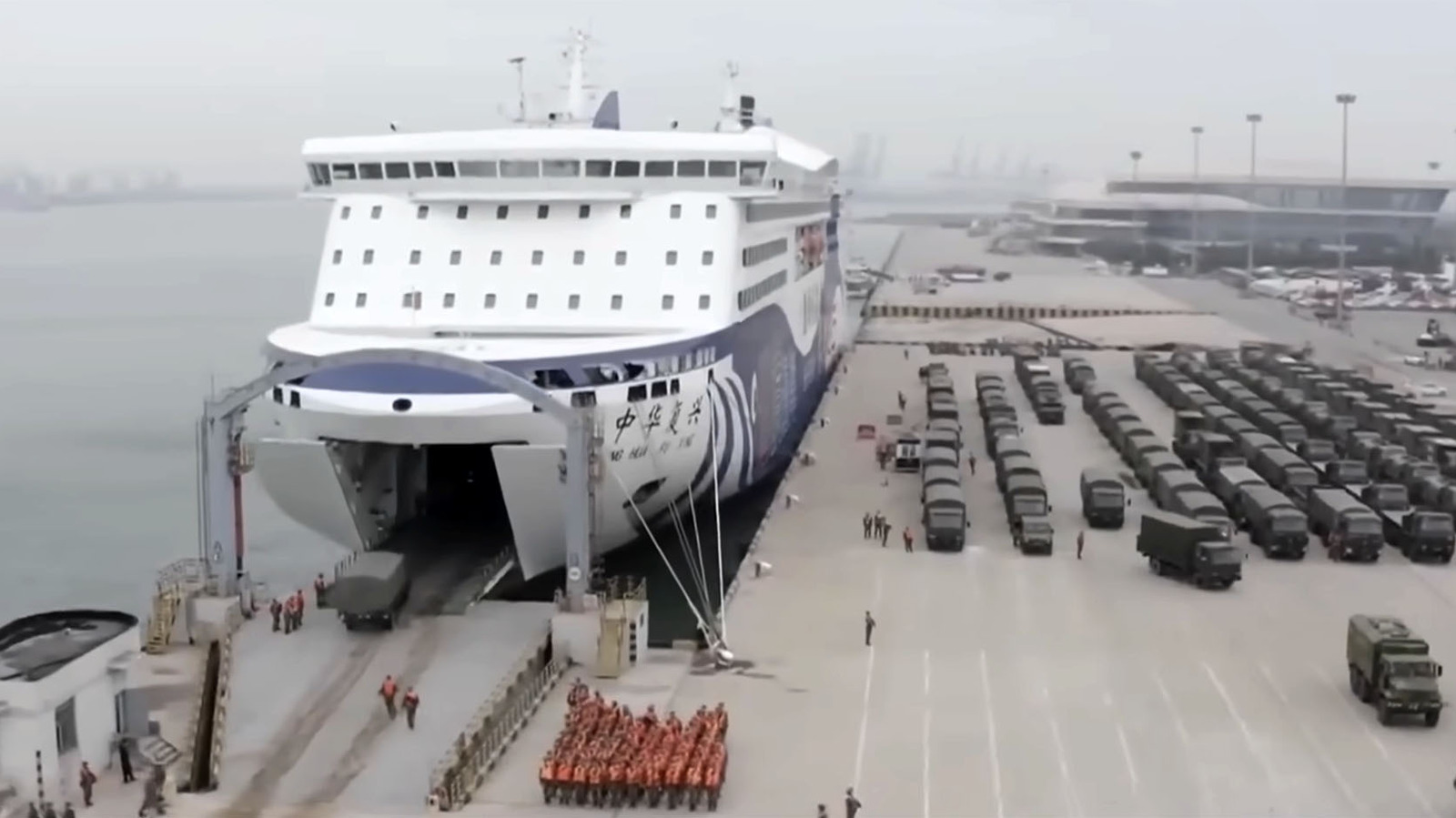
With a capacity to carry over 10,000 new vehicles for transport from factories in Asia to destinations around the world, these ships, known as roll-on/roll-off (Ro-Ro) ferries, are now the biggest of their type in the world. The concept of the PLA putting civilian ferries into military use is not a new one, or even an idea China is trying to hide. Back in 2021, China held a public military exercise where a civilian ferry was used to transport both troops and a whole arsenal of military vehicles, including main battle tanks.

The relatively limited conventional naval lift capacity of the PLA is something that’s been pointed out while game-planning a Chinese amphibious move on Taiwan, and it’s widely expected that the PLA would lean on repurposed civilian vessels to boost its ability to move soldiers and vehicles across the Taiwan Strait. With these newer, high-capacity Ro-Ro ferries added to the fleet, the PLA’s amphibious capacity and reach could grow significantly.

A makeshift amphibious assault ship

However, even with the added capacity of these massive ferries, military analysts have pointed out that Ro-Ro ships would not be able to deploy vehicles and soliders directly onto a beach the way a purpose-built military amphibious assault ship can. Traditionally, to deploy vehicles from these ships, the PLA would first need to capture and then repurpose Taiwan’s existing commercial port facilities into unloading bases for military vehicles and equipment.

However, maybe most alarming is that satellite imagery and U.S. Intelligence reports show that, along with increasing ferry production output, the PLA is also working on a system of barges and floating dock structures to help turn these civilian ferries into more efficient military transports. With this supporting equipment in place, ferries may not need to use existing port infrastructure to bring their equipment on shore.

Beyond the general military concern over China’s growing amphibious capability, there are also ethical concerns if China is planning to rapidly put a fleet of civilian merchant vessels into military service. If the PLA were to deploy these dual-purpose vessels into direct military operations, the United States and its allies would likely be forced to treat civilian-presenting ships as enemy combatants. On top of all the other strategic challenges a Taiwan invasion would bring, the U.S. having to navigate the blurred legal lines between military and merchant vessels could potentially give China a strategic advantage amidst the fog of war.


Source link