Minnesota water is at risk as mining expands


In Minnesota, water connects us all. It runs through small-town taps, wild rice beds, trout streams, and the quiet inlets of the Boundary Waters. It links the Iron Range to Duluth and Lake Superior, the St. Croix to the Mississippi, and everyone who calls this state home. Water sustains us — and right now, it needs our protection.

That’s why organizations across Minnesota have come together to speak with a shared voice about what’s at stake.

Minnesota’s clean water is under growing threat from multiple proposed sulfide ore mining projects that promise economic benefits but carry significant long-term risks. Transnational companies like Twin Metals/Antofagosta, NewRange/Glencore, Tamarack Mine/Talon Metals/Rio Tinto, and Green Bridge Metals are proposing mines in four of our state’s most important and sensitive watersheds — the Mississippi River, St. Croix River, Rainy River (Boundary Waters) and St. Louis River (Lake Superior). 

Related: Minnesota water advocates lament Senate vote to remove mining moratorium on Boundary Waters watershed

These are the sources of drinking water, recreation, habitat, economic vitality and cultural lifeways for people across the state. Once contaminated, it may take centuries to heal, if at all.

Mine proponents say they can extract minerals safely. But science and experience tell a different story: The U.S. Environmental Protection Agency identifies sulfide ore mining as one of the country’s most toxic industries. This type of mining has a long record of causing toxic pollution, including acid mine and heavy metal drainage that can poison fish, wildlife and communities for many generations. In state after state, the risks have proven real, and the consequences have often fallen on the people and waters downstream

The stakes in Minnesota are simply too high to gamble with.

In honor of Earth Day, organizations and tribal nations across Minnesota stand together to affirm six shared principles we believe should guide every decision about our waters:

  • Water cares for us. It is the foundation of life.
  • Water is vulnerable. Once polluted by acid and toxic metals released from sulfide ore mining, surface water and groundwater may never recover.
  • Water protects our health. What we pour into it, we pour into ourselves.
  • Water is a shared responsibility. From towns to cities and Tribal Nations, we all have a duty to protect clean water.
  • Water cannot be replaced. Fresh water is limited. As demand grows for minerals used in electric vehicles, data centers, artificial intelligence and defense infrastructure, pressure to mine in sensitive watersheds grows with it.
  • Water connects us. Surface water and groundwater in Minnesota link us to our neighbors across communities, states, and generations.

Tribal nations within Minnesota have protected these waters for generations, and their stewardship reminds us that caring for water is a shared responsibility. When we protect clean water, we protect the health of our communities, the future of our children, and the places and resources that make Minnesota home.

We advocate for rigorous scientific review, respect for tribal sovereignty and public accountability in any decision that could put Minnesota’s clean water at risk. Clean water is Minnesota’s inheritance, not an expendable resource for short-term profit.

Related: Minnesota’s Boundary Waters is not a place to experiment with mining

Earth Day reminds us that protecting our inherited water means making the right decisions today to prevent long-term damage. We call upon our state leaders, regulators, communities and all Minnesotans to listen to what our water is telling us. We cannot be the generation that lets pollution flow downstream with regret in its wake.

We can choose a different path. One that honors our shared responsibility and shared future. We invite all who share these principles to join us in protecting Minnesota’s waters for generations to come.

This MinnPost Voices commentary was written by Kelly Applegate, commissioner of natural resources for the Mille Lacs Band of Ojibwe, who also represents Water Over Nickel, on behalf of the following organizations: Minnesota Center for Environmental Advocacy, Water Over Nickel, Friends of the Boundary Waters, Friends of the Cloquet Valley State Forest, Tamarack Water Alliance, Friends of the Mississippi River, Duluth for Clean Water, Clean Water Action Minnesota, CURE, Center for Biological Diversity , Save Lake Superior Association, Save Our Sky Blue Waters and Save the Boundary Waters.


Source link

Leave a Reply

Subscribe to Our Newsletter

Get our latest articles delivered straight to your inbox. No spam, we promise.

Recent Reviews


In the ever-shifting geopolitical sphere, China’s growing military presence and the ongoing tensions over Taiwan and the South China Sea continue to be a closely watched topic — particularly in regard to China’s ambition for naval power. In recent years, much speculation has been made over the country’s rapid military development, including the capabilities of the newest Chinese amphibious assault ships.

While there’s no denying its military advancements and buildup, much has been made about the logistical and military difficulties that China’s People’s Liberation Army (PLA) would face if it launched an amphibious invasion of Taiwan. However, there’s growing concern that if a Taiwan invasion were to happen, it wouldn’t just be military vessels taking part in the action, but a fleet of commercial vessels, too — including a massive new car ferries that could quickly be repurposed into valuable military transports.

While the possibility of the PLA using commercial vessels for military operations has always been on the table for a potential Taiwan invasion, the scale with which China has been expanding its commercial shipbuilding industry has become a big factor in the PLA’s projection of logistical and military power across the Taiwan Strait. It’s also raised ethical concerns over the idea of putting merchant-marked ships into combat use.

From car ferry to military transport

The rapid growth of modern Chinese industrial capacity is well known, with Chinese electric vehicle factories now able to build a new car every 60 seconds. Likewise, China has developed a massive shipbuilding industry over the last 25 years, with the country now making up more than half of the world’s shipbuilding output. It’s from those two sectors where China’s latest vehicle-carrying super vessels are emerging. 

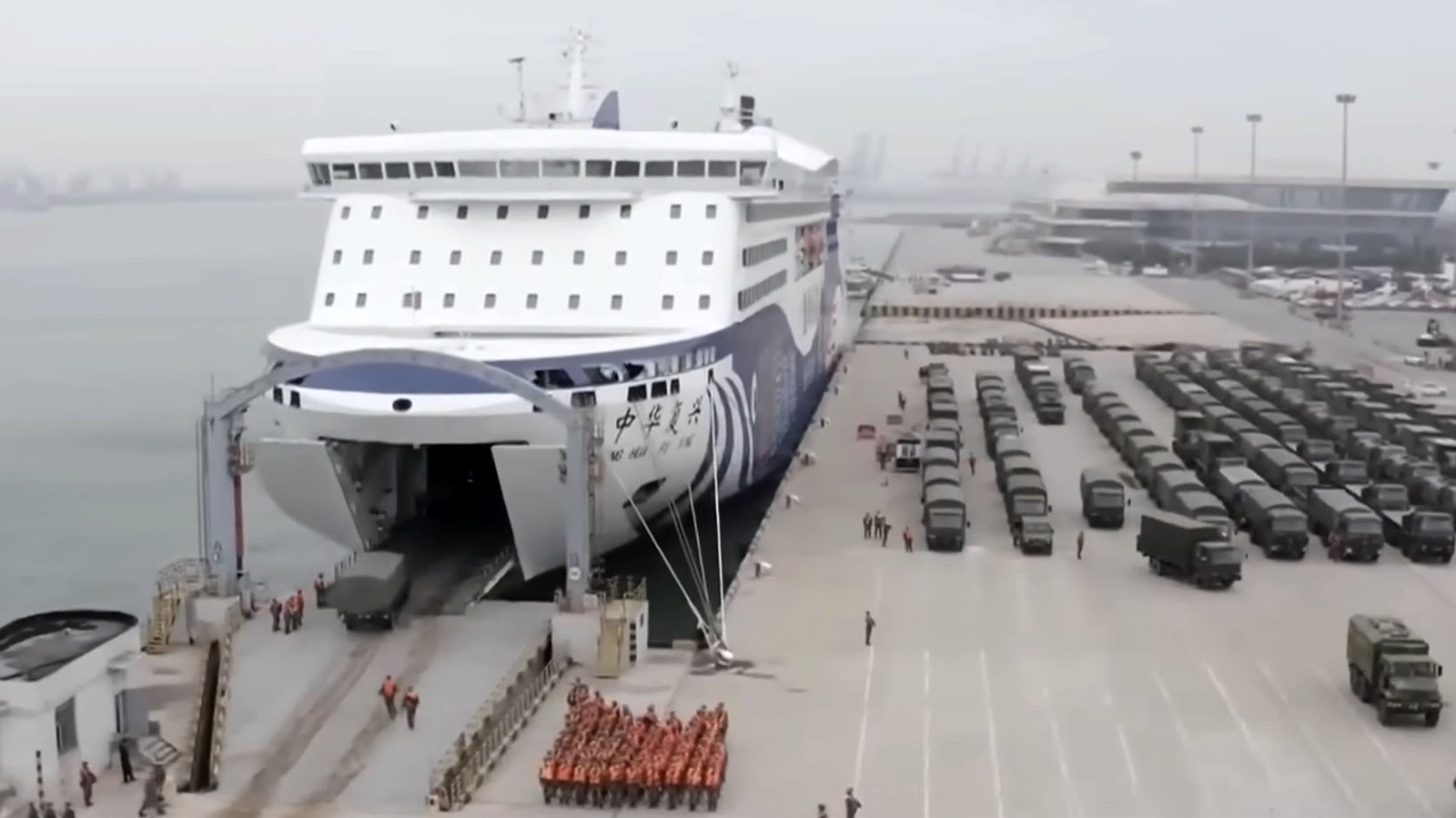
With a capacity to carry over 10,000 new vehicles for transport from factories in Asia to destinations around the world, these ships, known as roll-on/roll-off (Ro-Ro) ferries, are now the biggest of their type in the world. The concept of the PLA putting civilian ferries into military use is not a new one, or even an idea China is trying to hide. Back in 2021, China held a public military exercise where a civilian ferry was used to transport both troops and a whole arsenal of military vehicles, including main battle tanks.

The relatively limited conventional naval lift capacity of the PLA is something that’s been pointed out while game-planning a Chinese amphibious move on Taiwan, and it’s widely expected that the PLA would lean on repurposed civilian vessels to boost its ability to move soldiers and vehicles across the Taiwan Strait. With these newer, high-capacity Ro-Ro ferries added to the fleet, the PLA’s amphibious capacity and reach could grow significantly.

A makeshift amphibious assault ship

However, even with the added capacity of these massive ferries, military analysts have pointed out that Ro-Ro ships would not be able to deploy vehicles and soliders directly onto a beach the way a purpose-built military amphibious assault ship can. Traditionally, to deploy vehicles from these ships, the PLA would first need to capture and then repurpose Taiwan’s existing commercial port facilities into unloading bases for military vehicles and equipment.

However, maybe most alarming is that satellite imagery and U.S. Intelligence reports show that, along with increasing ferry production output, the PLA is also working on a system of barges and floating dock structures to help turn these civilian ferries into more efficient military transports. With this supporting equipment in place, ferries may not need to use existing port infrastructure to bring their equipment on shore.

Beyond the general military concern over China’s growing amphibious capability, there are also ethical concerns if China is planning to rapidly put a fleet of civilian merchant vessels into military service. If the PLA were to deploy these dual-purpose vessels into direct military operations, the United States and its allies would likely be forced to treat civilian-presenting ships as enemy combatants. On top of all the other strategic challenges a Taiwan invasion would bring, the U.S. having to navigate the blurred legal lines between military and merchant vessels could potentially give China a strategic advantage amidst the fog of war.


Source link