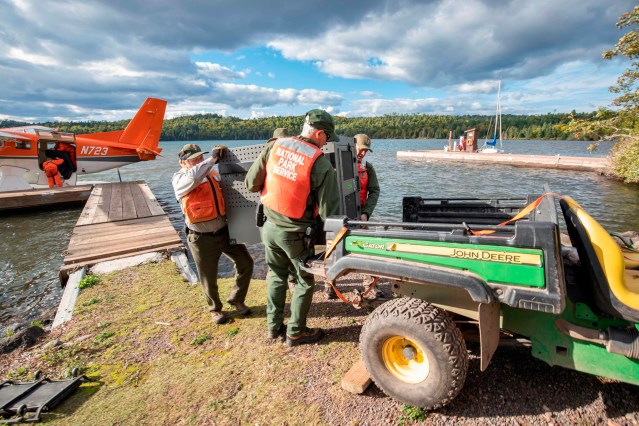
Wolves on a remote island in Lake Superior appear to be thriving, but they’re making deep dents in the moose population that they rely on as a leading food source, according to a report released Monday.
Isle Royale is a 134,000-acre (54,200-hectare) national park in far western Lake Superior between Grand Marais, Minnesota, and Thunder Bay, Canada. The island is a natural laboratory, offering scientists a rare opportunity to observe wolves and moose largely free from human influence.
Related: Wolves in Ely spark debate about their protected status
Researchers have conducted wolf and moose population surveys on the island since 1958. The surveys had been an annual winter event when the roadless island is closed to visitors, but researchers have run into obstacles in recent years.
The pandemic in 2021 forced scientists to cancel the survey for the first time. The National Park Service ordered researchers to evacuate the island during their 2024 winter survey after weeks of unusually warm weather left the ice surrounding the island unsafe for ski-plane landings. Researchers rely on the planes for easier wildlife tracking but the island has no runway, forcing them to land on iced-over Lake Superior. Things didn’t go much better last year when researchers were forced to scrap the effort after their pilot suffered a last-minute medical issue.

But this year a team of researchers led by scientists from Michigan Tech University were able to conduct a survey from Jan. 22 through March 3. Their findings led them to estimate the island’s wolf population at 37 animals. Data gathered before researchers evacuated in 2024 showed the population at 30.
The 2026 estimates are the highest since the late 1970s and represent a marked improvement since the population dwindled to just two wolves a decade ago. Researchers believe inbreeding led to depressed survival rates in pups.
Related: Stauber leading effort to strip protections from the gray wolf
The island’s moose population, though, is declining dramatically. This year’s survey put the population at 524 moose, down 75% from a high of 2,000 in 2019. Wolves likely killed almost a quarter of the moose population over the last year, scientists estimated. For the first time in almost 70 years, researchers observed no moose calves during the winter survey.
Sarah Hoy, a Michigan Tech researcher who specializes in predator-prey interactions and one of the survey’s co-leaders, said scientists had to brave wind chills that dipped to minus 50 degrees Fahrenheit (minus 45.5 Celsius) and it was difficult to keep warm with the woodstoves in their cabins.
But clear skies facilitated exceptional observations. The scientists spotted wolves on all but one survey flight, she said. One of the highlights was watching a pack snuggle up together on the ice on Valentine’s Day, she said.
“It’s always such a privilege to get to see wolves interacting, witnessing courtship behavior, pups playfully tugging on each other’s tails, or a pack working together to take down a moose,” she said.
Scientists plan to conduct summer research on the island with an eye toward how the burgeoning wolf packs can maintain balance with the rest of the ecosystem.
Related