


There are certain engine technologies that seem to make a lot of sense, until you scratch beneath the surface just a little. Desmodromic valvetrains are one such technology. To be fair, this is more of a case of a solution that once made sense, but advances in engine technology have overtaken it.
Before we look at why desmodromic valvetrains are so rarely used in motorcycles, it helps to understand just what they are and why they were developed. Basically, these systems negate the need for springs to close the engine’s valves. Rather, it uses a set of cam lobes and rocker arms to mechanically force them shut. If you’re thinking that this sounds like a more complex solution than a simple spring setup, then you can start to see why they’re a rarity. But, on the plus side, the desmodromic valvetrain has been behind some of the best-sounding motorcycles ever.
However, this wasn’t a case of adding complexity for complexity’s sake — there was a very good reason for developing such a system, “was” being a key word here. Historically, spring-controlled valve systems, when paired with high-revving bike engines, suffered from a condition known as valve float. This usually happens at high revs when the springs are unable to close the springs fast enough. They also had an unfortunate tendency to break and destroy engines. Ducati was one of the early pioneers of the system and is now the only manufacturer still using the system.
Desmodromic valvetrains: An open and shut case?
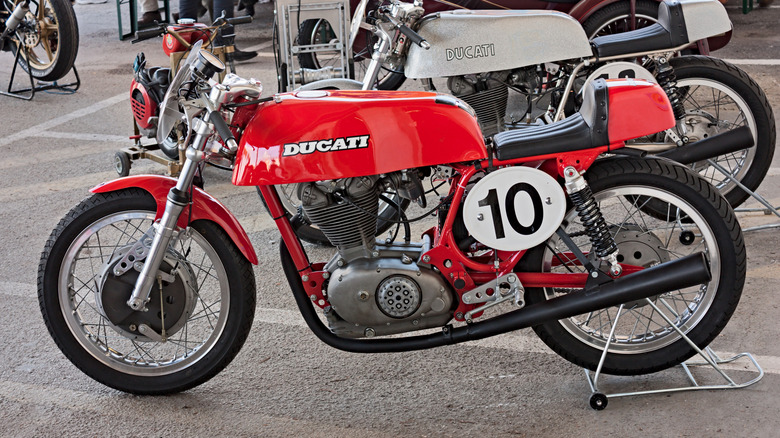
Desmodromic valvetrains are complicated. This statement is really the crux of the matter; adding complexity for complexity’s sake is not good engineering practice. However, when the desmodromic system made its Ducati debut on the 125 Desmo Grand Prix in 1956, the story was different. The valvetrain was responsible for a notable boost that allowed the engine to rev up to 13,000 rpm without losing performance.
As engine technology improved, these advantages have eroded. What is left is the added complexity without the associated performance boost. Even Ducati, the long-time champion of desmodromic valvetrains, no longer uses it on all its models.
In November 2020, the company unveiled its new Multistrada V4 motorcycle, one of the most popular motorcycles for larger riders. This was the first Ducati to use a non-desmodromic valvetrain since the Italian manufacturer began using the system in the late 1950s. For Ducati to drop a system that’s been part a core part of its identity is a big step, and the advantages that the new engine offers go a long way to understanding why such a decision was made.
The complexities of Desmodromic valvetrains mean they are relatively maintenance-heavy, with valve adjustments required every 19,000 miles in many cases. Compare this against the valve clearance check interval of 60,000 km (about 37,000 miles) for the Multistrada, and you can begin to see why the powertrain without the desmodromic system is more appealing. The desmos might not quite be ready to be relegated to the history books, but with the company’s V2 engine also abandoning desmo, it is an increasing rarity.

Stephan is the sports journalist for the Maple Grove Report.