


Most people take the range of household appliances we use every day for granted. But each of these time-saving conveniences had a beginning, which, for many, happened a very long time ago in another place and time. Take, for instance, the two devices we use to sanitize stuff — the washing machine and the dishwasher (we’ve ranked today’s top models worst to first). Each took a very different evolutionary path, leading one to have a window, while the other did not.
Both can use extremely hot water to properly sanitize things so they’re hygienically safe to use again, producing steam and condensation that would normally block the view of anything inside the machine. While tableware remains securely “locked” in place in a dishwasher, the washing machine’s spinning drum tosses clothes around freely and constantly wipes the window clean. Additionally, seeing the clothes and the associated water level was one way to eliminate some of the guesswork from the equation, especially in early models that lacked sophisticated technology, thus making it the primary reason for the window.
One of the earliest attempts at automating the mundane task of “doing the laundry” was patented by an English chap in 1691 as a “Washing and Wringing” contraption. Many different versions came and went, most of which looked nothing like the machine we know and love today. In 1851, American inventor James King created the first “modern” washing machine with a drum that rotated via hand crank. One design that stuck around was the top-loading feature, where clothes were dropped into the top of a barrel or tub filled with water, making the entire process easy to monitor.
Spoiled by the set it and forget it feature
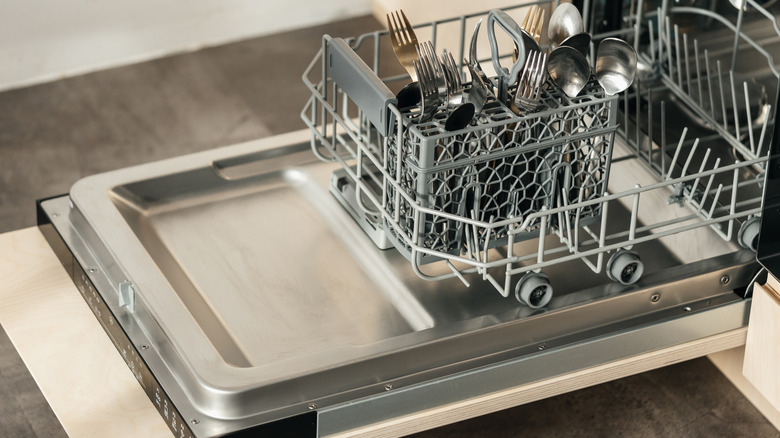
Meanwhile, one of the earliest patented versions of the dishwasher splashed onto the scene in 1850. And no, it wasn’t the inventor’s kid or spouse, but a mechanized appliance concocted by Joel Houghton. While not a huge hit, it did get other industrious minds spinning. In 1886, Josephine Garis Cochran patented the first “modern” dishwasher, a hand-cranked machine with dish racks that used water pressure to clean instead of harsh dish-breaking scrubbers.
Believe it or not, watching dishes get sparkling clean was actually considered aesthetically unappealing, but there’s a more technical reason why windows were omitted from dishwashers. Since they were more compact than washing machines, their size limited where features like detergent compartments could be placed. A dishwasher with a window could also make it more complicated to retain heat and prevent leaks. All in all, there was no real practical need for dishwashers to come with windows. However, washing machines took a different path once front-loading designs came onto the scene.
It wasn’t until 1937 that American John Chamberlain (working for Bendix Aviation Corporation) built the first machine that automatically washed, rinsed, and spun clothes dry in a single cycle. It was also the first to feature a front-loading design, creating a whole new dilemma: the water level still needed to be monitored. So, Chamberlain installed a see-through window. What’s more, flailing clothes — delicate or otherwise — can easily cause issues that may need to be addressed (i.e., getting tangled), so having a way to peek inside without interrupting the cleaning cycle is still smart. It was a huge success and was quickly adopted as a standard design feature that even the best front-load washer brands use today.

Stephan is the sports journalist for the Maple Grove Report.