The South’s 3 Secret Beach Escapes Worth The Trip This Summer


Share The Article

Whether you’re old school and call it the Gulf of Mexico or have caved to its updated name, the Gulf of America, there’s one stretch between Galveston and Mississippi’s ever-so-trendy coastal hotspots you likely have never uttered:

The Gulf of Louisiana.
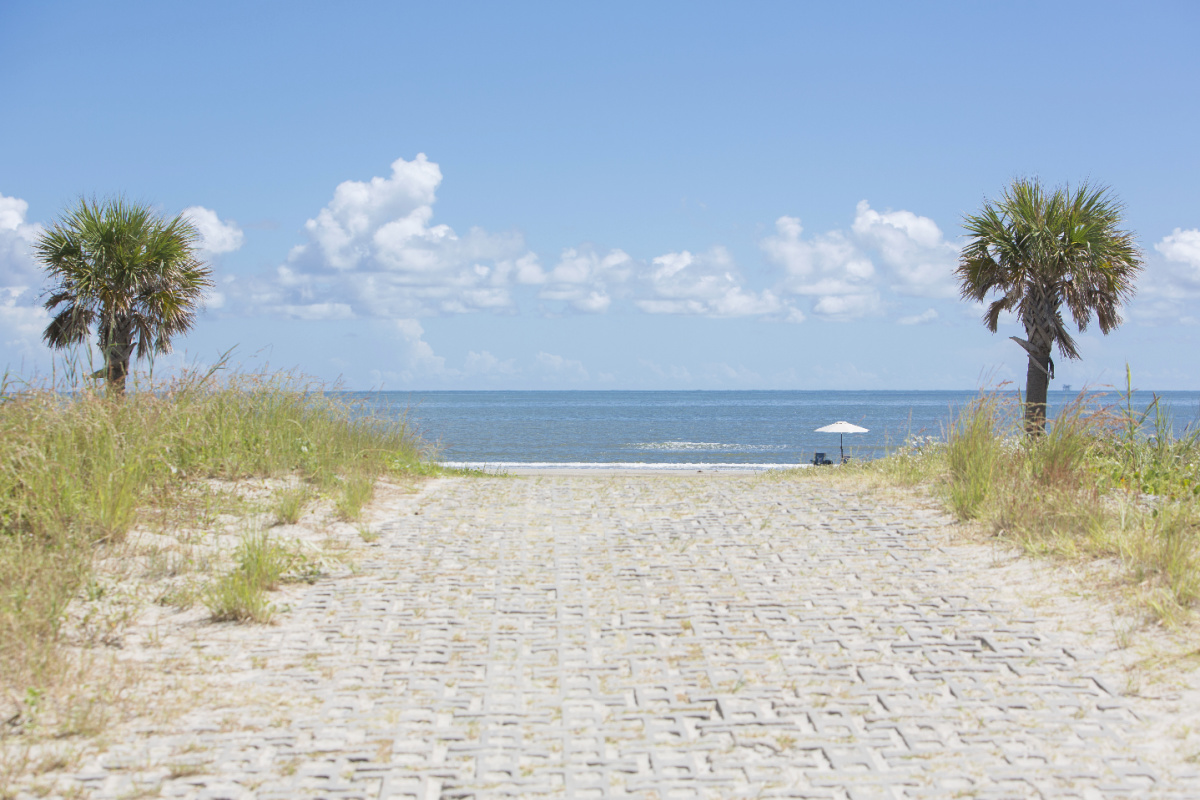
Paved pathway to Louisiana beach

It’s true — the land of Mardi Gras, untamed swamplands, and crawfish boils does indeed have beaches, and very pretty ones at that.

The Bayou State isn’t just lakes and rivers; there are hidden beach towns just as enticing, if not more, than its neighbors to the east and west.

But anything beats Galveston, amirite?

Local experts recently highlighted Louisiana’s top beach escapes. As such, the Travel Off Path team dissected our favorites with a fine-toothed comb and we believe these 3 Gulfside hideaways deserve a loud “Who dat?” this summer.

PLUS: We’ve created an interactive quiz for you at the end of this article to find your perfect Bayou Beach match!!

Grand Isle: Louisiana’s Only Inhabited Barrier Island

Entrance to Grand Isle, Louisiana

Be sure to check the latest Travel Alerts & Entry Requirements before your trip.

Grand Isle was put on my radar when my weekly binge of the Dat Louisiana Life family swapped their houseboat hideout for Louisiana’s surprisingly clear-water beach town — at least for that day anyway…

Like some Gulf towns, water conditions can be unpredictable, where one day you can see your toes and avoid squashing hermit crabs, while others are more brackish, like that of Galveston and Mississippi.

But what makes Grand Isle special is its a full-fledged vacation destination, fully equipped for a beachfront getaway with cozy lodging and ample outdoor activities.

There are 7 miles of virtually footprint-free sand, with the exception of the few locals in the know.

Bird on scenic beach in Grand Isle, LA

But the truth is not many people are coming from outside states. It’s not that they’re not welcome; it’s just that Louisiana isn’t often viewed as a beach destination, especially after being hit hard by Katrina and overshadowed with the Superdome madness and fallout of the storm.

Grand Isle has since been restored, yet remains low-key for a relaxing vacation with less pizzazz and more memorable days spent under the sun, fishing from its 400-foot pier, camping, boating, and indulging way too much seafood.

Holly Beach: Welcome To “The Cajun Riviera”

You might think certain pockets of New Orleans or Baton Rouge feel like a “Cajun Riviera” in their own right, but it’s actually little-known Holly Beach that has adopted the moniker.

Wildflowers blooming at Holly Beach, LA

Not that there’s a laundry list of comparisons, this map-dot slice of paradise is considered to be one of Louisiana’s prettiest beaches.

For wildlife enthusiasts, it’s a great spot for birdwatching, since that’s practically become the new Pokémon Go, as well as all-day fishing and crabbing.

If there was ever a place along the Gulf to bring a metal detector, this is the place. Maybe skip the goofy attire, though.

You know who you are…

Holly Beach is particularly known for its small-town hospitality and all-but-guaranteed no-crowd coastline.
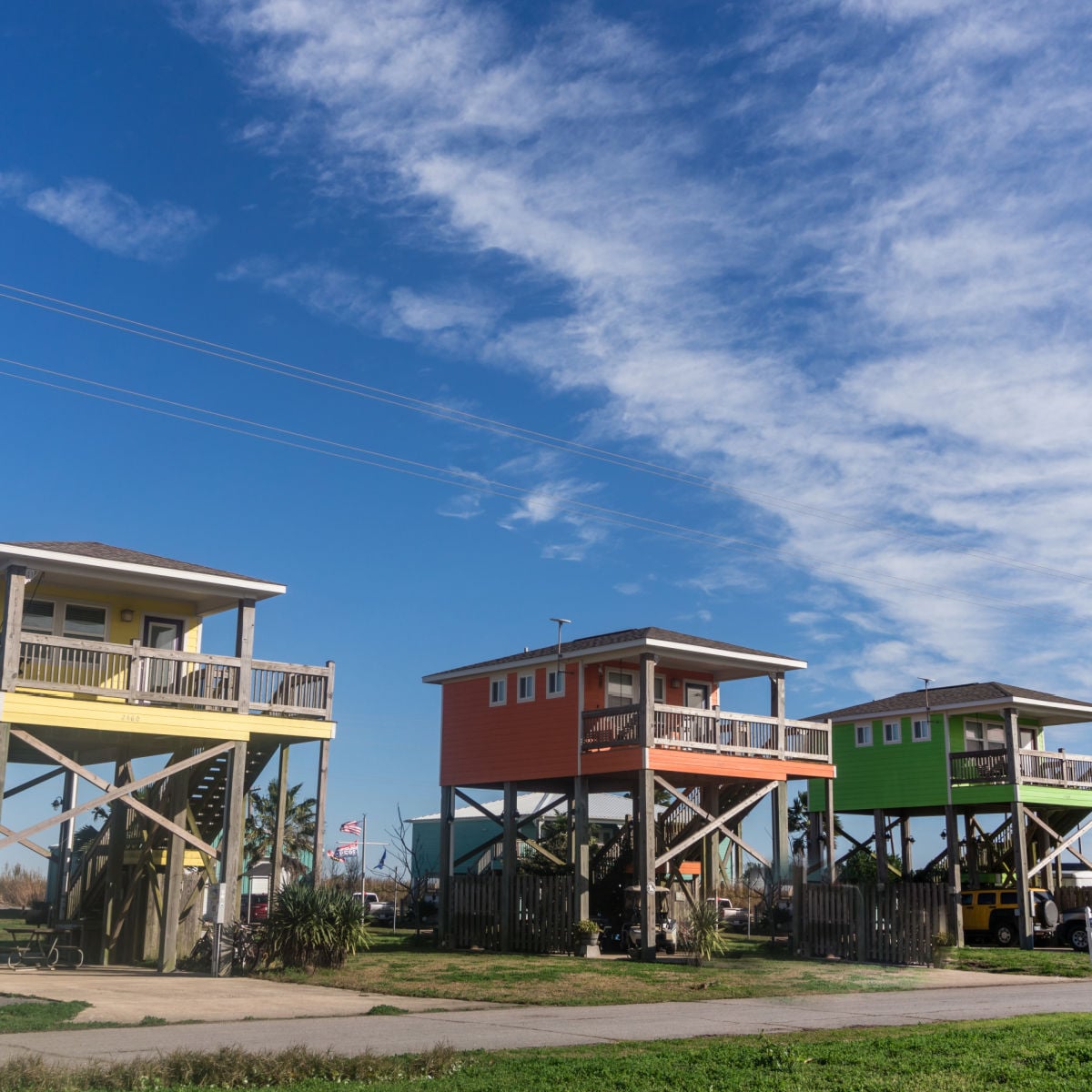
Colorful stilt homes - Holly Beach, LA

As such, if you’re tired of spending your summers elbow-to-elbow in Destin, Panama City, or even what’s becoming of Mississippi right now, Holly Beach is on the flip side of the spectrum.

With the only “hotel” being an RV resort, your best bet for a weekend getaway is booking one of many vacation rentals in a colorful stilt home, unless you brought your apartment on wheels for a road trip.

Speaking of getting here, this Gulf oasis is actually more convenient to reach from Houston than from New Orleans, as it’s located just across the Texas-Louisiana line.

Fontainebleau Beach: New Orleans’ Secret State Park Is A Must-Visit

View of Lake Pontchartrain from Fontainebleau State Park

Next time you find yourself dreaming of beignets and po’boys, hold off for dinner because your daytime should be spent lakeside on a secret beach that blew our minds.

Why?

Because when it comes to Louisiana in general, you think most bodies of water are off-limits due to Jurassic swamp vibes.

Have we been lied to all along?

Not exactly — but that was one of the most surprising aspects of watching the wholesome, nature-forward lifestyle depicted on Dat Louisiana Life as much as I have: swimming in rivers and lakes is deemed normal.
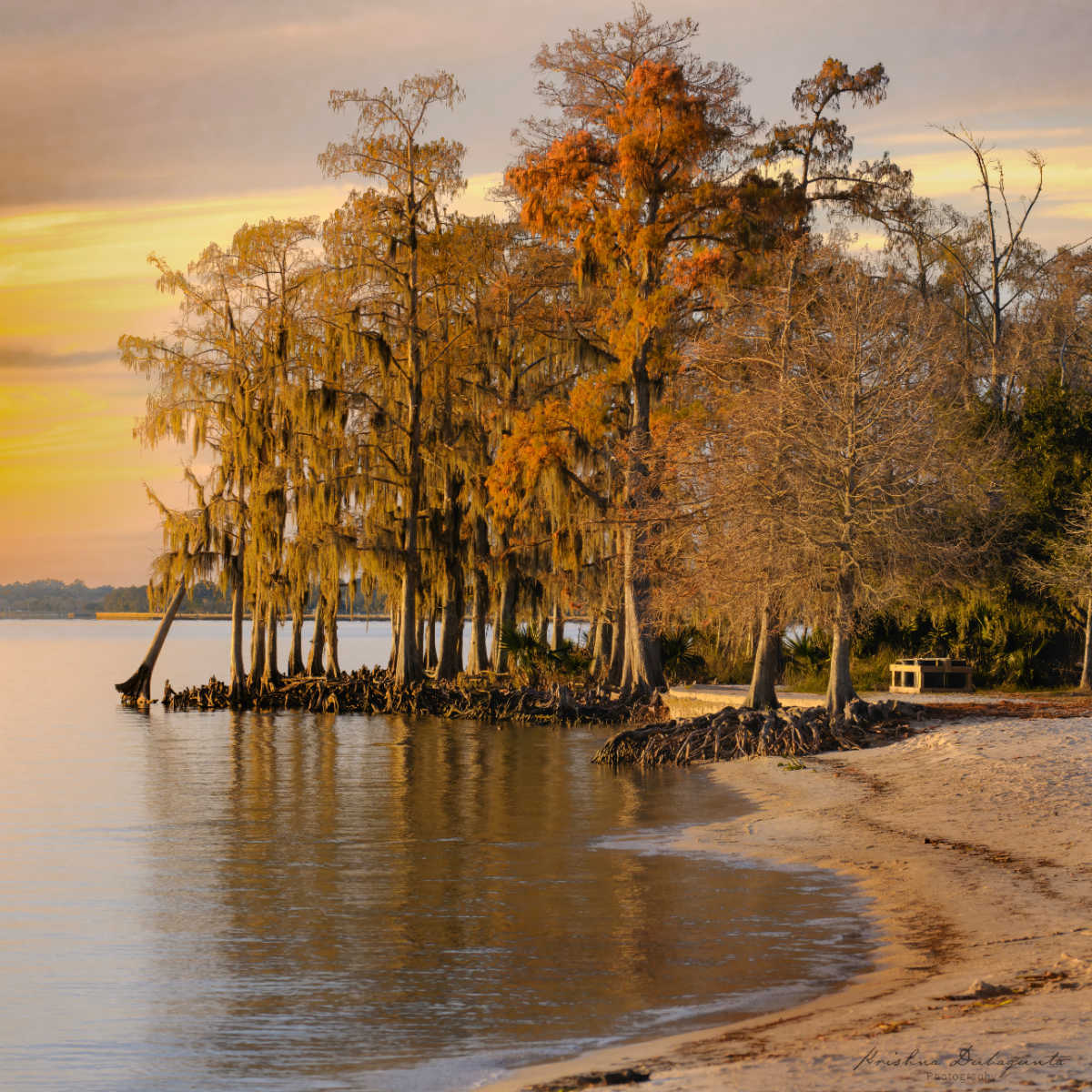
Sandy beach in Fontainebleau State Park

Our local sources claim Lake Pontchartrain boasts “white-sand beaches”, where you can sit back and relax or swim in the warm water as sailboats breeze by.

Located within Fontainebleau State Park, Fontainebleau Beach is one of Louisiana’s most scenic hideaways, perfect for sunbathing and wading to beat the South’s notorious summer humidity.

That said, yes, gators still play a vital role in the ecosystem, so you do want to keep your wits about you, but the park is still promoted and described as a safe swimming spot.

The park is located across the sprawling Lake Pontchartrain on the opposite side of New Orleans, making for a fun, unexpected day trip many tourists skimp over.


Now take this quiz to find your perfect Bayou Beach match!

Question 1 of 4

What is your ideal scenery?


Question 2 of 4

Choose your primary activity:


Question 3 of 4

Which logic fits your trip?


Final Question

Pick your hidden gem vibe:


🐚

Grand Isle

Louisiana’s Barrier Gem

Why: You want a full-service beach getaway.

Pro Tip: Visit the 400-foot pier for world-class fishing or camp right on the 7-mile stretch of sand.

🏘️

Holly Beach

The “Cajun Riviera”

Why: You crave small-town hospitality and a crowd-free coastline.

Pro Tip: Rent a colorful stilt home and bring a metal detector—this spot is famous for coastal treasures.

🌲

Fontainebleau Beach

The Secret Lakefront Hideaway

Why: You want a nature-forward escape conveniently located near New Orleans.

Pro Tip: Head across Lake Pontchartrain for white-sand swimming that defies the typical swamp reputation.


Source link

Leave a Reply

Subscribe to Our Newsletter

Get our latest articles delivered straight to your inbox. No spam, we promise.

Recent Reviews


There are a ton of laptops on the market at any given moment and almost all of those models are available in multiple configurations to match your performance and budget needs. If you’re feeling overwhelmed with options when looking for a new laptop, it’s understandable. To help simplify things for you, here are the main things you should consider when you start looking.

Price

The search for a new laptop for most people starts with price. If the statistics that chipmaker Intel and PC manufacturers hurl at us are correct, you’ll be holding onto your next laptop for at least three years. If you can afford to stretch your budget a little to get better specs, do it. That stands whether you’re spending $500 or more than $1,000. In the past, you could get away with spending less upfront with an eye toward upgrading memory and storage in the future. Laptop makers are increasingly moving away from making components easily upgradable, so again, it’s best to get as much laptop as you can afford from the start.

Generally speaking, the more you spend, the better the laptop. That could mean better components for faster performance, a nicer display, sturdier build quality, a smaller or lighter design from higher-end materials or even a more comfortable keyboard. All of these things add to the cost of a laptop. I’d love to say $500 will get you a powerful gaming laptop, for example, but that’s not the case. Right now, the sweet spot for a reliable laptop that handles average work, home office or school tasks is between $700 and $800 and a reasonable model for creative work or gaming is upward of about $1,000. The key is to look for discounts on models in all price ranges so you can get more laptop capabilities for less.

Operating system

Choosing an operating system is part personal preference and part budget. For the most part, Microsoft Windows and Apple MacOS do the same things (save for gaming, where Windows is the winner), but they do them differently. Unless there’s an OS-specific application you need, get the one you feel most comfortable using. If you’re not sure which that is, head to an Apple store or a local electronics store and test them out. Or ask friends or family to let you test theirs for a bit. If you have an iPhone or iPad and like it, chances are you’ll like MacOS, too.

In price and variety (and PC gaming), Windows laptops win. If you want MacOS, you’re getting a MacBook. Apple’s MacBooks regularly top our best lists, the least expensive one is the M1 MacBook Air for $999. It is regularly discounted to $750 or $800, but if you want a cheaper MacBook, you’ll have to consider older refurbished ones.

Windows laptops can be found for as little as a couple of hundred dollars and come in all manner of sizes and designs. Granted, we’d be hard-pressed to find a $200 laptop we’d give a full-throated recommendation to but if you need a laptop for online shopping, email and word processing, they exist.

If you are on a tight budget, consider a Chromebook. ChromeOS is a different experience than Windows; make sure the applications you need have a Chrome, Android or Linux app before making the leap. If you spend most of your time roaming the web, writing, streaming video or using cloud-gaming services, they’re a good fit.

Size

Remember to consider whether having a lighter, thinner laptop or a touchscreen laptop with a good battery life will be important to you in the future. Size is primarily determined by the screen — hello, laws of physics — which in turn factors into battery size, laptop thickness, weight and price. Keep in mind other physics-related characteristics, such as an ultrathin laptop isn’t necessarily lighter than a thick one, you can’t expect a wide array of connections on a small or ultrathin model and so on.

Screen

When deciding on a screen, there are a myriad number of considerations, like how much you need to display (which is surprisingly more about resolution than screen size), what types of content you’ll be looking at and whether you’ll be using it for gaming or creative work.

You really want to optimize pixel density; that is, the number of pixels per inch the screen can display. Although other factors contribute to sharpness, a higher pixel density usually means a sharper rendering of text and interface elements. (You can easily calculate the pixel density of any screen at DPI Calculator if you don’t feel like doing the math, and you can also find out what math you need to do there.) I recommend a dot pitch of at least 100 pixels per inch as a rule of thumb.

Because of the way Windows and MacOS scale for the display, you’re frequently better off with a higher resolution than you’d think. You can always make things bigger on a high-resolution screen, but you can never make them smaller — to fit more content in the view — on a low-resolution screen. This is why a 4K, 14-inch screen may sound like unnecessary overkill but may not be if you need to, say, view a wide spreadsheet.

If you need a laptop with relatively accurate color that displays the most colors possible or that supports HDR, you can’t simply trust the specs — not because manufacturers lie, but because they usually fail to provide the necessary context to understand what the specs they quote mean. You can find a ton of detail about considerations for different types of screen uses in our monitor buying guides for general purpose monitors, creators, gamers and HDR viewing.

Processor

The processor, aka the CPU, is the brains of a laptop. Intel and AMD are the main CPU makers for Windows laptops, with Qualcomm as a new third option with its Arm-based Snapdragon X processors. Both Intel and AMD offer a staggering selection of mobile processors. Making things trickier, both manufacturers have chips designed for different laptop styles, like power-saving chips for ultraportables or faster processors for gaming laptops. Their naming conventions will let you know what type is used. You can head over to Intel or AMD for explanations so you get the performance you want. Generally speaking, the faster the processor speed and the more cores it has, the better the performance will be.

Apple makes its own chips for MacBooks, which makes things slightly more straightforward. Like Intel and AMD, you’ll still want to pay attention to the naming conventions to know what kind of performance to expect. Apple uses its M-series chipsets in Macs. The entry-level MacBook Air uses an M1 chip with an eight-core CPU and seven-core GPU. The current models have M2-series silicon that starts with an eight-core CPU and 10-core GPU and goes up to the M2 Max with a 12-core CPU and a 38-core GPU. Again, generally speaking, the more cores it has, the better the performance.

Battery life has less to do with the number of cores and more to do with CPU architecture, Arm versus x86. Apple’s Arm-based MacBooks and the first Arm-based Copilot Plus PCs we’ve tested offer better battery life than laptops based on x86 processors from Intel and AMD.

Graphics

The graphics processor handles all the work of driving the screen and generating what gets displayed, as well as speeding up a lot of graphics-related (and increasingly, AI-related) operations. For Windows laptops, there are two types of GPUs: integrated (iGPU) or discrete (dGPU). As the names imply, an iGPU is part of the CPU package, while a dGPU is a separate chip with dedicated memory (VRAM) that it communicates with directly, making it faster than sharing memory with the CPU.

Because the iGPU splits space, memory and power with the CPU, it’s constrained by the limits of those. It allows for smaller, lighter laptops, but doesn’t perform nearly as well as a dGPU. There are some games and creative software that won’t run unless they detect a dGPU or sufficient VRAM. Most productivity software, video streaming, web browsing and other nonspecialized apps will run fine on an iGPU.

For more power-hungry graphics needs, like video editing, gaming and streaming, design and so on, you’ll need a dGPU; there are only two real companies that make them, Nvidia and AMD, with Intel offering some based on the Xe-branded (or the older UHD Graphics branding) iGPU technology in its CPUs.

Memory

For memory, I highly recommend 16GB of RAM (8GB absolute minimum). RAM is where the operating system stores all the data for running applications and it can fill up fast. After that, it starts swapping between RAM and SSD, which is slower. A lot of sub-$500 laptops have 4GB or 8GB, which in conjunction with a slower disk can make for a frustratingly slow Windows laptop experience. Also, many laptops now have the memory soldered onto the motherboard. Most manufacturers disclose this but if the RAM type is LPDDR, assume it’s soldered and can’t be upgraded.

Some PC makers will solder memory on and also leave an empty internal slot for adding a stick of RAM. You may need to contact the laptop manufacturer or find the laptop’s full specs online to confirm. Check the web for user experiences because the slot may still be hard to get to, it may require nonstandard or hard-to-get memory or other pitfalls.

Storage

You’ll still find cheaper hard drives in budget laptops and larger hard drives in gaming laptops. Faster solid-state drives have all but replaced hard drives in laptops and can make a big difference in performance. Not all SSDs are equally speedy, and cheaper laptops typically have slower drives. If the laptop only comes with 4GB or 8GB of RAM, it may end up swapping to that drive and the system may slow down quickly while you’re working.

Get what you can afford and if you need to go with a smaller drive, you can always add an external drive or two down the road or use cloud storage to bolster a small internal drive. The exception is gaming laptops: I don’t recommend going with less than a 512GB SSD unless you really like uninstalling games every time you want to play a new game.


Source link