
Verdict
The pour-over method is considered the best way to brew coffee, but drip coffee is the easiest to make. However, the Ratio Four Coffee Machine combines the best of both worlds. The Bloom cycle allows it to make a delicious cup – or two or three or four cups – of full-bodied, flavorful, barista-level coffee. However, it has the simplicity of a drip coffee maker: just add water and coffee grounds, push a button, and your work is done.
-
One-button operation
-
Minimalist design
-
Brews into carafe or mug
-
Water tank goes on left, right, or behind
-
Barista-quality coffee
-
No hot plate or thermal carafe
-
No alerts for anything
Key Features
-
One-button operation
Eliminates the need to fiddle with controls, or adjust settings.
-
Detached water tank
Can be positioned on the left, right, or back of the coffee maker, which saves space in tight kitchens.
Introduction
The Ratio Four is a 20-ounce (defined as four 5oz cups) drip coffee maker that brews barista-level coffee without the manual effort typically required. Designed to brew like a pour over, it has a Bloom cycle, and the stainless-steel spiral shower head evenly distributes water. However, since the Ratio Four is actually a drip coffee maker, it’s a simple process of just filling the water tank with water, adding coffee grounds, and pressing one button. And here’s another interesting feature: while the Ratio Four comes with a flat filter basket, it also works with the Hario V60, Kalita Wave, Origami, and other ceramic, glass, and stainless-steel drippers/filter cups as well.
For those who don’t need to make a large carafe of coffee, the Ratio Four is good choice. As a general rule, I tend to brew an entire pot of coffee, planning to drink two – maybe, three – cups. That’s because when I brew a small amount, it never seems to taste as good. The Ratio Four solves this problem by letting me make 20 ounces of delicious coffee.
Design and features
- Compact design
- Removable tank can be positioned anywhere
- Also compatible with conical and flat-bottom drippers
The Ratio Four arrived in a brown cardboard box, and inside of that, a company-branded carboard box. Everything was packaged securely to prevent any damage during the shipping process.
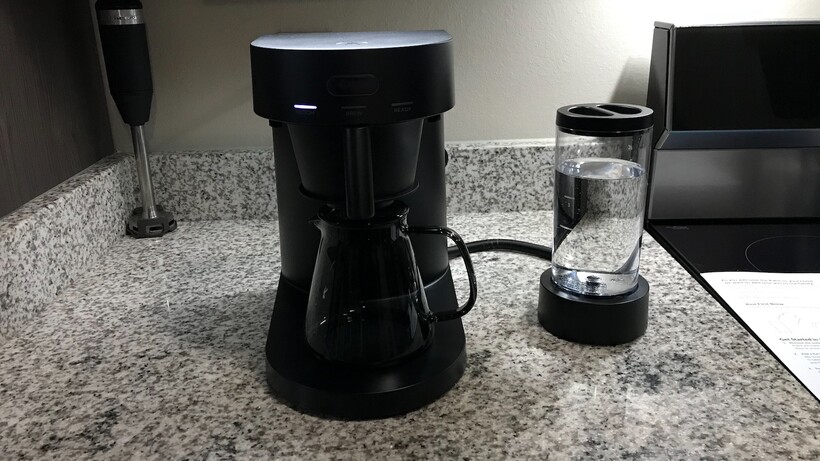
The Ratio Four has a compact design (10.6” L x 7.5” W x 11.5” H) and weighs 12 pounds. It’s available in two colors: black, and linen.
The removable water tank is an interesting feature. Many coffee makers have a removable water tank. However, this one sits on a separate dock, and connects via the water line to the actual coffee maker. At first glance, it looks like an odd design choice, but provides one major benefit: since the water tank is not built-in, it can be moved to the left or the right of the coffee machine, or even placed behind it. (The water line isn’t really long enough to put it in front of the coffee maker). This is one reason the Ratio Four is so compact, and if your kitchen or office is tight on space, you can position it where you have the most room.
Since it can be removed from the dock, the round, BPA-free water tank is easy to fill and empty, and it has markings to indicate the number of cups/water volume.

The Ratio Four has a handblown glass carafe, which can hold 20 ounces of brewed coffee, and also a heat lid, to be placed on the carafe when the coffee has finished brewing. However, the coffee maker does not have a hot plate. As a result, coffee does not remain hot for very long.

This is probably the shortest description I’ve ever written on a coffee maker’s control panel. The Ratio Four’s control panel consists of one button at the top, and three lights to indicate which phase the coffee maker is in: Bloom, brew, ready.

There’s a flat-bottom filter basket included. However, the Ratio Four’s filter basket can also be replaced with an alternate pour over device (a conical or flat-bottom dripper) like the Hario V60, Kalita Wave, and Origami ceramic dripper as well.

The power cord is removable, which helps store the Ratio Four flush against the wall. Other items in the box include the quick-start guide, and the user manual.
Performance
- One button operation
- Bloom cycle
- Brews directly into carafe or mug
The true beauty of the Ratio Four is revealed in the coffee maker’s performance. It’s such a simple and straightforward process. I merely fill the water tank to the desired line (choices are 5 ounces, 10 ounces, 15 ounces, and 20 ounces).
Then I scoop ground coffee into the brew basket. Unlike most coffee makers, the brew basket is not removable. This is slightly problematic because I usually remove the filter in the brew basket and replace it with a paper filter. It’s advisable not to use both, since double filtering can restrict the flow rate of water and lead to over-extraction. However, since the Ratio Four’s filter can’t be removed, and I hate having to clean brew baskets, I chose to use both. To compensate for this double filtering, I used a higher coffee-to-water ratio.

The final step (for me) is to press the Start button to begin the brewing process. The Bloom cycle starts first. If you’ve never used a coffee maker with a Bloom cycle, at first it might appear that the coffee maker is malfunctioning. That’s because just a small amount of water comes out of the machine. And then, the water stops flowing at all.

However, what’s actually happening during the Bloom cycle is that this small quantity of water is evenly saturating the coffee beans. The Ratio Four’s wide showerhead is designed to maximize saturation and flavor.

After a few seconds (15 to be exact), the water will begin flowing again in pulsating movements. And the status light will move from Bloom to Brew. (Note: the coffee maker distributes water at a temperature range that is between 195°F to 203°F.
When the brewing cycle is over, the status light moves to Ready. There are no beeps or other types of alerts to let you know the coffee has finished brewing.
I’ve tested the Ratio Four using double filtering, and also using only the included filter brew basket. The latter produced more robust and flavorful coffee with just the right level of acidity (no surprise), but I was also impressed with the double-filtered results as well – enough that when I wasn’t testing, but just making coffee for sheer joy, this is the process I used.
One significant difference between brewing 20 ounces of coffee in a regular 10-cup coffee maker – for example, the Thyme & Table Drip Coffee Maker, is that smaller quantities of coffee taste so much better in the Ratio Four. To be clear, larger quantities are delicious in the Thyme & Table Drip Coffee Maker, and smaller quantities taste good as well, but not as good as in the Ratio Four coffee maker, which is designed for brewing just a few cups.

I also brewed coffee directly into a coffee mug. This is only possible because the Ratio Four doesn’t have a hot plate, which could burn up the mug and start a fire. And whether that’s a positive or a negative aspect may depend on the user. If you’re just brewing small quantities of coffee, and you plan on gulping it down quickly, there may not be a need for a hot plate.

And, admittedly, when using the heat lid on the carafe, coffee will stay hotter for a wee bit longer. However, I don’t always drink my coffee as soon as it’s ready, so I would prefer to have it stay hotter (not just warm) for longer. But considering how good the coffee tastes, I’m not above putting it in the microwave (when using a microwave-safe mug).

Should you buy it?
You don’t want to press a lot of buttons or select a bunch of presets
No need to select quantity, strength, temperature, or anything else: load the coffee grounds, add water, and as Aerosmith would say, “just push play.”
You want to use ground coffee and Nespresso pods
If you want to switch it up between ground coffee and Nespresso pods, this is not the machine for you.
Final Thoughts
The Ratio Four Coffee Maker could very well be a game-changer in the coffee world – especially for those who prefer to brew smaller quantities. The simplicity of the machine is an obvious benefit, and the fact that it looks good on any countertop, while not taking up much space, is another advantage. Add to this the ability to brew into a coffee mug or the included carafe. Just keep in mind that the carafe won’t keep coffee hot for long since there’s no hot plate. However, if you tend to drink your coffee quickly, that won’t be a problem.
How we test
We test every coffee machine we review thoroughly over an extended period of time. We use industry-standard tests to compare features properly. We’ll always tell you what we find. We never, ever, accept money to review a product.
Find out more about how we test in our ethics policy.
- Used as our main coffee machine for the review period
- Tested for at least a week
- We roast our own beans for regular coffee machines, so we can fairly compare each machine; pod machines are tested with a variety of compatible capsules
- Depending on capabilities, we test each machine’s ability to make espresso and cappuccino
FAQs
No, you can brew straight into a mug as there’s not hot plate.
Test Data
| Ratio Four Coffee Machine |
|---|
Full Specs
| Ratio Four Coffee Machine Review | |
|---|---|
| Manufacturer | – |
| Size (Dimensions) | 7.5 x 10.6 x 11.5 INCHES |
| Weight | 12 LB |
| Release Date | 2026 |
| First Reviewed Date | 09/04/2026 |
| Coffee Machine Type | Filter |
| Number of boilers | 1 |

Stephan is the sports journalist for the Maple Grove Report.