Where Are Gerber Knives Made & Who Owns The Company?


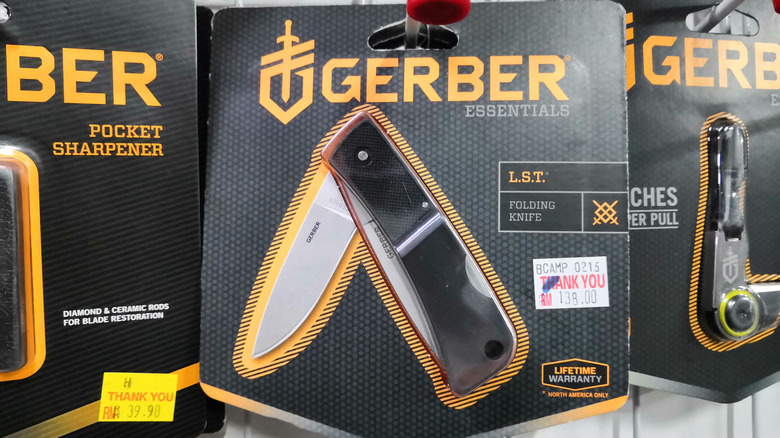
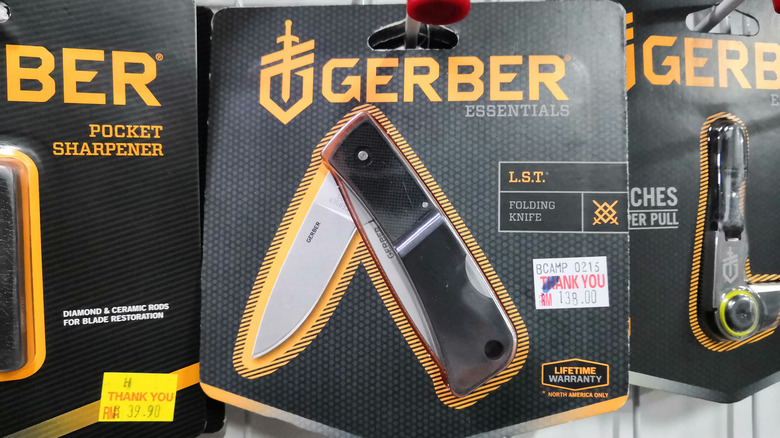
The Gerber company name is very well-known in the United States, but for two very different reasons, which can be confusing to some. You may know it as the long-standing company that’s been turning out food for infants and young children since 1927. The other company — with the exact same spelling — has been in existence since 1939, so almost as long. It manufactures a veritable smorgasbord of knives, multi-tools, camping equipment, and cutting tools (think axes, machetes, saws, etc.).

Despite both companies taking the same last name from their respective founders, Gerber Legendary Knives, which outshines Swiss Army Knives, in both price and features has no business relationship or corporate connection to the baby food maker. Joe Gerber turned his Portland, Oregon, ad agency into a kitchen knife company. He brought his sons, Pete and Ham, into the fold and grew the company into an international outdoor brand.

In 1987, Fiskars Group (based in Finland) purchased the then privately owned Gerber, and still owns it today. Fiskars, which specializes in a host of outdoor products and consumer goods, has been around since 1649. Despite overseas ownership, Gerber’s headquarters still resides in Portland, Oregon, where it all started. While Gerber makes the majority of their knives in Portland, certain products and models are made overseas in China. 

Most of Gerber’s premium products are made in the USA
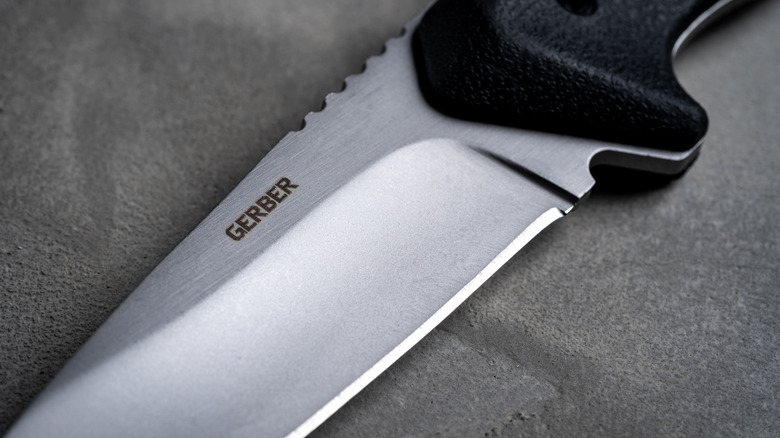
Way back in 1939, long before Gerber knives became legendary, Joe and Pete decided to send a handful of kitchen cutlery sets to some of their advertising clients as Christmas presents, so they collaborated with local blacksmith David Murphy to make them. The knives turned out to be so good that New York City outfitters Abercrombie & Fitch — who at the time were quite famous for their massive catalog of specialized hunting and fishing gear – decided to include them in their catalog. 

Fiskars Group is one of the oldest companies in Finland and has an interesting story all its own. They also make a product that virtually everyone though they may not be familiar with its origins. Fiskars was founded in 1649, after Peter Thorwöste was granted permission to set up a shop in Fiskars, Finland, to craft cast iron and forged products. At the time, Finland was still under Swedish rule and one of Europe’s biggest iron suppliers. Jumping ahead some three hundred years to 1967, it produced its very first pair of now world-famous orange plastic handled scissors. Today, Fiskars is an amalgamation of lifestyle brands, including Waterford, Royal Copenhagen, Wedgwood, and others, available in over 100 countries.

Gerber manufactures many of its premium, military-grade, hunting, and survival gear (including a multi-tool that’s cheaper and better than a Leatherman) in Portland, Oregon. However, entry-level and mid-range models come from contract factories in China, enabling them to sell products at competitive prices overseas. A line of products was once sold under the “Gerber International” label (made in Taiwan), but that’s no longer the case.


Source link

Leave a Reply

Subscribe to Our Newsletter

Get our latest articles delivered straight to your inbox. No spam, we promise.

Recent Reviews


Researchers in South Korea developed a wearable system that uses seven smart rings to read finger and hand motions to translate American Sign Language and International Sign Language into text. The purpose is to make communicating easier between those who sign and nonsigners without needing a separate human interpreter. 

AI Atlas

According to the study, published Friday in the journal Science Advances, the system reliably recognized 100 ASL and ISL words during testing. It also performed well with users the system had not seen before, and it didn’t require recalibration for each person. Because the system detects words in sequence, it can produce sentence-level translations without extra training on grammar. 

ASL and ISL are the everyday languages of more than 72 million deaf and hard-of-hearing people. However, most hearing people do not know any words in these languages or have a very basic understanding. That gap makes certain tasks, like ordering at a restaurant or asking for help, much more difficult. 

A graphic shows two illustrated people talking in sign language, ASL and ISL. The graphic also shows the different components of the ring as well as pictures of hands modeling the rings.

A concept of how the rings work in the real world. 

American Association for the Advancement of Science (AAAS)

Existing sign language translator prototypes often rely on bulky gloves that can distract from or block natural hand movement or feel uncomfortable for the wearer, which limits real word adaption. Camera-based technologies can work well in controlled environments but are often limited to those places where a camera can be set up with a clear line of sight, the researchers wrote. 

To solve these problems, the researchers designed sensing rings for each finger that can capture precise motion and finger position while letting the hands move naturally. The rings can detect both signs that involve movement, like the words for “dance,” “fly” and “sun,” and signs that are held still, like “I” and “you.”

“These advances suggest that [the device could enable] barrier-free public translation systems for unseen users and unrestricted daily assistive interfaces,” the authors wrote in the study. 

The authors are affiliated with Yonsei University, Hankuk University of Foreign Studies and the Korea Institute of Science and Technology, among others. While the technology is still experimental, the authors wrote that the technology has the potential to ease communication difficulties. The underlying idea could also help improve controls for other systems, like virtual or augmented reality.

“Beyond sign language translation, the ring-type, wireless, and modular architecture of (wirelessly connected, ring-type sign language translators) may also be extended to other gesture-driven applications such as virtual or augmented reality control, touchless device interfaces, or rehabilitation monitoring systems where fine-grained hand movement tracking is essential,” they wrote.


Source link