
Finally, we know that plug-in solar systems are finally coming to the UK at some point soon, but so far, the lead headlines from the nationals have been about the supermarket chains that will fill the aisles with £400 systems that you can take away and connect yourself.
While all systems sold must meet safety requirements, there’s a lot more to consider, including how much energy you want to generate, installation requirements, and whether you need a battery.
After seeing the new Anker SOLIX Solarbank 4 E5000 Pro (freshly launched and available in Germany), it’s clear that the talk about plug-in solar in the UK has been oversimplified, and that it will be more important to buy the right system rather than the cheapest.
Solar panels might not be straightforward to install
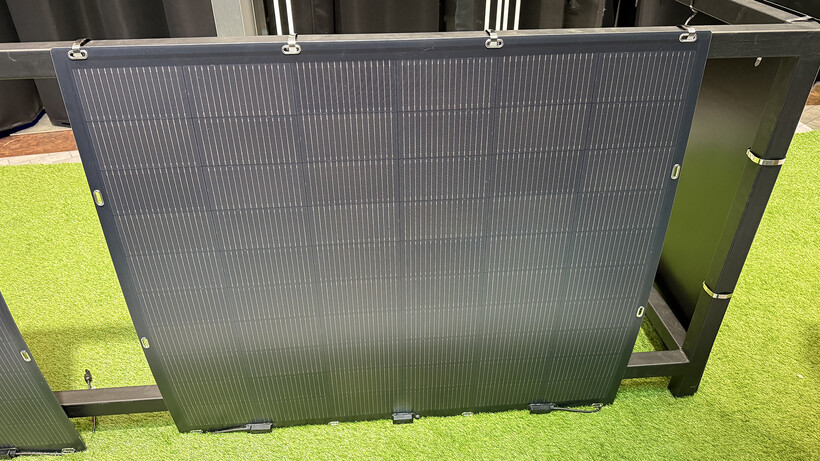
Plug-in solar is often also referred to as balcony solar. Many of the systems are designed to use thin, light solar panels that are tied to the front of a balcony, connecting via an inverter to a regular power socket.
Sounds easy, but even a lightweight solar panel is around 8kg, and it needs to be secured properly to avoid falling off. Before I buy any system, I’d want to double-check the installation instructions and make sure they all make sense, and you’re more likely to get that from a bigger manufacturer.

While balcony solar is one option, plug-in solar is also designed for use with panels ground-mounted in a garden or mounted on a flat roof, such as a garage or garden office. These alternative mounting options need frames to angle the panels towards the sun, and this needs to be made clear at the point of purchase.
I think there’s a real danger that systems will be bought, because people think they’re plug-in and easy to install, but the reality will be that some installations will be more complicated, and you might even want to pay a professional to do the work to get it right.
While a lower price may seem good, that’s not the only metric: a solar panel’s wattage is important. Wattage is measured using Standard Test Conditions (STC), so it isn’t the amount of power generation you’ll see, but how much power a panel can produce in ideal conditions. It’s still a useful metric: the higher the wattage the more power you’ll generate from the sun. This metric has nothing to do with physical panel size, either, as two identically sized panels can have a different rated Wattage.
My guess is that cheap systems will use older, lower-power panels, so you’ll see less benefit from them.
Be careful of cheap batteries
According to research from global business insurer, QBE, the UK fire brigades are tackling a lithium-ion fire every five hours (or 4.8 fires per day). Most fires were from ebike batteries, with converted or retrofitted models the cause of the majority.
What this statistic shows is that Li-ion batteries can be dangerous. If I bought a plug-in solar system with a battery, I would only buy from a reputable vendor with specialist knowledge in this kind of market, particularly for any batteries placed outside.
With the Anker SOLIX Solarbank 4 E5000 Pro, for example, you get C5-M anti-corrosion (the highest protective coating rating), a guarantee that it will operate in temperatures down to -20°C, and an IP66 rating (fully protected against dust and protection from high-pressure water jets). This system, and ones from other reputable manufacturers, are fully designed to be installed outside, and I wouldn’t buy an outdoor battery system with lower ratings to avoid fire damage.
Batteries have other important metrics, too: capacity, depth-of-discharge, and the number of charge cycles they’re rated for. With the Anker SOLIX Solarbank 4 E5000 Pro, you get a base 5kWh capacity, which is roughly around half the total power that a typical UK household will use in a day.
This system is rated to last for 10,000 charge cycles at a 100% depth of discharge. So, what does that mean?
A charge cycle is when the battery is charged and then discharged. The higher the number of charge cycles, the longer the battery will last for, which means you can store more power in total before the battery has to be replaced.
Alongside the number of charge cycles is the rated depth of discharge. Many batteries are rated at 90% depth of discharge, which means that each charge cycle uses only 90% of the rated capacity, with the remaining 10% unused.
The Anker SOLIX Solarbank 4 E5000 Pro, you get 100% depth-of-discharge, so all of that capacity is available.
Before buying any solar battery, it’s important to know what to expect, how long the system will last and how much power it can hold. It’s then, the cost over a product’s lifetime that’s important. For example, Anker says that its new system has a payback time of just three-years.
And, it’s an expandable system. You can add up to 30kWh of battery storage, using the stackable design, and add up to 12 solar panels for a total 5kW input. With cheaper systems, you’re likely to be stuck with what you get in the box, with no expansion available.

The current change to regulations only talks about 800W input
Currently, although the UK government has said plug-in solar will be available soon, the regulations are not in place. That makes life difficult for the manufacturers, as it’s not clear what they’ll need to do to any products to make them compatible with the UK. That’s true of the Anker SOLIX Solarbank 4 E5000 Pro, which will be sold in the UK, although whether the maximum output can be used isn’t yet clear.
If we look at Germany, plug-in solar devices that connect to a standard Schuko socket are limited to an 800W output. However, have a Wieland socket installed by an electrician, and the Anker SOLIX Solarbank 4 E5000 Pro can have its full 2500W output enabled.
In the UK, the government has said that it’s working “with the Energy Networks Association, DNOs and Ofgem to update the G98 distribution code and wiring regulations BS 7671 to allow UK households to connect <800W plug-in solar panels to domestic mains sockets, without the need for an electrician and with tailored safety standards.”
What isn’t clear is whether higher power output will be available if the system is professionally installed.
That’s potentially quite a big difference. With an 800W output, you can trickle power into your home for smaller appliances, but when you exceed this limit, you’ll have to buy power in. With 2500W, you can power pretty much anything in your home, up to a lot of ovens, so you can use all of the free power you’ve generated.
If the UK regulations allow for higher power inputs, and you’ve got space to put a decent number of solar panels, having a system that can feed more power in may well be worth it, even if that will be a future update as regulations evolve.
I should point out that the Solarbank 4 E5000 Pro has a neat trick, in that you can directly plug a device into its 2500W input, say, powering your washing machine directly from the battery.
Intelligent power usage is just as important
As noted before, when I talked about whether solar panels are worth it in the UK, it’s important to maximise solar power usage. For example, running a washing machine cycle when there’s excess power.
With a battery, it gets more complicated, as you want to balance charging it with solar and also use an anytime-of-use tariff to access cheap electricity. With budget systems, you’ll have to handle all of this yourself.
With a more expensive system, you don’t just get the hardware, but software behind it. Using AI, with inputs from how you use power, the weather forecast and more, the system can optimise your plug-in solar, maximising free energy for charging, but balancing this out with any time-of-use tariff that you have.
This level of intelligence can help unlock better savings and make any system deliver more.
Rather than just going for the lowest price for a plug-in solar system, it’s more important to get one that has a longer life, better warranty, wider installation options (with help if needed), and the option to expand to meet future needs.

Stephan is the sports journalist for the Maple Grove Report.