
Follow ZDNET: Add us as a preferred source on Google.
During Google’s two-hour keynote this week, the company spent a generous 12 minutes discussing Android XR and the “Intelligent Eyewear” genre that it encompasses. But when you’ve got hardware partners in Samsung and Qualcomm, and a rich software ecosystem to build around, that’s all the time you really need to send a message.
Google is effectively launching three pairs of smart glasses by the end of this year: audio-only models from Warby Parker and Gentle Monster, Project Aura with Xreal, and a reference model with a single-view display.
Also: Everything we saw at Google I/O: Gemini 3.5, Android XR glasses, Spark, and more
I don’t know how much each pair will cost when it eventually hits the market — I’d ballpark something that’s above comfort — and I don’t know how much of its capabilities will change in the months leading up to that.
What I do know is that they’re all supercharged by Gemini, and after demoing the latest features at Google I/O this week, I can live with that. It may be time for you to embrace it, too.
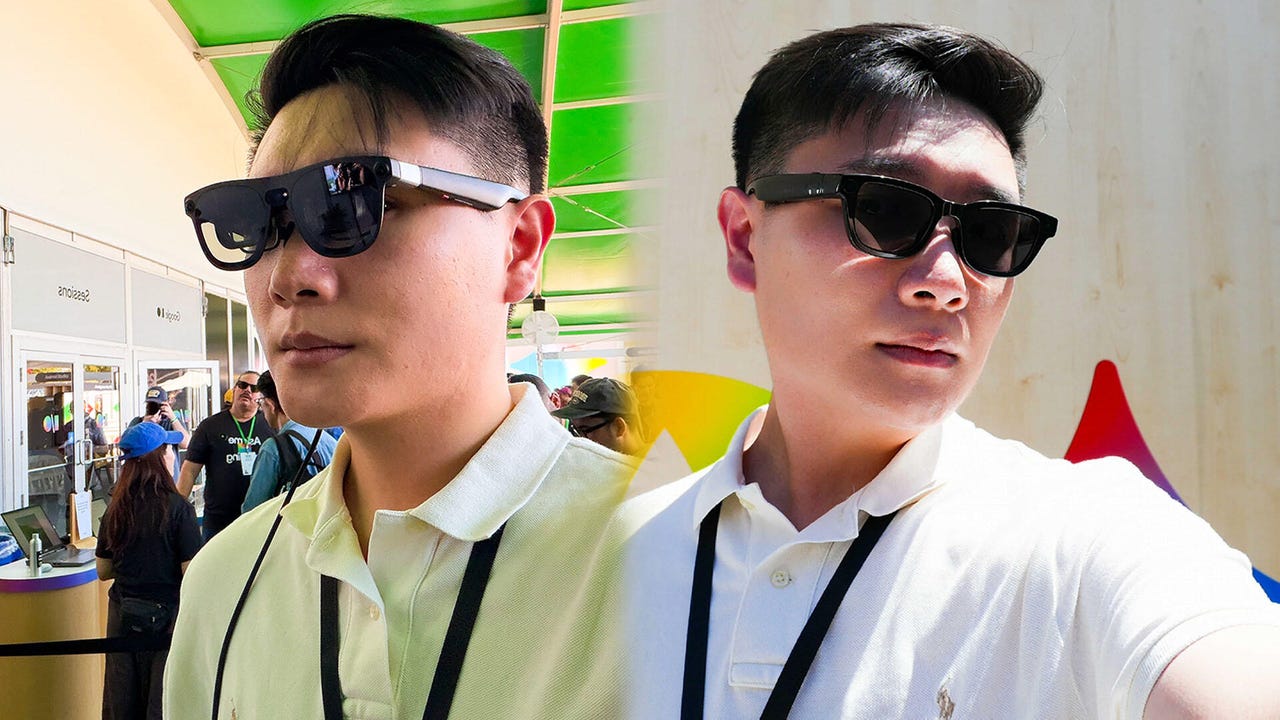
Wearing Android XR glasses (again)
My first encounter with Google’s Android XR reference glasses, a pair with a built-in display, tap gestures, and multimodal Gemini capabilities, was exactly one year ago at I/O. It was a brief, five-minute demo that mainly highlighted the wearable’s lightweight form factor for me.
I tried them again in December, when the company was ready to showcase more camera-based tools that, while still controlled, showed more promise.
For my third and latest demo, I was essentially limit-testing the glasses’ AI capabilities, with free rein to prompt Gemini with things my wildest, post-keynote mind could imagine. “Pull up every FIFA World Cup game that the US is scheduled for, with the exception of when they play against Paraguay, and add them to my calendar,” I asked the assistant. Within seconds, I saw scheduled events in the Calendar app of the demo phone.
“Take a picture, turn every person in the frame into a Despicable Me minion, and change the color to grayscale,” I briefly followed up. You can see the results below, stitched together from individual photos the glasses captured and saved to the paired phone’s gallery.
Let’s face it: most of us aren’t going to ask our smart glasses to play make-believe. But the idea of such wearables as a natural extension of our smartphones, thanks to seamless app integrations and ecosystems, feels like the best path — one that Google has the right to win and, for now, use as leverage over Meta and Apple.
Also: Google’s Project Aura is a wild pair of supercharged Xreal glasses
In another test, I asked Gemini to jot down all the ingredients I need for a dish I saw in a cookbook in front of me, and note that I’d like to prepare it next Tuesday. Moments later, I saw all of that information listed in a Google Keep entry.
That’s what my Google I/O demo was really about: cross-device and cross-app compatibility so seamless that I’m learning new things and accomplishing tasks within seconds of putting the glasses on. Google is fully embracing that aspect, and I’m all for it.
Project Aura’s secret sauce is vibes
I also tried Google’s Project Aura glasses back in December, but my latest demo truly opened my eyes to its potential.
The Xreal-designed wearable is, simply put, a more portable version of the Samsung Galaxy XR headset. You can engage with floating apps and windows anchored within the 70-degree field-of-view display, pinch and pull various UI elements, and stream content from a Steam Deck while running Gemini Live for in-game guidance.
More interestingly, I demoed a few applications that, according to Google, were vibecoded in a week with Gemini Canvas and Antigravity. One app spawned a talking molecule whenever I made a pinch gesture on an object near me. Pinching a potted plant, for example, prompted the bubbly molecule to educate me about its species. I could see students and curious-minded folks alike benefiting from such a concept.
Also: I tried ditching my laptop for a more futuristic setup – and found 5 surprising alternatives
In another vibecoded app, 3D Paint, I was able to draw floating lines as if I were holding a piece of chalk. The premise of it is basic, and its appeal quickly wore off for me, but if these are among the use cases that developers can come up with in a week’s time, I’m hopeful that we’ll find more and better reasons to put on XR glasses when they officially launch later this year.
A pairing that just makes sense
I’ve spent a lot of time wondering where AI truly belongs in our lives, and I may have found my answer in Mountain View this week. Getting quick access to Gemini on your phone, laptop, and smartwatch is great, but its sweet spot is ambient accessibility.
Whether you’re holding onto a subway pole with smart glasses on, driving through traffic on a rainy day, or have lost your remote to navigate Netflix on your TV, a highly connected, hands-free assistant may just be the most plausible future of the technology.