Efficiency is key this time around


Google has officially announced Wear OS 7. While the update brings the usual AI buzzwords, the more interesting upgrade might actually be battery life.

According to Google, smartwatches upgrading from Wear OS 6 to Wear OS 7 could see up to a 10% improvement in battery efficiency. That may not sound dramatic on paper. However, for smartwatch users constantly juggling charging habits, an extra few hours can make a genuine difference.

The update also lays the groundwork for smarter AI-powered watches later this year. Google confirmed that select smartwatches launching in late 2026 will include Gemini Intelligence support. This will allow for more advanced voice-driven tasks and app controls directly from the wrist.

Google hasn’t shared a full list of compatible devices yet. However, the feature will likely lean heavily on newer chips with on-device AI capabilities, such as Qualcomm’s Snapdragon Wear Elite platform and the Pixel Watch.


Beyond the AI additions, Wear OS 7 looks like a fairly substantial polish update overall. Google is introducing redesigned widgets with more flexible layouts. These give smartwatch apps a cleaner and more glanceable interface that feels a bit closer to modern Android phones.

Advertisement

Live Updates are also coming to Wear OS. Watches will be able to display real-time information from apps like food delivery services directly on the watch face. Instead of constantly opening an app, users can simply glance at their wrist for updates.

Media controls are getting smarter too. Wear OS 7 now lets users decide which phone apps can automatically trigger media controls on their watch. Meanwhile, a new audio output switcher makes it easier to move playback between connected devices like earbuds, phones, and speakers.

Fitness tracking is another major focus. Google is introducing something called Wear Workout Tracker, a native tracking framework developers can use instead of building their own systems from scratch. The idea is to create more consistent workout experiences across apps, with features like heart rate monitoring and media controls baked in. ASICS Runkeeper is already confirmed as one of the early partners.

Google is also updating its Watch Face Format tools. This makes it easier for developers to create more responsive and dynamic watch faces.

Overall, Wear OS 7 feels less like a flashy redesign and more like Google finally tightening up the smartwatch experience in the areas that actually matter.

Advertisement


Source link

Leave a Reply

Subscribe to Our Newsletter

Get our latest articles delivered straight to your inbox. No spam, we promise.

Recent Reviews


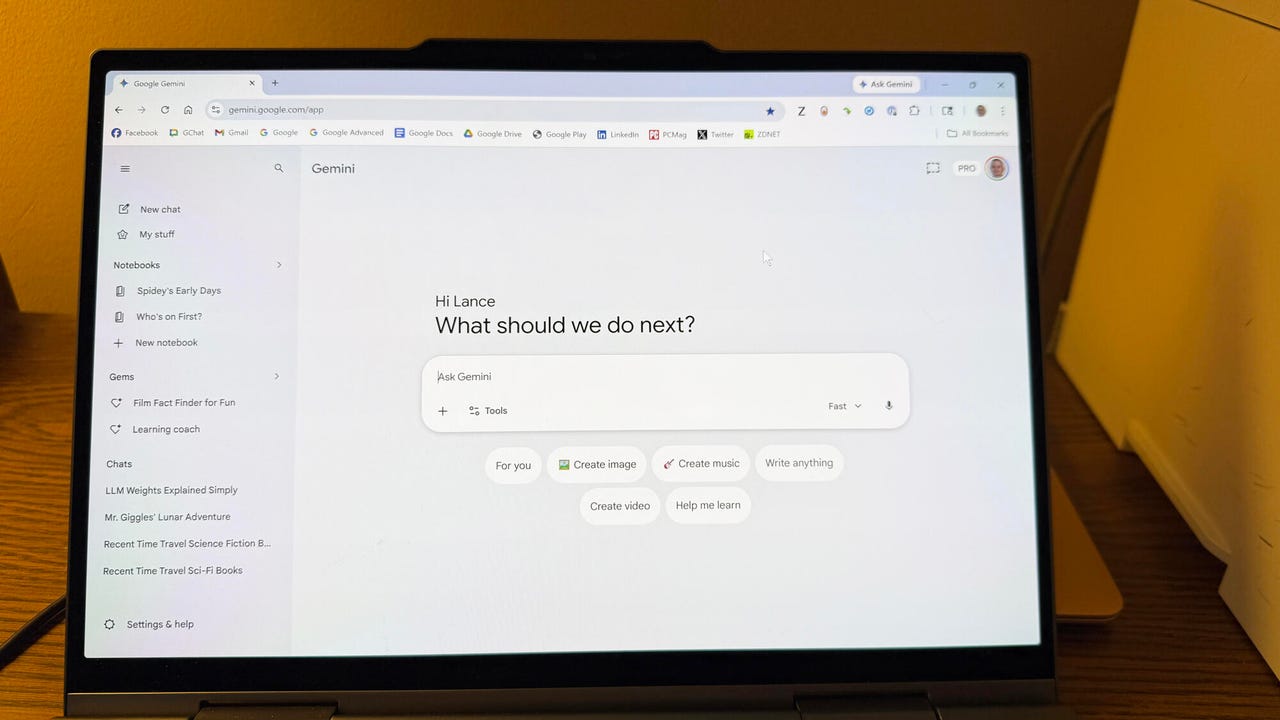
Google Gemini

Lance Whitney/ZDNET

Follow ZDNET: Add us as a preferred source on Google.


ZDNET’s key takeaways

  • Google is downloading a 4GB file to the PCs of many Chrome users.
  • The file is harmless and is used for the Gemini Nano on-device LLM.
  • You’ll see it if you’ve opted into the on-device AI setting in Chrome.

Google is silently saving a Chrome-related file to many computers. That’s nothing earth-shaking. But this file is a hefty 4GB in size, which has caught the attention of some Google watchers. What is the file, why is it being installed, and how can you check for it?

Also: I let Chrome’s AI agent shop, research, and email for me – here’s how it went

In a new blog post, computer scientist Alexander Hanff, aka the Privacy Guy, pulled back the curtain on this mysterious file. Named weights.bin, the file is being downloaded deep within the user data folder of many Chrome users. The file itself is related to Gemini Nano, which Google is using as the on-device AI model for Chrome users.

If you delete the file, it comes back

Though there’s nothing risky or dangerous about the file, Hanff and others have expressed concerns that it’s being downloaded without users’ knowledge or permission. And if you delete the file, it eventually comes back, Hanff said. That by itself is hardly alarming; that’s part of any software update. Rather, some of the criticism centers on the file’s size. If you have ample hard disk space, then 4GB is likely not a big deal. But if you’re running low, that big a file might chew up space you can’t spare.

Traditionally, AI models like Gemini use the cloud to interact with you. Submit a request, ask a question, or kick off a conversation, and the AI taps into its online data and resources to respond. But that method can be slow and naturally requires that you be connected. By traveling between your device and the cloud, your data can also be exposed.

A trend has emerged in which companies are experimenting with locally stored LLMs (large language models). That not only speeds up the process, but it also means you can use the AI offline and more securely. Gemini Nano has already been in play on Google’s own Pixel phones.

That explains why the file is so large; it has to pack in a lot of data. In this case, a weights file contains numbers that measure the level of importance an AI model assigns to your input. The AI uses these values to determine what should come next. For example, let’s say you start typing the phrase “Why did my new phone cost me an arm and a…” at the prompt. The AI assigns weights to your input to help it predict that the next word would be “leg.”

Also: This powerful Gemini setting made my AI results way more personal and accurate

How can you tell if the file has been downloaded to your PC? First, open Chrome, go to Settings, and select System. On the System screen, check whether the On-device AI option is turned on. If so, then you probably have the file or will soon get it.

To double-check, you’ll have to navigate to the user folder on your PC. That location varies based on your operating system. On my Windows 11 PC, I ran a search in File Explorer for weights.bin. The search took a long journey through the following path: C:\Users\lance\AppData\Local\Google\Chrome\User Data\OptGuideOnDeviceModel\2025.8.8.1141. At that final location, the weights.bin file appeared, measuring 4GB.

Since the file is downloaded again if you simply delete it, you’ll have to take an extra step to get rid of it permanently. After you delete the file, go back to Settings in Chrome and select System. Then  turn off the switch for On-device AI.

But as long as you have enough disk space (and if you can’t spare 4GB, then it’s time to clean up your drive), the file is little cause for concern. Just forget about it, especially if you’re keen to try on-device AI, and we’ll see what the future holds for Gemini Nano.


Source link