
Verdict
A reference example of a modern two-channel integrated amplifier, the TDAI-2210 is as much a pleasure to set up as it is to listen to. While there is no getting past the price, its excellent display, RoomPerfect room-correction software, and crisp, lively sound make it worth the investment.
-
Colour touch-panel screen is top notch
-
RoomPerfect room correction tightens sound
-
Pure digital amplification delivers impeccable sound quality
-
Expensive, especially with phono or HDMI upgrades
-
AirPlay certification remains pending (at time of writing)
-
UPnP requires a third-party app
Key Features
-
Amplification
Pure digital design delivering 210W into 4-ohms/105W into 8-ohms
-
EQ
RoomPerfect room correction
-
Display
5-inch full-colour touch panel
Introduction
Nobody does digital amplification and design quite like Lyngdorf.
With its pure digital design philosophy, Lyngdorf already has excellent form in the streaming amplification space. However, the TDAI-2210 raises the bar with the addition of a full-colour touch-panel display, making for an enticingly modern, user-friendly option.
Design
- 100% digital until output stage
- “Lossless” volume control
- Compact and solidly built with 5-inch colour screen
The Lyngdorf TDAI-2210 takes a minimalist approach to high-end audio. At just 325 x 102 x 300mm, it will fit into spaces that will elude full-size units, making it a great option for areas where a less obtrusive approach is required. Despite its size, at 4.8kg it is no lightweight, and it feels reassuringly heavy and well put together.
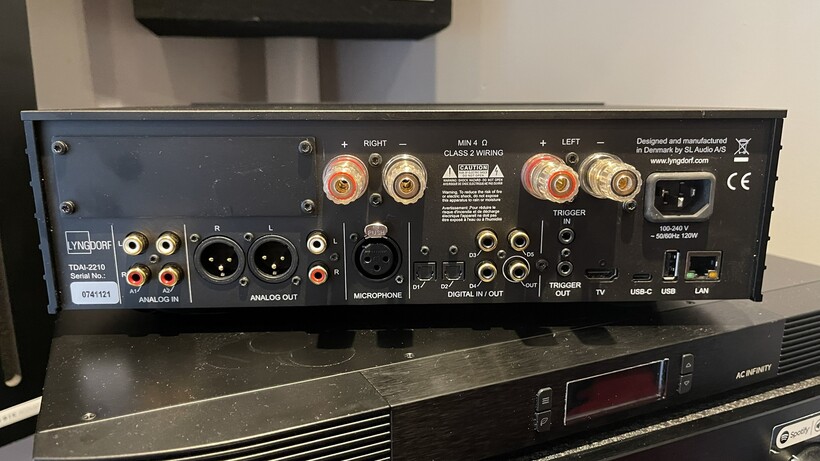
The rear panel provides a wealth of inputs and outputs. Ethernet is present, along with USB-A and USB-C ports for connecting storage devices for direct file playback.
An eARC HDMI 2.1 input lets you connect it to a TV, and there are two RCA inputs for connecting one or two subwoofers. There are also RCA outputs, so you can integrate it into a home cinema system to power the front stage for music playback.

Meanwhile, the digital outputs are there should you wish to add another power amp, while maintaining the benefits of the amplification’s fully digital design.
The front is dominated by a gorgeous 5-inch colour display. It might not be the same as holding a vinyl record sleeve, but it’s still wonderful to see an album cover as the music plays, without a phone or tablet screen.
Thanks to a smooth matte finish, the display is perfectly responsive, and the menus are all intuitively laid out. As you move through them, you get a sense that everything has been thought through.
The display is big enough for a good-sized on-screen keyboard, which was much appreciated when entering the Wi-Fi password. There are also helpful on-screen guides for setting up the speaker configuration and the RoomPerfect room correction.

While this is a network streamer, you could theoretically control the TDAI-2210 using just the display – good news if you want to use the USB ports to play music without network access.
While the screen is the star. To the right of it is a large circular volume control. With a solid metallic finish, it feels great to touch, but it’s the way it rotates freely and easily that stands out. Lyngdorf describes this as a “lossless volume control”.
Instead of a conventional potentiometer to physically reduce the voltage, the dial sends an optical digital signal that reduces the volume at the output stage. This is possible because, as a True Digital Amplifier Integrated (hence TDAI), this power DAC design means that the standard digital PCM audio signal remains in the digital domain right up to the output stage.
Only at the output stage is this then converted into a high-current pulse width modulation (PWM) switching signal that physically drives the speakers. Consequently, as well as allowing for the effortlessly smooth volume wheel, there is no resolution loss at the output stage, so the quality is maintained at whatever volume level you’re listening at.

Of course, you’ll probably be using the remote most of the time, so it’s pleasing that this maintains the premium feel. My favourite button was “Display” at the top left, which brings up a graphic of the input and details of the tracks bit- and sample rate.
The app is basic but elegant, and displays cover art when playing from drives. It also gives you a direct link to the web interface, making it easy to make setup changes should you need to.
Features
- Bright and responsive colour screen
- RoomPerfect room correction is easy to set up and effective
- Supports Spotify, Tidal, and Qobuz Connect, and Google Cast
While well-featured out of the box, the Lyngdorf TDAI-2210 is that it can be upgraded via a removable panel at the rear. There are two modules to choose from. One is a turntable-ready phono stage that also provides a balanced XLR input and an extra pair of RCA inputs, and the other adds two additional HDMI 2.1 inputs and one output.
The core feature of the TDAI-2210, though, is as a streamer. It has Spotify, Tidal, and Qobuz Connect built-in to pull audio to the device, or you can push audio from, say, Amazon Music to it via Google Cast.

Apple Music users will be less satisfied. While AirPlay 2 is a listed feature, it requires Apple to certify the unit, which, as of this review being published, it has yet to do. I was assured that as soon as Apple pulls its finger out, it will be enabled via firmware upgrade.
However, until then, Apple Music and Amazon Music subscribers may want to hold off. As a fallback, Bluetooth BLE 4.0 is available. This doesn’t support aptX HD or lossless, however, so it should only be used for casual listening.
A key feature of the TDAI-2210 is its support for RoomPerfect. For many stereophiles, the thought of using room correction is an anathema, but for Lyngdorf, the technology is central to its philosophy.
RoomPerfect takes a different approach to other room correction software. Rather than forcing your speakers to fit a pre-determined curve, it measures your room to reduce unwanted acoustic effects – bass bloom, standing waves and harsh reflections – while retaining your loudspeakers’ sonic character. You can bypass it if you choose, but I’d argue that doing so would negate choosing a Lyngdorf.

Compared to my experience with others, setting up RoomPerfect could not be easier. No laptop is required; you plug the supplied microphone directly into the rear of the unit, and with the help of the also supplied stand, place it as your primary listening position with the microphone tip pointing directly at your speakers. It first determines if you have the volume at a sufficiently loud volume and once it’s happy, it sends out tones that measure the room’s sonic characteristics.
Once the main position is done, you are then encouraged to let it learn more about the room by moving the microphone in random directions in different positions. As you do this, the room knowledge percentage is indicated on the display, and once you hit 96%, or so, you are fine to stop and save the profile.
This can then be easily backed up to a USB stick should you want to move the unit to a different room. The process proved speedier than other systems I’ve tried and is not spooked by background noise, making it more user-friendly overall. It can then be set to the primary focus position, a general setting, or bypassed altogether.
There is also a wide range of “Voicing” options to choose from: essentially preset EQ options for you to experiment with.
Performance
- Responsive, whether by screen, app, web, or remote
- Plenty of power on tap for small to medium rooms
- Excellent mid-range detail enhances the whole soundstage
To test operation and sound, I primarily used Qobuz Connect, which offers CD-quality and hi-resolution streams. The unit appears in the app as an endpoint, and it proved solid and reliable most of the time. Inevitably, when using Wi-Fi, it did require the occasional restart; so if you can use Ethernet, it is recommended.

You can also use UPnP to play files stored on your network. I have some FLAC-encoded hi-res files on an old Synology NAS and to my surprise, this didn’t appear in the native Lyngdorf app. However, they did when I switched to mConnect: a third-party app that has a free version available on app stores.
I also played files stored on a USB thumb drive, though it proved fussy. Of the two drives I tested, both were formatted using FAT32, as required but while one was read right away, the other was not. It turned out that the second needed a full format using the MBR scheme and once this was done, it was fine.
So, after all that, how does the unit sound? For me, RoomPerfect was preferred. It brought all parts of the music into focus, with the bass notably more delineated. While I experimented with the different Voicing modes, I mostly left it on neutral. I tested in three rooms and configurations: one with full-size speakers with no subwoofer, a second with bookshelf speakers and one sub, and a third with in-wall speakers and two subwoofers.

The Lyngdorf consistently delivered an open, articulate, but lively sound. It does a great job of letting the characteristics of the room and the speakers come through, for better or worse.
The first room with tower speakers showed that the unit had plenty of power to fill an open plan space, and even without a sub there was weight to the music. In the second space when connected to a TV via ARC (I had to change the TV’s output from Auto to PCM to get sound) it showed a significant improvement in weight and detail over my budget Denon X3400 amp. (Though, of course, limited to stereo).

It was really able to stretch its legs in the dedicated listening room. Connected to two 4-ohms speakers, I could sense that it was unleashing all 210 Watts, and it provided an appreciable uplift over my Anthem MRX-720. RoomPerfect has a reputation for the way it dials in the subs, and this proved to be exactly the case, smoothly integrating into the soundstage rather than standing out.
Tracks with strong vocals and pianos had a pleasingly holographic quality, and in complex tracks, I regularly noticed more detail in the mid-range. It made for a toe-tapping listen that was natural and not fatiguing on the ears. Indeed, planned short listening sessions often turned into far longer ones.
Should you buy it?
If you are looking for a near-flawless streamer that’s easy to live with, the Lyngdorf TDAI-2210 is easy to recommend. It’s comfortably the best-sounding bit of audio kit I’ve had in my home.
You use iOS for your music
If you need to be convinced of the benefits of using room correction for stereo, this may not be the product for you. And if you require Apple AirPlay, you should wait until the unit has been certified.
Final Thoughts
For most, the Lyngdorf represents an expensive bit of kit. For me, it was an eye (ear?)-opener, on “how the other half live.”
However, I was never in doubt where the money was going. This is a well-thought-out product that has the substance to match its style, which has convinced me of the benefits of a dedicated unit for stereo music. The ability to add more functionality and more power, should you need it, also makes it a safe investment.
How We Test
I tested in three average-sized rooms: an open-plan room with a pair of Lyngdorf FR-2 speakers, in a TV room with a pair of Monitor Audio Bronze bookshelf speakers and a single subwoofer, and in a dedicated, acoustically-treated home cinema room connected to a pair of M&K IW150 speakers and two M&K V12 subwoofers.
- <strong>Tested with real-world use</strong>
- <strong>Tested for several days</strong>
FAQs
Not at the time of review, but while you wait for Airplay support, you could physically connect a cable to the USB-C port on the rear
Though the TDAI-2210 accepts hi-res audio files at up to 24-bit 192KHz, everything is re-clocked internally to 32-bit 96KHz to ensure stability and avoid jitter issues.
Full Specs
| Lyngdorf TDAI 2210 Review | |
|---|---|
| Manufacturer | – |
| Size (Dimensions) | 325 x 300 x 102 MM |
| Weight | 4.8 KG |
| Release Date | 2026 |
| Resolution | x |
| Connectivity | Internet Radio (airable), Spotify Connect, TIDAL Connect, Roon Ready, Google Cast, Apple AirPlay2, DLNA / UPnP |
| Colours | Matte black |
| Inputs | Two x Single Ended RCA, Mic input (XLR) for RoomPerfect, two HDMI |
| Outputs | Single Ended RCA, XLR Balanced, 1 x 3.5mm Headphone, Coaxial digital, HDMI |

Stephan is the sports journalist for the Maple Grove Report.