Only 2 Of These US Fighter Jets Were Ever Built


The United States has produced a plethora of powerful military aircraft, and one of the most useful across all roles is the F-16 Fighting Falcon. General Dynamics designed the legendary fighter, which first entered the active inventory in 1979. The F-16 has been flying ever since, though modernization efforts and upgrades have rendered the F-16 of today into something far more advanced than its first-generation counterpart. Since its introduction, over 4,600 F-16s have been built, and it’s the U.S. Air Force’s most widely used fighter jet.

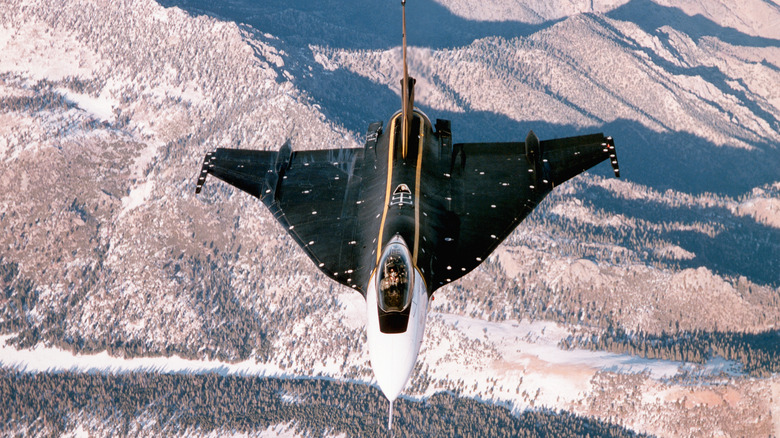
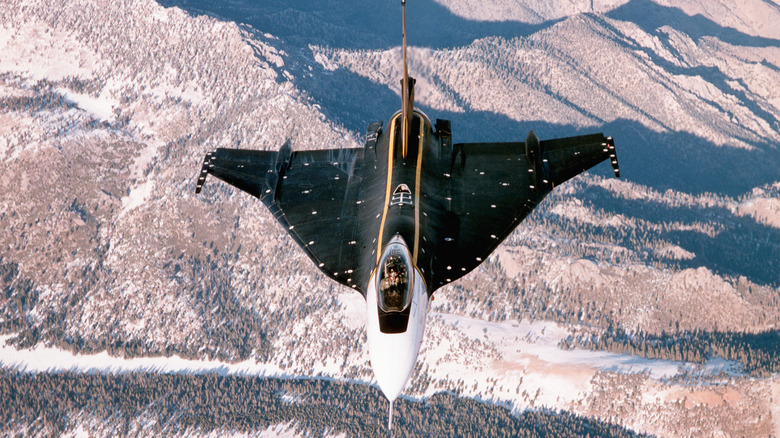
There are many variants of the F-16, but only two examples of a particular model exist: the F-16XL. These were specially-made F-16s designed with a cranked-arrow delta wing. The F-16XL came into being as a contender for the Air Force’s Enhanced Tactical Fighter Program in 1981. It lost that contest, so the project was shelved. The two that were built were transferred to NASA in 1988, where they were used for research purposes. The unusual design of the wing and several alterations made to the aircraft made it ideal for NASA’s research goals.

The F-16XL was far more than an F-16 with a different wing configuration, as it required numerous modifications to the fuselage to produce. It featured a large array of weapon hard points, and had it been chosen for the ETF program, the F-16XL would have been a highly advanced aircraft for its period. When it was unveiled, Lt. Gen. Lawrence A. Skantze, the then Commander of Aeronautical Systems Division, described it as having “one foot in the present and one foot in the future.”

NASA’s tests of the F-16XL and their ultimate fate
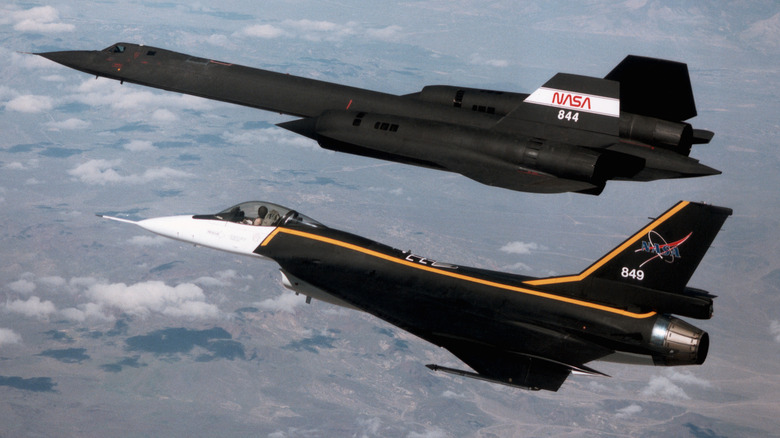
Once NASA got its hands on the first of two F-16XLs, it used it to fly alongside the SR-71 Blackbird, which is the fastest aircraft ever produced. The F-16XL’s job during these flights was to study sonic booms when NASA worked on its high-speed civil transport program. During the tests, the F-16XL flew up to Mach 1.8 (1,381 mph), and as the two aircraft flew, engineers recorded how sonic booms were impacted by different conditions. A standard F-16 has a top speed of Mach 2 (1,500 mph at altitude), so they were pushed close to their maximum speed.

The second F-16XL, which was a two-seat version, arrived sometime later with a different paint scheme and configuration. NASA put the two aircraft through several tests, flying them to study different aspects of their design while studying their laminar flow characteristics at specific altitudes and speeds. While NASA’s study didn’t return the intended results, the agency called it a success and maintained the two F-16XLs until 1999, when they were placed into storage at Edwards Air Force Base, California.

Both aircraft are on display at Museum Airpark on Edwards Air Force Base, so they’ve been fully retired. Regarding their specifications, they have a wingspan of 34 feet, 3 inches, measure 52 feet, 2 inches in length, and stand 17 feet, 7 inches tall. Their maximum takeoff weight is 48,000 lbs., which is over five tons more than a standard F-16, so the XL is an appropriate designation.


Source link

Leave a Reply

Subscribe to Our Newsletter

Get our latest articles delivered straight to your inbox. No spam, we promise.

Recent Reviews


Researchers in South Korea developed a wearable system that uses seven smart rings to read finger and hand motions to translate American Sign Language and International Sign Language into text. The purpose is to make communicating easier between those who sign and nonsigners without needing a separate human interpreter. 

AI Atlas

According to the study, published Friday in the journal Science Advances, the system reliably recognized 100 ASL and ISL words during testing. It also performed well with users the system had not seen before, and it didn’t require recalibration for each person. Because the system detects words in sequence, it can produce sentence-level translations without extra training on grammar. 

ASL and ISL are the everyday languages of more than 72 million deaf and hard-of-hearing people. However, most hearing people do not know any words in these languages or have a very basic understanding. That gap makes certain tasks, like ordering at a restaurant or asking for help, much more difficult. 

A graphic shows two illustrated people talking in sign language, ASL and ISL. The graphic also shows the different components of the ring as well as pictures of hands modeling the rings.

A concept of how the rings work in the real world. 

American Association for the Advancement of Science (AAAS)

Existing sign language translator prototypes often rely on bulky gloves that can distract from or block natural hand movement or feel uncomfortable for the wearer, which limits real word adaption. Camera-based technologies can work well in controlled environments but are often limited to those places where a camera can be set up with a clear line of sight, the researchers wrote. 

To solve these problems, the researchers designed sensing rings for each finger that can capture precise motion and finger position while letting the hands move naturally. The rings can detect both signs that involve movement, like the words for “dance,” “fly” and “sun,” and signs that are held still, like “I” and “you.”

“These advances suggest that [the device could enable] barrier-free public translation systems for unseen users and unrestricted daily assistive interfaces,” the authors wrote in the study. 

The authors are affiliated with Yonsei University, Hankuk University of Foreign Studies and the Korea Institute of Science and Technology, among others. While the technology is still experimental, the authors wrote that the technology has the potential to ease communication difficulties. The underlying idea could also help improve controls for other systems, like virtual or augmented reality.

“Beyond sign language translation, the ring-type, wireless, and modular architecture of (wirelessly connected, ring-type sign language translators) may also be extended to other gesture-driven applications such as virtual or augmented reality control, touchless device interfaces, or rehabilitation monitoring systems where fine-grained hand movement tracking is essential,” they wrote.


Source link