Premier League Soccer: Stream Tottenham vs. Everton From Anywhere Live


When to watch Tottenham vs. Everton

  • Sunday at 11 a.m. ET (8 a.m. PT).

Where to watch

  • Tottenham vs. Everton will air in the US on NBC and Peacock Premium.

73% off with 2yr plan (+4 free months). Now only $3.49/month


See more details

See at Fubo

Fubo

Watch the Premier League in Canada

Fubo Canada

Tottenham go into this final fixture of the season at home to Everton with their English Premier League future very much in the balance. Roberto De Zerbi’s men know they need only a draw to secure their place in the English top flight next season.

Tuesday’s disappointing 2-1 London derby defeat to Chelsea at Stamford Bridge means relegation rival West Ham could leapfrog Spurs to safety. However, that’s only if Spurs fail to gain a point here and the Hammers beat Leeds in their final game (happening at the same time at the London Stadium). Having not won at home in the EPL since December, and with the atmosphere at times mutinous inside the Tottenham Hotspur Stadium, a nightmare scenario for Spurs doesn’t seem out of the question.

Standing in the way of Spurs’ salvation is an Everton team that has failed to win since beating Chelsea 3-0 back on March 21, a run that means the Toffees can no longer qualify for Europe. That poor performance is likely to give Spurs fans some hope. Everton boss David Moyes will likely be determined to end the season on a high note, while also doing his part to help his former club, West Ham, claw its way out of the abyss.

Spurs take on Everton on Sunday at Tottenham Hotspur Stadium in north London, with kickoff set for 4 p.m. BST. That makes it an 11 a.m. ET or 8 a.m. PT start in the US and Canada, and a 1 a.m. AEST kickoff in Australia. 

Tottenham Hotspur's Richarlison looking onwards.

Brazilian star Richarlison’s second-half strike wasn’t enough to prevent Spurs slipping to a 2-1 defeat to London rivals Chelsea on Tuesday. 

Mike Egerton/PA Images/Getty Images

How to watch Tottenham vs. Everton in the US without cable

This crucial game in the battle to beat relegation will be broadcast on NBC and streaming service Peacock. To catch the game live on Peacock, you’ll need a Peacock Premium or Premium Plus subscription. 

Peacock offers two Premium plans, and after recent price increases, the ad-supported Premium plan costs $11 a month and the ad-free Premium Plus plan costs $17 a month.

How to watch the Premier League 2025-26 with a VPN

If you’re traveling abroad and want to keep up with English Premier League action while away from home, a VPN can help enhance your privacy and security when streaming.

It encrypts your traffic and prevents your internet service provider from throttling your speeds, and can also be helpful when connecting to public Wi-Fi networks while traveling, adding an extra layer of protection for your devices and logins. VPNs are legal in many countries, including the US and Canada, and can be used for legitimate purposes such as improving online privacy and security. 

However, some streaming services may have policies that restrict VPN use to access region-specific content. If you’re considering a VPN for streaming, check the platform’s terms of service to ensure compliance.

If you choose to use a VPN, follow the provider’s installation instructions to ensure you’re connected securely and in compliance with applicable laws and service agreements. Some streaming platforms may block access when a VPN is detected, so verify whether your streaming subscription allows VPN use.

James Martin/CNET

Price $78 for two yearsLatest Tests No DNS leaks detected, 18% speed loss in 2025 testsJurisdiction British Virgin IslandsNetwork 3,000 plus servers in 105 countries

ExpressVPN is our current best VPN pick for people who want a reliable and safe VPN, and it works on a variety of devices. It’s normally $120 a year for its most popular plan (Advanced), but if you sign up for an annual subscription for $90, you’ll get three months free. That’s the equivalent of $6 a month.

Note that ExpressVPN offers a 30-day money-back guarantee.

73% off with 2yr plan (+4 free months). Now only $3.49/month

Livestream Tottenham vs. Everton in the UK 

All 10 simultaneous matches on the final day of the Premier League season will be available to watch live and exclusively on Sky Sports, with this match set to be shown on its Sky Sports Main Event channel. If you already have Sky Sports as part of your TV package, you can stream the game via its Sky Go app. Cord-cutters will want to set up a Now account and a Now Sports membership to stream the game. 

Now TV

Sky’s standalone streaming service Now offers access to Sky Sports channels with a Now Sports membership. You can get a day of access for £15 or sign up to a monthly plan from £35 a month right now.

Livestream Tottenham vs. Everton in Canada 

If you want to livestream the final EPL games of the season in Canada, you’ll need to subscribe to Fubo. 

Fubo

Fubo is the go-to destination for Canadians looking to watch the EPL, with exclusive streaming rights to every match. It currently costs CA$27 for the first month, then CA$31.50 per month thereafter.

Livestream Tottenham vs. Everton in Australia 

Livestreaming rights for all matches on the final day of the Premier League season are with Stan Sport.

Stan

Stan Sport will set you back AU$20 a month (on top of a Stan subscription, which starts at AU$12). It’s also worth noting that the streaming service is currently offering a seven-day free trial.

A subscription will also give you access to Premier League, Champions League and Europa League action, as well as international rugby and Formula E.


Source link

Leave a Reply

Subscribe to Our Newsletter

Get our latest articles delivered straight to your inbox. No spam, we promise.

Recent Reviews


There are certain engine configurations that are known even to those whose interest in engines is minimal. For instance, most people will know what makes a V-engine a V-engine, and even the differences between an in-line and flat engine

One engine design trait that’s perhaps less well-known is also related to the engine block, but not to with how the cylinders are arranged in the engine, rather with how they’re supported and cooled. When looking at this aspect of engine design, there are really three main types of engine block to look at. At the extremes are closed-deck and open-deck engine blocks, with some modern engines taking a halfway house approach with a semi-closed design. 

Let’s start by defining what an engine deck is. Essentially, the engine deck is that part of the block that the head gasket sits on, and the engine head attaches to. This means that an inline engine with a single line of cylinders will have one deck, whereas a V-configuration with two banks of cylinders will have two decks. 

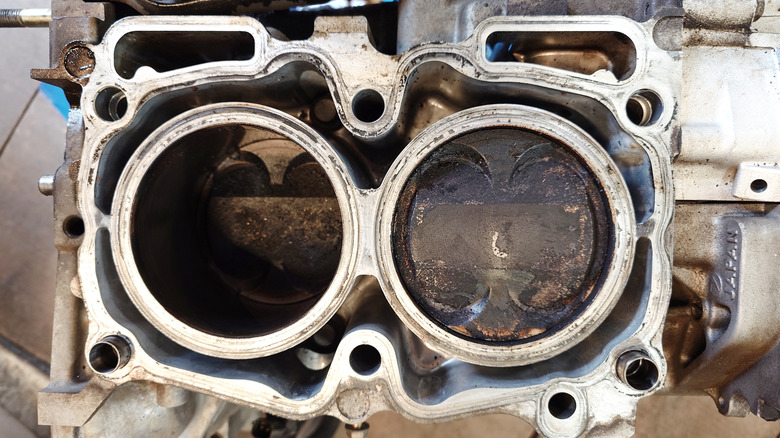
Now that we understand that, we can begin to discuss the differences between closed-deck and open-deck engine blocks. In an open-deck engine, there is open space around the top of the cylinders that allows the coolant to circulate more freely. In a closed-deck design, in case you haven’t guessed it by now, the deck features extra material that offers less in the way of cooling, but it does support the cylinders more rigidly. Let’s pop the cylinder head off and have a closer look at these engine block types and why they matter more than you may think. 

Open-deck engines are cool, but flawed

For engine makers, there are definite advantages to open-deck designs — they cost less to manufacture when compared to closed-deck engines, and keep the engine cooler by exposing more of the surface area of the cylinder to the cooling liquid. 

However, all this open space around the cylinders is all very well and good when looking at cooling and manufacturing complexity — but cracks start to appear (sometimes literally) when we look at other aspects of closed-deck engine blocks. While it’s unfair to call open-deck engines unreliable and leave it at that, there are trade-offs in the design, and these become more noticeable in high-performance situations.

Essentially, the lack of material at the top of the engine deck means the engine is less structurally rigid right at the point where it meets some of the most extreme forces engines have to cope with — the combustion point at the top of the cylinder.

If you removed the head from an open-deck design and look down at the deck, this structural weakness is visible. From this viewpoint, the cylinders look separate from the rest of the engine block, with the gap between the two being used for coolant, as some open-deck designs have limited support at either end of the cylinder bank. While this gives more space for coolant to move freely, the downside is that it also does the same for the cylinder. Over time, even the limited movements of cylinders can weaken the head gasket and bring all the associated troubles that follow such a failure. 

Why some engines use closed- and semi-closed deck designs

Open-deck engine blocks are optimized for cooling and manufacturing efficiency. However, incorporate such a configuration in a high-revving, turbocharged brute of an engine and, well, it could end very badly. This is why such engines will usually use a closed-deck configuration. 

In a closed-deck engine, the open spaces around the cylinders of an open deck are filled with additional material. Obviously, the removal of such space and the flexibility it gives to the cylinders substantially strengthens the engine block. This is why some people fill engine blocks with concrete — it removes the flexibility afforded by the presence of cooling chambers. This is especially important for high-performance engines, but to call it overkill for the family runabout is not overstating the case. 

However, and the more observant among you will be there by now, filling an engine’s cooling cavities with material may add strength — but at the expense of cooling efficiency. This is why many modern turbocharged engines or higher-performance engines use a halfway house design in the form of semi-closed decks. 

Semi-closed decks are a compromise design that offers more rigidity to the cylinders by adding more support points. These supports are usually at the top of the cylinder. For instance, while there are pros and cons to Subaru’s EJ20 engine, the company released a version with a semi-closed deck with four additional support points, which should make it less prone to bore distortion. Ultimately, open-deck and closed-deck engine blocks represent design decisions based on the demands the engine is expected to handle. 


Source link