Another US State Wants To Put Speed Limiting Devices On The Cars Of Fast Drivers


Speeding is serious, from putting drivers and pedestrians in harm’s way to the damage it can do to a person’s driving record. While speed limit enforcement helps limit the number of speeders on the road, many continue to ignore the law. In response, state legislators are taking action. Most recently, Washington state passed House Bill 1596. The law is also known as the BEAM Act, in memory of Boyd Buster Brown, Eloise Wilcoxson, Andrea Smith Hudson, and Matilda Wilcoxson, who were killed in a high-speed crash in 2024. 

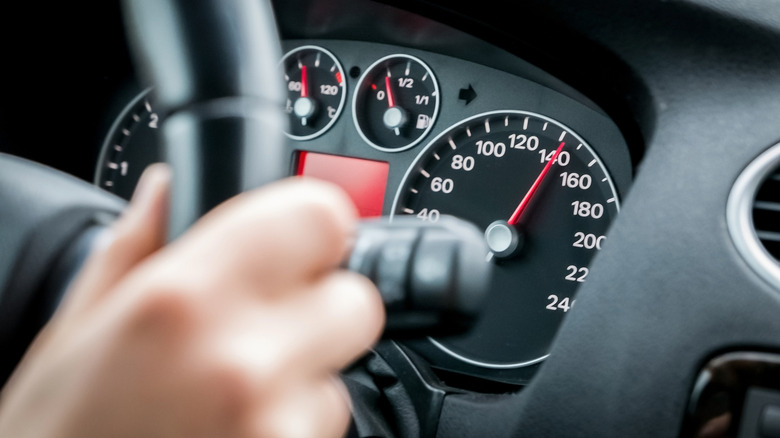
When the law goes into effect, Washington drivers with licenses suspended for reckless driving or excessive speeding will be required to install an “intelligent speed assistance” device or speed limiter before being allowed to obtain a restricted driver’s license. The device mentioned in the bill will use GPS technology to monitor the vehicle’s speed, forcing the driver to stay within a preset speed limit. A driver will only be able to override the device three times per month. 

The Washington bill defines excessive speeding as 10 mph or more above the limit when the posted speed limit is 40 mph or less, and 20 mph or more above the limit when the posted speed limit is greater than 40 mph. It comes after other states like New York introduced speed limiter laws for those said to have shown especially reckless driving habits. Bill 1596 isn’t set to go into effect until January 2029, so Washington drivers have time to familiarize themselves with the nuances of this law. They’ll certainly want to, since violating the requirements means financial penalties and the potential for further trouble with the law.

Washington’s speed limiter law comes with fees and penalties

On top of speed restrictions and monitoring, there are other consequences for drivers who end up on the wrong end of Washington’s speed-limiter law. For one, there are financial considerations, since the device isn’t free. Unless they qualify for a waiver, drivers will have to pay for installing, removing, and leasing it. They’ll also have to pay a $21 monthly fee to the device manufacturer, which will send the money to the state’s Department of Licensing, which will be used to help those in need of financial assistance obtain the device.

Moving away from financials, there are also consequences for attempting to manipulate the speed limiter device once it’s connected to the vehicle. Whether the person who has to drive with the limiter does so, or has someone else do it on their behalf, attempted removal, alteration, or any other form of tampering outside of valid safety or repair reasons will result in a gross misdemeanor charge. The punishment for such charges can mean up to a year in prison and a hefty $5,000 fine.

Traffic law is ever-changing in the United States. Several states have begun adopting variable speed limits, and, evidently, speed limiter devices are becoming an increasingly common tool for cracking down on speeding and the dangers that come with it. Once Washington House Bill 1596 goes into effect in 2029, we may see just how game-changing these devices can really be for the state.


Source link

Leave a Reply

Subscribe to Our Newsletter

Get our latest articles delivered straight to your inbox. No spam, we promise.

Recent Reviews


Researchers in South Korea developed a wearable system that uses seven smart rings to read finger and hand motions to translate American Sign Language and International Sign Language into text. The purpose is to make communicating easier between those who sign and nonsigners without needing a separate human interpreter. 

AI Atlas

According to the study, published Friday in the journal Science Advances, the system reliably recognized 100 ASL and ISL words during testing. It also performed well with users the system had not seen before, and it didn’t require recalibration for each person. Because the system detects words in sequence, it can produce sentence-level translations without extra training on grammar. 

ASL and ISL are the everyday languages of more than 72 million deaf and hard-of-hearing people. However, most hearing people do not know any words in these languages or have a very basic understanding. That gap makes certain tasks, like ordering at a restaurant or asking for help, much more difficult. 

A graphic shows two illustrated people talking in sign language, ASL and ISL. The graphic also shows the different components of the ring as well as pictures of hands modeling the rings.

A concept of how the rings work in the real world. 

American Association for the Advancement of Science (AAAS)

Existing sign language translator prototypes often rely on bulky gloves that can distract from or block natural hand movement or feel uncomfortable for the wearer, which limits real word adaption. Camera-based technologies can work well in controlled environments but are often limited to those places where a camera can be set up with a clear line of sight, the researchers wrote. 

To solve these problems, the researchers designed sensing rings for each finger that can capture precise motion and finger position while letting the hands move naturally. The rings can detect both signs that involve movement, like the words for “dance,” “fly” and “sun,” and signs that are held still, like “I” and “you.”

“These advances suggest that [the device could enable] barrier-free public translation systems for unseen users and unrestricted daily assistive interfaces,” the authors wrote in the study. 

The authors are affiliated with Yonsei University, Hankuk University of Foreign Studies and the Korea Institute of Science and Technology, among others. While the technology is still experimental, the authors wrote that the technology has the potential to ease communication difficulties. The underlying idea could also help improve controls for other systems, like virtual or augmented reality.

“Beyond sign language translation, the ring-type, wireless, and modular architecture of (wirelessly connected, ring-type sign language translators) may also be extended to other gesture-driven applications such as virtual or augmented reality control, touchless device interfaces, or rehabilitation monitoring systems where fine-grained hand movement tracking is essential,” they wrote.


Source link