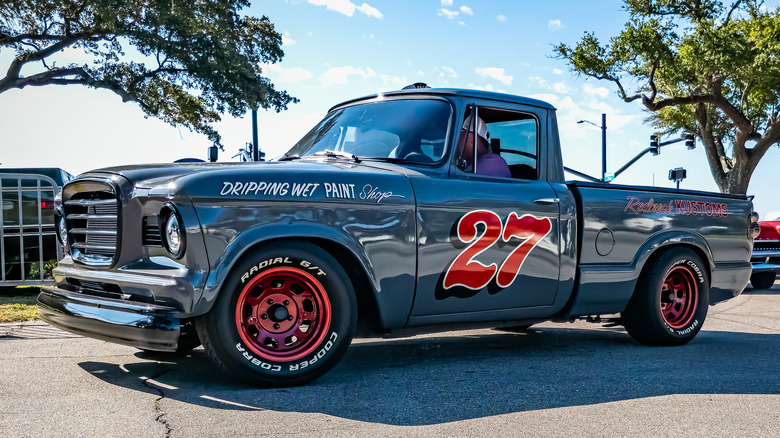

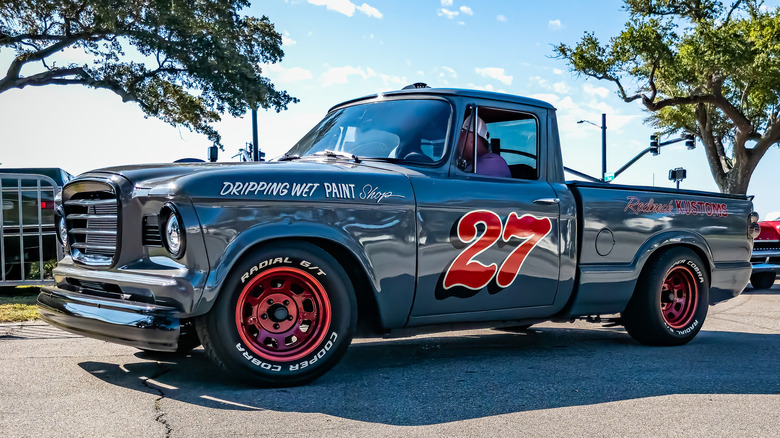
The year 1963 started out optimistically for Studebaker, but the end of that same year would also spell the end of U.S. production for the long-running brand. As of December 9, 1963, all of the company’s production moved from its original South Bend, Indiana factory to its Hamilton, Ontario, Canada plant. By March 17, 1966, production would also end in Canada, marking the end of the brand entirely. However, for a little while in the 1960s, Studebaker had one of the most powerful engines it had ever built. And two of those went into pickup trucks from the ’60s that look even cooler today.
Studebaker was an independent vehicle producer without the resources of a General Motors, Ford, or Chrysler. It badly needed to “pep up” its aging vehicle lineup — and chose a performance boost as the way to do it. In 1963, having just acquired the Paxton company that made superchargers, the company decided to offer them across its complete line of automobiles.
These supercharged versions, which used a Paxton SN60 supercharger integrated into the company’s 289 cubic-inch V8s and given the R2 designation, were made available on Studebaker’s Avanti, Lark, and Gran Turismo Hawk cars. In addition to these production cars, the Studebaker engineering department had also ordered two R2 supercharged versions of its Champ pickup truck. This was almost four decades before Ford would first use a supercharger to give a literal boost to its 1999 SVT F-150 Lightning, a very special muscle truck.
What else should you know about Studebaker and its supercharged pickups?
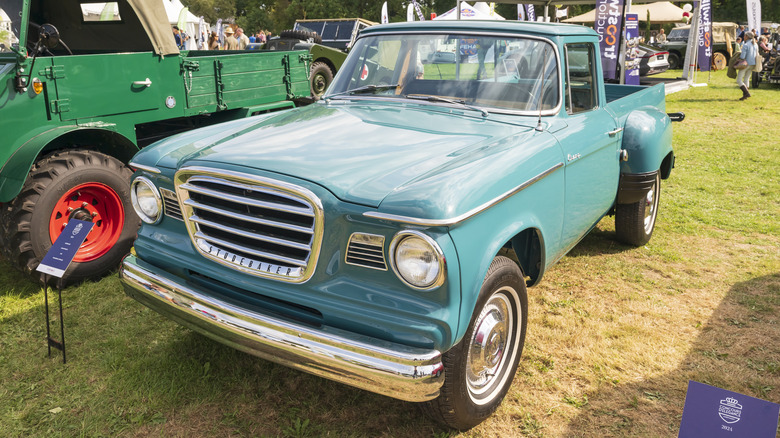
The Champ pickup truck was Studebaker’s last stab at the pickup market before fading away. It utilized the Studebaker Lark’s front clip, dashboard, and doors, in an attempt to look fresh. The current whereabouts of the two rare supercharged Champ pickup trucks are unknown. However, what is known is that one was white and the other was black, with the white one getting an automatic transmission and the black one getting a four-speed manual. Other options that were added to the black Champ pickup were dual exhaust, gauges, an oil cooler, power steering, and disc brakes. The white Champ was ordered by an Indianapolis, Indiana businessman, while the black one eventually made it to the western U.S., where it reportedly resides.
As to what happened to Studebaker, it had been founded back in 1852, when its primary business involved making a variety of horse-drawn wagons, including the Conestoga wagons that crossed the American prairie as settlers headed west. The company entered the automobile business in 1902 making electric vehicles, switching over to internal combustion engines in 1911. By the 1920s, it had stopped making horse-drawn vehicles entirely.
Studebaker had its ups and downs for the next few decades, and in 1954 the company was acquired by Packard, becoming the Studebaker-Packard Corporation. Unfortunately, competing with full-line manufacturers with deep pockets was a losing game, and Studebaker had to call it quits in 1966. Production of the Champ pickup ended when the company shuttered its South Bend plant in 1963.

Stephan is the sports journalist for the Maple Grove Report.