

Verdict
This wildly ambitious all‑in‑one is the antithesis of everyday audio, and those that can put it to good use will enjoy thrilling fidelity and envelope-busting functionality – but it’s a challenge to use and comes at a price
-
Striking industrial design
-
Stunning tri‑mode amplification
-
Extensive processing options
-
Frightening price
-
Unashamedly over-engineered
-
Overtly complicated
Key Features
-
DAC
Four Burr-Brown DSD1793s
-
Modes
Solid-State mode, Tube Mode, and Tube+
-
All-in-one
DAC, preamp, streamer, headphone amp
Introduction
The iDSD Phantom is a (take a deep breath) reference class DAC, streamer, preamp, headphone amplifier that offers studio grade audio in a lifestyle friendly desktop chassis.
Able to drive high-end headphones, dovetail with high-calibre systems, and offering an often bewildering number of playback options, it’s the most ambitious offering from IFi Audio.
Building on the company’s earlier Pro iDSD two channel DAC/amp, this newcomer adds DSD2048 remastering, a novel quad DAC architecture, and tri-mode amplification.
It’ll almost certainly do more than what you’ll want it for – but is that a plus or a minus? Let’s give this headphone amp with delusions of grandeur a closer listen…
Price
Clearly, the iDSD Phantom’s not inconsiderable ambition comes at a cost. Available now and unapologetically premium, it sells for £4,499 in the UK, with international pricing set at $4,499 USD and €4,695.
Nearest rivals are probably the Ferrum WANDLA DAC/preamplifier, and the Chord Hugo TT2 DAC/preamp with M Scaler, but neither quite match the iDSD Phantom’s specification bouquet.
Design
- Circular OLED display
- Compact design
- Transparent valve window
iFi Audio has a reputation of eye-catching industrial design, and this new Phantom continues that tradition. The unit adopts a two-tier construction, with a polished silver upper section (home to the DAC and streamer) and a matte black base (which houses amplification).
The aesthetic is said to draw inspiration from Rolls-Royce, and while that sounds a bit pretentious, there’s an undeniable sense of luxury in the materials and finish.
For all that, the iDSD Phantom is surprisingly compact, occupying less space than some single-purpose streamers. With a footprint of just 256 x 185 x 120mm, it’s relatively easy to accommodate on a desk or bureau.

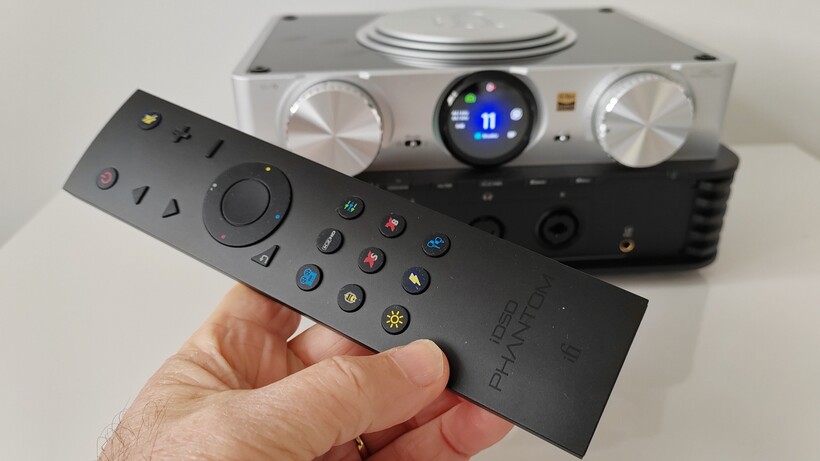
The front fascia is dominated by a circular OLED colour display. This is flanked by rotary controls that double as push buttons. These govern volume, input selection and navigation through the device’s multiplicity of modes. There’s also small physical buttons for the various processing models, although the use of equally tiny typography doesn’t favour presbyopics.
Beneath this, you’ll find the many headphone options. If you’re not using these, a magnetic plate completes the grille design.
Through the transparent glass top panel, the internal architecture is partially visible, including the softly glowing GE5670 tubes that power its valve output stages.
Also supplied are a range of cables, and an Optibox transceiver, should you need one.
And yes, the power supply is a separate brick (actually a high-spec iPower Elite 15V power supply).

User Experience
- Album art of VU meter display
- Manual amplifier switching
- Bluetooth remote control
Setting up the iDSD Phantom involves connecting it to a home network via the iFi Nexis app, then choosing just how you want to use it. Navigation via the rotary/ push dials is broadly intuitive, though the sheer number of options means some acclimatisation is required.

The central OLED doesn’t just unlock settings, it can also present album artwork or display VU meters. I like that you don’t need to use the app to tweak. Physical switches let you toggle output modes and processing options, useful if you’re sitting in close proximity to the unit.
But my evaluation wasn’t without hiccups. The unit bricked during a firmware update (iFi suggested it was a server issue at their end), which then involved a convoluted restoration process.
Features
- K2 HD upsampling
- Quad DAC configuration
- Tri-amplification output
- Post processing spatial adjustments
Extensive, and in some cases unique. That about sums up the iDSD Phantom’s feature résumé. At its core is a quad Burr-Brown DAC configuration, in an interleaved arrangement to improve linearity and detail retrieval.
This is paired with a Class A amplification stage capable of delivering up to 7747mW, which is more than sufficient to drive demanding headphones.
The system can also remaster audio to DSD2048, using a proprietary FPGA-based engine. The intent is to shift quantisation noise well outside the audible band, thereby preserving clarity and micro-detail in a way that more closely resembles studio-grade monitoring.
There are three amplification options. Solid-state uses discrete J-FET circuitry for surgical precision; Tube mode engages NOS GE5670 valves for warmth and harmonic richness, while Tube+ pushes that further, deliberately elevating second-order harmonics.
Additional processing includes XBass Pro and XSpace Pro for tonal and spatial enhancement, plus K2HD technology, designed to restore lost harmonics.

Developed in collaboration with JVC Kenwood, K2 first appeared on the Japanese Hi-Fi scene back in the late eighties. It was designed to replace nuances lost during digital encoding, and was developed by Victor Studio engineers, who used their archive of master recordings as reference.
I’ve always been a bit of a fan. The iDSD Phantom offers both a native-resolution K2 mode, and a new, upscaling K2HD variant.
XBass Pro is a selectable low-frequency boost that doesn’t impact the midrange, while XSpace Pro aims to replicate speaker-like spatial cues.
Everything considered, it’s quite the sonic toolset.
Connectivity
- Balanced and unbalanced outputs
- AES/EBU pro audio XLR
- Wi-Fi but no Bluetooth
As you might expect of a highly jacked headphone amp/preamp, connectivity is extensive. There’s support for balanced and unbalanced head-fi, with 3.5mm, 4.4mm, XLR and dual 6.3mm sockets, while inputs comprise USB-A, USB-B, coaxial digital audio and AES/EBU pro audio XLR, plus Ethernet and Wi-Fi network streaming. There’s no Bluetooth (although if you need it, you could always connect an external Bluetooth receiver).

More esoteric still is an I/O BNC for a 10MHz clock signal, and an industrial grade M12 X Ethernet (up to 10 Gb/s) connection. USB-C is provided for service and firmware updates.
The unit is compatible with Qobuz Connect, Tidal Connect, Spotify Connect, DLNA/UPnP and AirPlay 2. It’s also Roon-ready. Analogue outputs include both RCA phonos and XLR, supporting integration into an existing Hi-Fi system.
Performance
- Customisable listening
- Astonishing detail
- Spatially layered
With so much science beneath the hood, it would be a crushing shame if the iDSD Phantom sounded anything less than sensational. Thankfully, it delivers on its promise.
I listened primarily on headphones, using Sendy Audio Peacock planar magnetic cans, which are wonderfully revealing.
Playing through a variety of genres, from easy listening smooth jazz to Caribbean party beats, I enjoyed a richly detailed and spatially expansive listening experience, with instruments and vocals occupying clearly defined positions within the soundstage. If there’s such a thing as sonic depth-of-field, this system delivers it.
Of course, qualification is required. For me, there are two irresistible keys to understanding the Phantom’s performance – that aforementioned switchable amplification, and the execution of that K2 processing.
When it comes to the former, there’s no one size fits all, and my preferences wavered. The solid-state mode offers enviable precision and control. It doesn’t sound dry, rather it exhibits a glassy transparency that’s mesmerising.

But I was often drawn to the Tube settings, which introduce a softer, more rounded character. Perhaps I was being seduced by the soft glow of those GE5670 tubes? I wouldn’t rule it out.
I think I preferred the standard Tube setting, although I’m not convinced I could tell it apart from its Tube+ stablemate in a blind listening comparison. We’re talking about very granular points of difference here.
Many settings tease with incremental refinement. They’re tiny rabbit holes of joy. K2 processing definitely enhances perceived detail, and K2HD adds a degree of extra polish, but XSpace Pro I’m not so sure about.
Long story short: for all its technical prowess, the iDSD Phantom remains fundamentally musical. Everything I played made me very happy indeed.
Should you buy it?
If you want state of the art, reference‑class headphone amp/DAC/streamer/preamp, the iDSD Phantom certainly fits the bill. It’s astonishingly capable, sounds fabulous, and looks every bit as impressive as its high price might suggest.
If you want a fuss free, singular audio solution, this really isn’t for you. Its high cost and baked in complexity will likely outweigh any sonic windfall.
Final Thoughts
The iDSD Phantom shows what a single-box audio system can achieve when the vision behind it is uncompromising. It’s an impressive testament to innovative design, advanced digital processing, and good old-fashioned craftsmanship.
Most importantly, it sounds great. I’m particularly impressed with the duality of those amplification options – channelling audiophile valve warmth alongside solid state precision is a win-win in my book. The return of K2 processing (which I thought had been consigned to the annuals of Japanese Hi-Fi history) is a very welcome refinement.
This iFi flagship offers a level of flexibility rarely seen in one device, so much so that during my audition I barely felt like I was scratching the surface. This is a complex beast that I suspect will be over qualified for most users, and the price is a stinger.
Still for those that can justify it, and are determined to use its many talents, this is an exceptional bit of kit.
How We Test
We test every DAC we review thoroughly over an extended period of time. We use industry standard tests to compare features properly. We’ll always tell you what we find.
We never, ever, accept money to review a product.
Find out more about how we test in our ethics policy.
- Tested for several days
- Tested with real world use
FAQs
Yes, its high output power and range of connections make it compatible with a huge variety of headphones, including demanding planar magnetic designs. Just not Bluetooth.
Yes, but they offer subtle variations rather than dramatic changes. The idea is to fine-tune the presentation, rather than completely alter it.
Full Specs
| ifi iDSD Phantom Review | |
|---|---|
| UK RRP | £4499 |
| USA RRP | $4499 |
| EU RRP | €4695 |
| Manufacturer | iFi Audio |
| Size (Dimensions) | 185 x 120 x 265 MM |
| Weight | 3.6 KG |
| DAC | 4x Quad Burr-Brown DSD1793 |
| Release Date | 2026 |
| Resolution | x |
| Connectivity | AirPlay 2, DLNA, Roon Ready, Qobuz Connect, Tidal Connect, Spotify Connect |
| Audio Formats | PCM up to 768kHz, Native DSD512, DSD remastering up to DSD2048 |
| Inputs | USB-B 3.0, coaxial optical (S/PDIF), AES/EBU, 2x USB-A, |
| Outputs | RCA phono (unbalanced), XLR (balanced), 3.5mm S-balanced, 4.4mm balanced, 4-pin XLR, Dual 6.3mm |

Stephan is the sports journalist for the Maple Grove Report.


