Breaking: Meteor Observed Over Mayon Volcano on May 25 (Advisory)


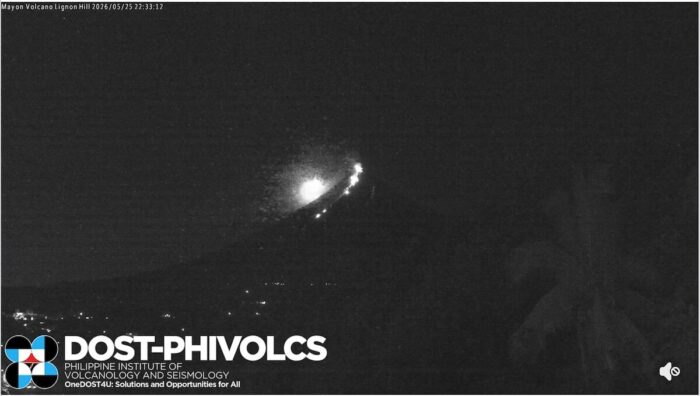
Quezon City – The bright streak of light captured over Mayon Volcano by the Philippine Institute of Volcanology and Seismology (PHIVOLCS) Ligñon Hill camera at 10:33 PM on 25 May 2026 was caused by a meteor entering the atmosphere, a phenomenon that often produces a brilliant flash.
Meteor Observed Over Mayon Volcano on May 25

Meteor Observed Over Mayon Volcano on May 25

While meteors or space rocks enter Earth’s atmosphere daily, the vast majority disintegrate completely before reaching the ground. These meteors typically burn up at altitudes ranging from 60 to 100 kilometers above sea level. As they plunge through the dense layers of the atmosphere at incredible speeds—sometimes tens of kilometers per second—the friction between the meteor’s surface and the air molecules generates intense heat.

This extreme heat causes the meteoroid to vaporize, leaving behind a luminous trail in the sky. The process also ionizes the surrounding air, creating a bright, glowing streak known as a “shooting star.” These streaks are often observed as fleeting flashes of light darting across the night sky. The brightness and duration of a meteor depend on its size, speed, and composition. If a fragment of the meteoroid is large enough to withstand the fiery descent and reach Earth’s surface, it is classified as a meteorite. Such fragments can range from tiny grains to large blocks. The study of meteorites provides valuable insights into the early solar system, as they are considered extraterrestrial relics that have remained largely unchanged for billions of years.

The event was visually striking, prominently featuring the majestic Mayon Volcano in the foreground of PHIVOLCS’ video footage. Its symmetrical, almost perfect cone shape stood out clearly against the bright sky, creating a breathtaking backdrop for the scene. The volcanic landscape, with its rugged slopes and hints of volcanic activity, added an element of awe and natural beauty. Tracking meteor trajectories is a complex scientific endeavor.

Across the globe, scientists rely on an intricate network of radar installations and optical cameras to detect and monitor meteors as they streak through the Earth’s atmosphere. These instruments work in tandem with advanced data analysis techniques and sophisticated computational models to accurately trace the paths of these fleeting celestial objects. Such efforts help researchers better understand meteors’ origins, behaviors, and potential impacts, contributing to our broader knowledge of space and planetary defense.

(Photo credit: DOST–PHIVOLCS)

Please follow #TeamOutofTown on Facebook, Twitter, Instagram, and Pinterest for more travel ideas.

Read: Mayon Volcano: Legend and awesome reality


Source link

Leave a Reply

Subscribe to Our Newsletter

Get our latest articles delivered straight to your inbox. No spam, we promise.

Recent Reviews


Researchers in South Korea developed a wearable system that uses seven smart rings to read finger and hand motions to translate American Sign Language and International Sign Language into text. The purpose is to make communicating easier between those who sign and nonsigners without needing a separate human interpreter. 

AI Atlas

According to the study, published Friday in the journal Science Advances, the system reliably recognized 100 ASL and ISL words during testing. It also performed well with users the system had not seen before, and it didn’t require recalibration for each person. Because the system detects words in sequence, it can produce sentence-level translations without extra training on grammar. 

ASL and ISL are the everyday languages of more than 72 million deaf and hard-of-hearing people. However, most hearing people do not know any words in these languages or have a very basic understanding. That gap makes certain tasks, like ordering at a restaurant or asking for help, much more difficult. 

A graphic shows two illustrated people talking in sign language, ASL and ISL. The graphic also shows the different components of the ring as well as pictures of hands modeling the rings.

A concept of how the rings work in the real world. 

American Association for the Advancement of Science (AAAS)

Existing sign language translator prototypes often rely on bulky gloves that can distract from or block natural hand movement or feel uncomfortable for the wearer, which limits real word adaption. Camera-based technologies can work well in controlled environments but are often limited to those places where a camera can be set up with a clear line of sight, the researchers wrote. 

To solve these problems, the researchers designed sensing rings for each finger that can capture precise motion and finger position while letting the hands move naturally. The rings can detect both signs that involve movement, like the words for “dance,” “fly” and “sun,” and signs that are held still, like “I” and “you.”

“These advances suggest that [the device could enable] barrier-free public translation systems for unseen users and unrestricted daily assistive interfaces,” the authors wrote in the study. 

The authors are affiliated with Yonsei University, Hankuk University of Foreign Studies and the Korea Institute of Science and Technology, among others. While the technology is still experimental, the authors wrote that the technology has the potential to ease communication difficulties. The underlying idea could also help improve controls for other systems, like virtual or augmented reality.

“Beyond sign language translation, the ring-type, wireless, and modular architecture of (wirelessly connected, ring-type sign language translators) may also be extended to other gesture-driven applications such as virtual or augmented reality control, touchless device interfaces, or rehabilitation monitoring systems where fine-grained hand movement tracking is essential,” they wrote.


Source link