
Follow ZDNET: Add us as a preferred source on Google.
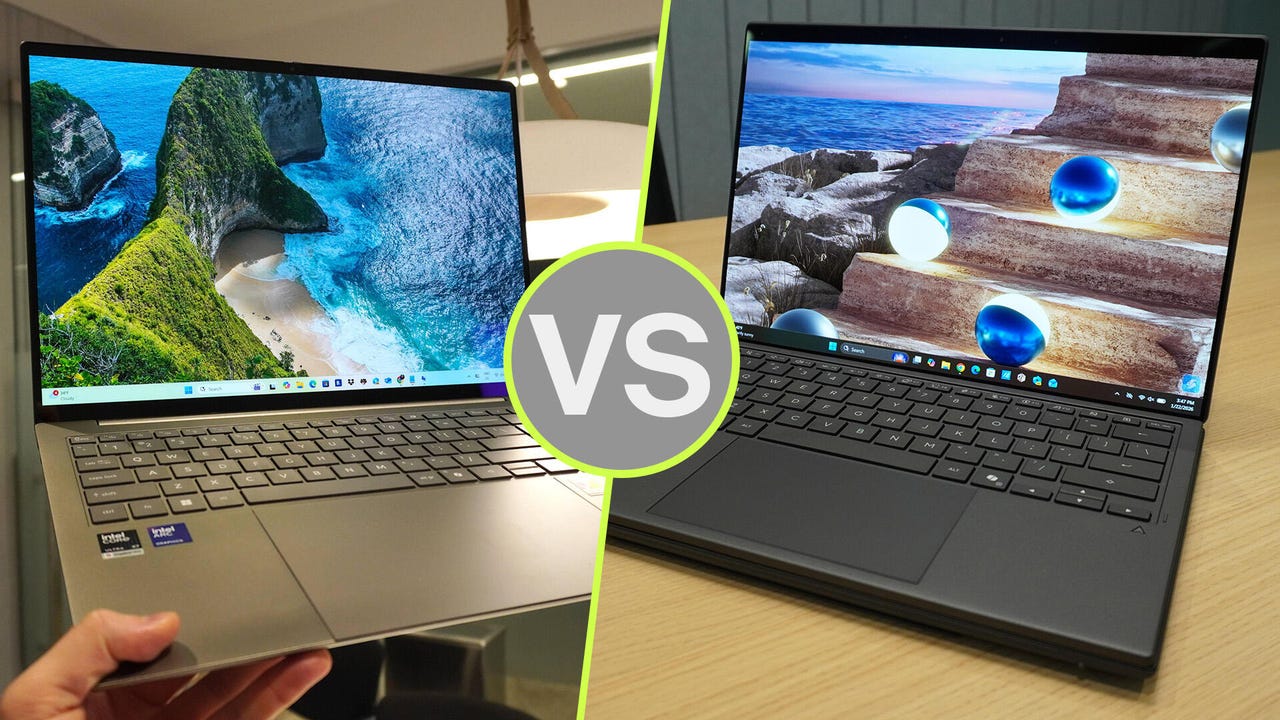
Acer and Asus are two of the top consumer laptop brands, but they couldn’t be more different in their offerings. Acer tends to focus more on practicality and value, with sensible machines and decent hardware at affordable prices. Asus, on the other hand, leans into the premium experience with vibrant OLED screens, powerful hardware, and ambitious — even experimental — designs.
For example, some models, like the Asus ZenBook Duo‘s dual screens, offer unconventional form factors you don’t see anywhere else. The company is not afraid to push the boundaries of design and interaction.
Also: Dell vs. Lenovo: I’ve tested dozens of laptops from both brands, and here’s my pick
So, which laptop brand should you buy? Acer is generally a better choice for people who want a more practical computer, while Asus makes more sense for users who want a more high-end machine with better hardware. Here’s a breakdown of where Acer and Asus each shine.
You should buy an Acer laptop if…
1. You want the best overall value
Acer consistently undercuts rivals’ pricing while still providing dependable performance and hardware. Two good examples are the Acer Aspire Go 15 and the Aspire Vero Green, both of which regularly sell for under $500. It’s worth noting that the Aspire Go 15 has been recommended many times over the years for striking that perfect balance between cost and functionality. It’s a great work computer.
Many of these machines are equipped with the latest Intel Core Ultra and AMD Ryzen processors, keeping the hardware responsive during day-to-day use. Even when multitasking and juggling multiple browser tabs and applications, Acer computers rarely feel sluggish.
Also: Best VPN services 2026: Expert tested and recommended
This value-first philosophy extends to Acer’s gaming lineup as well. Models like the Acer Nitro V 15 feature displays with fast refresh rates, capable cooling systems, and Nvidia RTX 50-series graphics cards, all at lower prices than competing Asus ROG laptops. This isn’t to say that Acer has no high-end models. The Swift Edge 14 costs $1,500 and features a vibrant 3K display and an ultrathin build.
2. You prefer a more practical design
Acer’s design language is pragmatic, and this works in its favor. Its devices are meant to blend naturally into office and school environments, opting for subtlety over flashy aesthetics or gimmicks. Devices like the aforementioned Aspire Go 15 have a clean, understated design that is notably professional.
They’re also sleek without being overly thin, allowing Acer to equip these models with comfortable keyboards, a generous selection of ports, and robust cooling systems. They still sport vivid displays, however; with virtually all of the 2026 mainstream consumer product lines with OLED options.
You should buy an Asus laptop if…
1. You want the best laptops for content creation
If you’re looking for a laptop to create content with, I highly recommend an Asus laptop over an Acer, as the brand has several models specifically designed for creative workloads. They often pair powerful processors with discrete Nvidia RTX graphics cards for high-resolution video rendering or 3D modeling (and some gaming on the side).
Review: Asus ProArt P16
They also boast some of the best laptop displays on the market. Many Asus models feature high-end OLEDs with tandem displays and Asus’ proprietary Lumina tech, outputting vibrant images with deep contrast and accurate colors. You’ll notice how high-quality they are the moment you lay your eyes on an Asus screen. They look incredibly sharp.
Additionally, certain models like the ProArt P16 have creator-specific features such as the DialPad, a small wheel on the trackpad that can be customized to certain actions like changing brush sizes in Photoshop or scrolling through a video timeline in Adobe Premiere. To top it off, it has a gorgeous display and powerful processor, plus a six-speaker system and smudge-resistant finish.
2. You want a unique design
If there’s one area where Asus boldly stands out from the competition, it’s with pushing the boundaries of design. Asus regularly experiments with unconventional form factors, particularly with the Zenbook Duo.
Review: Asus Zenbook Duo
Instead of a traditional clamshell design, the Duo features two full-size screens that can be used in multiple configurations. You can connect the accompanying keyboard to a single screen and use the Zenbook Duo as a regular laptop, or place the two panels on their side and use them as a dual-monitor setup. This flexibility opens up the door for a wide range of possibilities.
ZDNET’s Kyle Kucharski reviewed this laptop earlier in the year and found that swapping between the different panel configurations was easy and natural. It’s not just useful for creators; there are productivity applications, as well. He came to appreciate desktop mode with the screens turned vertically — ideal for reviewing documents or long lines of code.
Writer’s choice
If you’re familiar with my reviews, you’ll know that I value practicality above all else. I don’t care if a laptop has a super OLED, a 10,000mAh battery, or some other gimmicks. I just want one question answered: Does its value match the price tag?
Acer tends to answer “yes” to that question, which is why I give it the win in this comparison. It’s the better choice for most people. They’re just affordable and reliable machines with well-designed, grounded hardware.
Review: Asus Chromebook CX15
Asus focuses on providing a certain experience, particularly for content creators. That isn’t to say the company lacks budget options. Asus offers a solid range of Chromebooks, and its Vivobook lineup offers solid features relative to cost.
But Acer has a stronger presence in the lower- and midrange laptop space. If you want a dependable work computer, get an Acer. If you’re a content creator or want a powerful, feature-rich machine, Asus is the better choice.