The 45mm Pixel Watch 4 is $40 off, well ahead of Prime Day


Amazon’s Prime Day bonanza might not be too far off, but Google isn’t waiting to pass the savings on to you, with a new $40 discount on its flagship Pixel Watch over at Amazon.

That saving brings the Google Pixel Watch 4 down from $399.99 to $359.99, and at that price, it becomes one of the more complete Android smartwatches available right now.

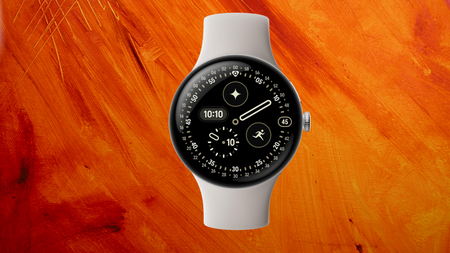
Pixel Watch 4 on an orange background

The Pixel Watch 4 (45mm) is $40 off right now, well ahead of Prime Day

Picking this up at $359.99 ahead of Prime Day means securing one of the year’s stronger smartwatch deals for a very agreeable price.

View Deal

The Actua 360 domed display is the first thing that distinguishes it physically, with scratch-resistant Gorilla Glass and a design that wraps around the edges of the case rather than sitting flat behind them, making the whole face feel more integrated than a conventional watch face.

Gemini is built in as the on-wrist AI assistant, which means asking for a playlist for a specific run pace or getting a quick reply drafted without picking up your phone are both genuinely hands-free rather than routed through a companion app.

Battery life is rated at up to 40 hours, and the fast charging story is equally strong: 15 minutes on the side charging dock delivers 15 hours of use, which means a short charge while you shower is enough to cover most of a day without anxiety.

Advertisement

The Whatsapp Logo

Get Updates Straight to Your WhatsApp

Join Now

Health tracking covers heart rate, SpO2, HRV, and sleep insights, and Loss of Pulse Detection can alert emergency services automatically if something is wrong, while Satellite SOS connectivity means the Google Pixel Watch 4 can reach help even without a phone signal nearby.

The aerospace-grade aluminium casing also carries an IP68 water resistance rating to 50 metres, runs Wear OS 6.0, and is compatible with Android 11 and above, making it a practical choice for anyone already in the Google ecosystem.

If you want to see how the Pixel Watch 4 sits within the wider field before committing, our guide to the best smartwatches covers every strong option across the market, and our best cheap smartwatch roundup is worth a look if you want to understand exactly how much watch your money buys at lower price points.

SQUIRREL_PLAYLIST_10148964

Advertisement


Source link

Leave a Reply

Subscribe to Our Newsletter

Get our latest articles delivered straight to your inbox. No spam, we promise.

Recent Reviews


Researchers in South Korea developed a wearable system that uses seven smart rings to read finger and hand motions to translate American Sign Language and International Sign Language into text. The purpose is to make communicating easier between those who sign and nonsigners without needing a separate human interpreter. 

AI Atlas

According to the study, published Friday in the journal Science Advances, the system reliably recognized 100 ASL and ISL words during testing. It also performed well with users the system had not seen before, and it didn’t require recalibration for each person. Because the system detects words in sequence, it can produce sentence-level translations without extra training on grammar. 

ASL and ISL are the everyday languages of more than 72 million deaf and hard-of-hearing people. However, most hearing people do not know any words in these languages or have a very basic understanding. That gap makes certain tasks, like ordering at a restaurant or asking for help, much more difficult. 

A graphic shows two illustrated people talking in sign language, ASL and ISL. The graphic also shows the different components of the ring as well as pictures of hands modeling the rings.

A concept of how the rings work in the real world. 

American Association for the Advancement of Science (AAAS)

Existing sign language translator prototypes often rely on bulky gloves that can distract from or block natural hand movement or feel uncomfortable for the wearer, which limits real word adaption. Camera-based technologies can work well in controlled environments but are often limited to those places where a camera can be set up with a clear line of sight, the researchers wrote. 

To solve these problems, the researchers designed sensing rings for each finger that can capture precise motion and finger position while letting the hands move naturally. The rings can detect both signs that involve movement, like the words for “dance,” “fly” and “sun,” and signs that are held still, like “I” and “you.”

“These advances suggest that [the device could enable] barrier-free public translation systems for unseen users and unrestricted daily assistive interfaces,” the authors wrote in the study. 

The authors are affiliated with Yonsei University, Hankuk University of Foreign Studies and the Korea Institute of Science and Technology, among others. While the technology is still experimental, the authors wrote that the technology has the potential to ease communication difficulties. The underlying idea could also help improve controls for other systems, like virtual or augmented reality.

“Beyond sign language translation, the ring-type, wireless, and modular architecture of (wirelessly connected, ring-type sign language translators) may also be extended to other gesture-driven applications such as virtual or augmented reality control, touchless device interfaces, or rehabilitation monitoring systems where fine-grained hand movement tracking is essential,” they wrote.


Source link