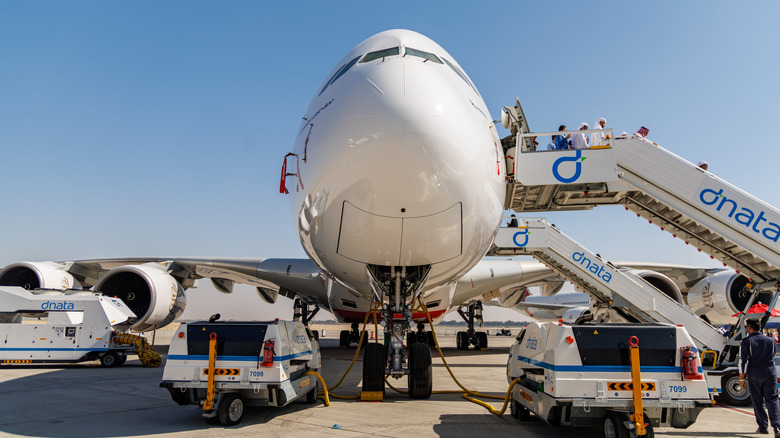
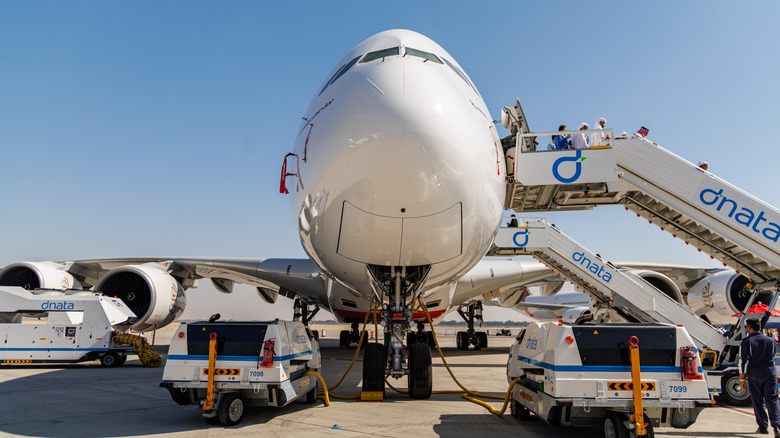
This Is The Largest Plane Currently Flying In 2026


As it is, the fact that passenger planes are a common sight in engineering is astounding. Then you consider that these forms of transportation are quite large, and the ability for them to take to the skies at all becomes even more amazing. There have been some pretty big jets over the years, but in 2026, which model is currently the largest in use? That honor goes to none other than the Airbus A380, a passenger plane that made its first flight in April 2005 and has been in use for public flights since late 2007.

In terms of its dimensions, the Airbus A380 is an astounding 239.5 feet in length and 78.7 feet high, with a wingspan of 262.5 feet. These proportions amount to a plane that can carry over 850 people with a total of just over 5,920 square feet between the two passenger decks. Speaking of passengers, their comfort and convenience throughout their flight are enhanced by the plane’s size. The A380 means larger seats, more standing height and legroom, and space for amenities like showers and lounges that other planes simply lack.

The Airbus A380 has spent many good years atop the passenger-plane heap as the largest in service. However, even after all these years since its introduction, its future doesn’t look entirely positive.

Boeing seeks to outdo the A380 as its presence diminishes
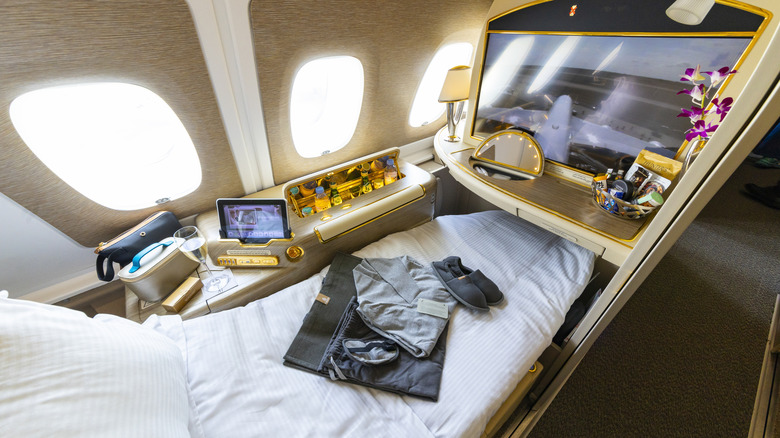
Initially, 500 Airbus A380 aircraft were proposed for production, though only 252 were actually produced. Ultimately, production of the A380 ended in 2021, as Airbus elected to discontinue it for several reasons. Estimates place the number still in use at around 220, hence the A380’s enduring place as the largest passenger plane in service. If Airbus’ competitors’ offerings get off the ground, though, it could very well lose some of its luster in short order.

One of the biggest companies in aviation, Boeing, has put in work on the Boeing 777-9, which is longer than the A380 at 251.6 feet. Though it first flew in 2020, it is still in the test-flight stage, and the company hopes for it to enter service by 2027 as the first in the wider Boeing 777X program to do so. There have also been talks of another, larger Boeing aircraft, the Boeing 777-10, dating back to 2016. It stems from Boeing’s desire to stretch the 777-9 to accommodate four more rows of passengers. In late 2025, it was claimed that feasibility studies for such a craft were imminent, though further information remains scarce regarding the 777-10 — assuming it becomes a reality at all.

For now, the Airbus A380 remains a true marvel of aviation. Surely someday a craft with even more historic dimensions will take to the skies, but as things stand in 2026, the A380 is the biggest of its kind.


Source link

Leave a Reply

Subscribe to Our Newsletter

Get our latest articles delivered straight to your inbox. No spam, we promise.

Recent Reviews


Researchers in South Korea developed a wearable system that uses seven smart rings to read finger and hand motions to translate American Sign Language and International Sign Language into text. The purpose is to make communicating easier between those who sign and nonsigners without needing a separate human interpreter. 

AI Atlas

According to the study, published Friday in the journal Science Advances, the system reliably recognized 100 ASL and ISL words during testing. It also performed well with users the system had not seen before, and it didn’t require recalibration for each person. Because the system detects words in sequence, it can produce sentence-level translations without extra training on grammar. 

ASL and ISL are the everyday languages of more than 72 million deaf and hard-of-hearing people. However, most hearing people do not know any words in these languages or have a very basic understanding. That gap makes certain tasks, like ordering at a restaurant or asking for help, much more difficult. 

A graphic shows two illustrated people talking in sign language, ASL and ISL. The graphic also shows the different components of the ring as well as pictures of hands modeling the rings.

A concept of how the rings work in the real world. 

American Association for the Advancement of Science (AAAS)

Existing sign language translator prototypes often rely on bulky gloves that can distract from or block natural hand movement or feel uncomfortable for the wearer, which limits real word adaption. Camera-based technologies can work well in controlled environments but are often limited to those places where a camera can be set up with a clear line of sight, the researchers wrote. 

To solve these problems, the researchers designed sensing rings for each finger that can capture precise motion and finger position while letting the hands move naturally. The rings can detect both signs that involve movement, like the words for “dance,” “fly” and “sun,” and signs that are held still, like “I” and “you.”

“These advances suggest that [the device could enable] barrier-free public translation systems for unseen users and unrestricted daily assistive interfaces,” the authors wrote in the study. 

The authors are affiliated with Yonsei University, Hankuk University of Foreign Studies and the Korea Institute of Science and Technology, among others. While the technology is still experimental, the authors wrote that the technology has the potential to ease communication difficulties. The underlying idea could also help improve controls for other systems, like virtual or augmented reality.

“Beyond sign language translation, the ring-type, wireless, and modular architecture of (wirelessly connected, ring-type sign language translators) may also be extended to other gesture-driven applications such as virtual or augmented reality control, touchless device interfaces, or rehabilitation monitoring systems where fine-grained hand movement tracking is essential,” they wrote.


Source link




