
Follow ZDNET: Add us as a preferred source on Google.
ZDNET’s key takeaways
- Dell’s new XPS 13 costs $599 for students and $699 for everyone else.
- It’s an open challenge to the MacBook Neo with a bigger display, lighter body, and better I/O.
- It features Intel’s new “Wildcat Lake” Series 3 CPU, designed for budget PCs.
When Dell’s COO Jeff Clarke announced the new XPS 13 ahead of Computex 2026, he made no attempt to avoid its inevitable comparison to the MacBook Neo. Oh no, he addressed it straight on. “We didn’t change a single feature when the Neo was launched. We stayed true to the XPS’ identity … And I think we’ve achieved it with the $599 price point.”
It’s a bold claim — refreshingly so — and the first time a PC maker has so openly positioned a flagship product in opposition to Apple’s wildly successful budget laptop that’s disrupted the PC market. The XPS 13 will cost $599 for students and $699 for the general market, a very aggressive price point for its feature set, especially with the iconic XPS name.
As the cost of memory soars (and consumer laptops with it), the Dell 2026 XPS 13 comes at just the right time, taking aim at students, young professionals, and budget-conscious consumers looking for a high performance laptop with premium features.
Lighter hardware, lighter price
Intel’s new “Wildcat Lake” Core Series 3 chips, announced earlier this year, trade in raw power for a much more affordable package. They use the same 18A process as Intel’s “Panther Lake” Core Ultra Series 3 CPUs, with similar battery longevity.
This includes the Intel Core 5 (6-core) or Intel Core 7 (8-core) chip, with an integrated Intel GPU with 2xe cores or 4xe cores respectively, offer less horsepower but still achieve up to 17 hours of battery life, according to Dell.
However, Clarke made it clear the new XPS is no “budget” PC. “We’re not in a race to the bottom,” he said. “We’re not trying to be the cheapest option.”
Yes, $599 for a new XPS is pretty dang cheap. But that’s for the lowest-end configuration. The Wildcat Lake chip, combined with the low-end RAM and storage options are the primary drivers of the competitive price.
Also: Dell XPS 14 (2026) review: A Windows laptop I wouldn’t mind returning to from Mac
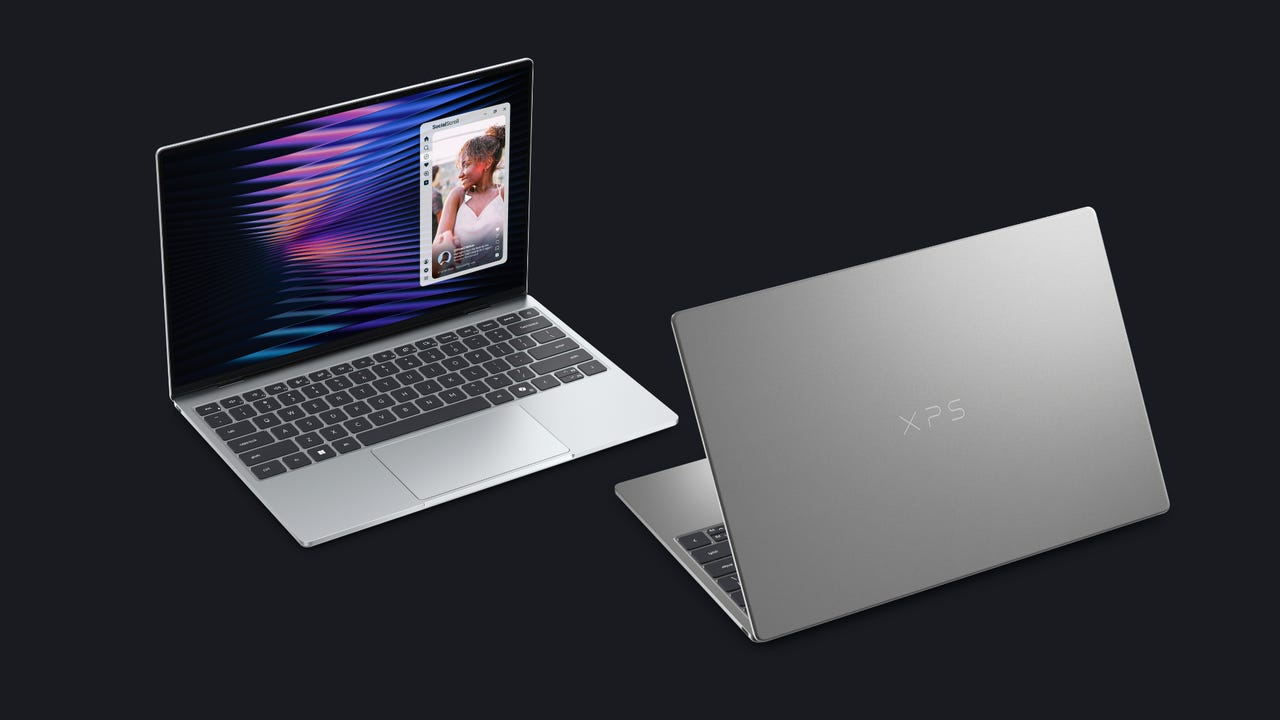
You have the option of 8GB, 16GB or 32GB of LPDDR5X RAM, and 256GB up to 1TB of storage. The rest of the device still looks pretty premium, especially the display — a 2.5K LCD touch display with a 120Hz variable refresh rate, 500 nits of brightness, and support for 100% of the DCI-P3 color gamut.
Where it beats the Neo
The XPS 13 is lighter than the Neo at 2.2 pounds (compared to 2.7) and has a slightly larger display at 13.4 inches (compared to 13). The InfinityEdge touch display allows for more flexibility to pinch and zoom, while there’s no touchscreen on any Macs (yet).
Oh, and it has backlit keys — something the Neo does not. Just note that these aren’t the zero lattice keys you’ll find on the 13’s more premium siblings, they’re the black “chiclet” keys that look a lot like, well, a MacBook. The result is a more generic-looking laptop (that’s not a bad thing) only differentiated by the “XPS” logo brandished on the clamshell.
The MacBook Neo in silver.
Kerry Wan/ZDNET
But it also beats the Neo when it comes to I/O. It has two USB-C 3.2 ports (one on either side) with support for power delivery and DisplayPort 2.1. The Neo is stuck with a USB-C port with up to 10Gb/s data transfer, with the other USB 2 port capping out at 480Mb/s. The XPS also supports more storage, up to 1TB — double that of the higher-tier Neo.
Also: We compared the MacBook Neo to its closest Windows and Chromebook rivals: by the specs
All of these options coalesce into a device that sure, you can score for $599 on the low-end: 8GB of RAM, 256GB of storage, and Intel’s Core 5 Series 3 CPU. But unlike the Neo, there are a lot more options to run with. Bumping up to 32GB of RAM and the 1TB SSD, for example, will raise the price well above $699, and at that point, I’d just consider the XPS 14.
It should be noted that the XPS 13 will still come in more higher-end configurations with the Intel Core Ultra Series 3 processors, but these models won’t be available until later — likely in the fall. Pricing for additional configurations have not yet been announced, but the XPS 13 will become available starting in summer 2026.