What Is The 50% Rule For Appliance Repair?


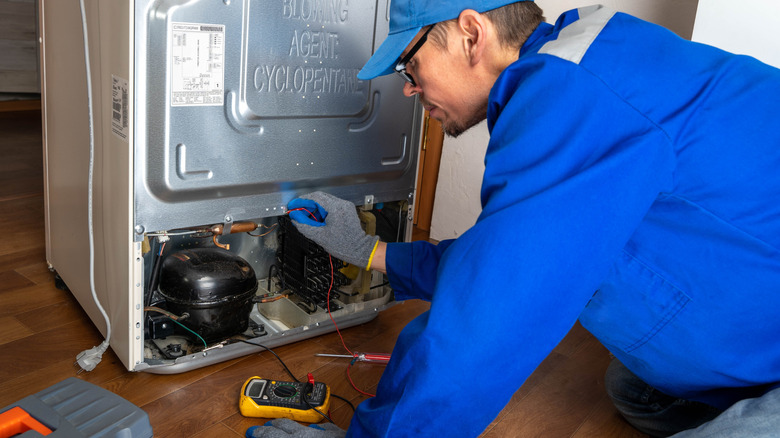
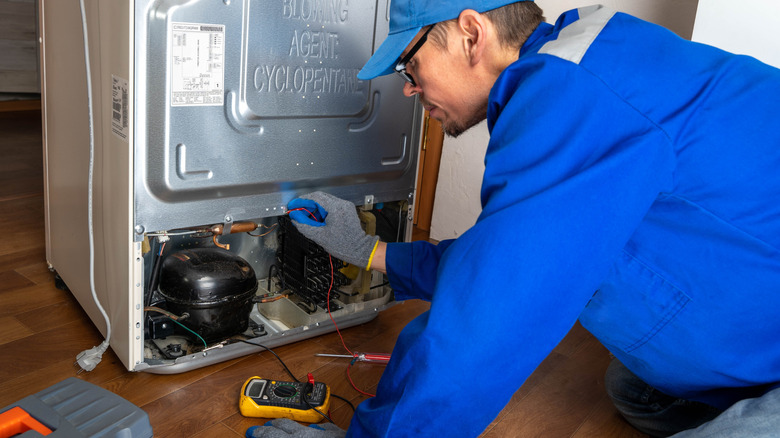
You don’t realize just how much you depend on your appliances until one of them goes down. It can happen when you least expect it, forcing you to decide whether or not to find a local repair service, or just buy a new appliance altogether. Before you take your home appliance in for repair, you should know the 50% rule, which says you don’t want to spend over half of what it would take to replace it.

Things can get tough when a repair estimate approaches that 50% line. For example, if you initially paid $1,500 for your refrigerator and the repair cost is $650, that might feel close enough to justify replacing it. But you also have to factor in the time it takes to research the right model, compare prices, and deal with added costs like delivery and installation. Plus, you could be waiting days or even weeks for a replacement to arrive. If the repair gets the original unit back to top form, it might make sense to just get it done.

Age should also play a role. Most appliances, including washing machines, have a limited lifespan. If a unit is nearing the end of its expected shelf life, it may begin breaking down more often. This means repairs will likely just be prolonging the inevitable. Older appliances tend to perform less efficiently as well, which could cost you more money in the long run.

What to know before getting an appliance repair estimate

If you need to get a repair estimate for an appliance, it’s important to know that the cost can vary based on a number of factors. The brand and model of the appliance, its age, and the urgency of the repair itself, can all play a part. The complexity of the repair is a factor as well, and the same is true of your location.

But before you call a local repair service, check the warranty on your appliance. If you don’t have that information or can’t remember if you have an extended warranty, you should contact the place of purchase. Home Depot and Lowe’s both offer warranties beyond manufacturer warranties. Just be sure to have your information ready to go and they should be able to help. If the warranty has expired, you can ask about replacement parts.

If you decide to get an estimate, you should try to find a reputable repair company. Some appliance manufacturers also have a network of trusted repair mechanics at their disposal. If not, this can be tough, so reaching out to friends and family for their recommendations can be a good idea. If you’re searching online, you can use Google to find repair services, read reviews, and get contact information. You can also visit the Better Business Bureau’s website, where you can use their Appliance Repair tool to find BBB accredited repair services. 


Source link

Leave a Reply

Subscribe to Our Newsletter

Get our latest articles delivered straight to your inbox. No spam, we promise.

Recent Reviews


Researchers in South Korea developed a wearable system that uses seven smart rings to read finger and hand motions to translate American Sign Language and International Sign Language into text. The purpose is to make communicating easier between those who sign and nonsigners without needing a separate human interpreter. 

AI Atlas

According to the study, published Friday in the journal Science Advances, the system reliably recognized 100 ASL and ISL words during testing. It also performed well with users the system had not seen before, and it didn’t require recalibration for each person. Because the system detects words in sequence, it can produce sentence-level translations without extra training on grammar. 

ASL and ISL are the everyday languages of more than 72 million deaf and hard-of-hearing people. However, most hearing people do not know any words in these languages or have a very basic understanding. That gap makes certain tasks, like ordering at a restaurant or asking for help, much more difficult. 

A graphic shows two illustrated people talking in sign language, ASL and ISL. The graphic also shows the different components of the ring as well as pictures of hands modeling the rings.

A concept of how the rings work in the real world. 

American Association for the Advancement of Science (AAAS)

Existing sign language translator prototypes often rely on bulky gloves that can distract from or block natural hand movement or feel uncomfortable for the wearer, which limits real word adaption. Camera-based technologies can work well in controlled environments but are often limited to those places where a camera can be set up with a clear line of sight, the researchers wrote. 

To solve these problems, the researchers designed sensing rings for each finger that can capture precise motion and finger position while letting the hands move naturally. The rings can detect both signs that involve movement, like the words for “dance,” “fly” and “sun,” and signs that are held still, like “I” and “you.”

“These advances suggest that [the device could enable] barrier-free public translation systems for unseen users and unrestricted daily assistive interfaces,” the authors wrote in the study. 

The authors are affiliated with Yonsei University, Hankuk University of Foreign Studies and the Korea Institute of Science and Technology, among others. While the technology is still experimental, the authors wrote that the technology has the potential to ease communication difficulties. The underlying idea could also help improve controls for other systems, like virtual or augmented reality.

“Beyond sign language translation, the ring-type, wireless, and modular architecture of (wirelessly connected, ring-type sign language translators) may also be extended to other gesture-driven applications such as virtual or augmented reality control, touchless device interfaces, or rehabilitation monitoring systems where fine-grained hand movement tracking is essential,” they wrote.


Source link