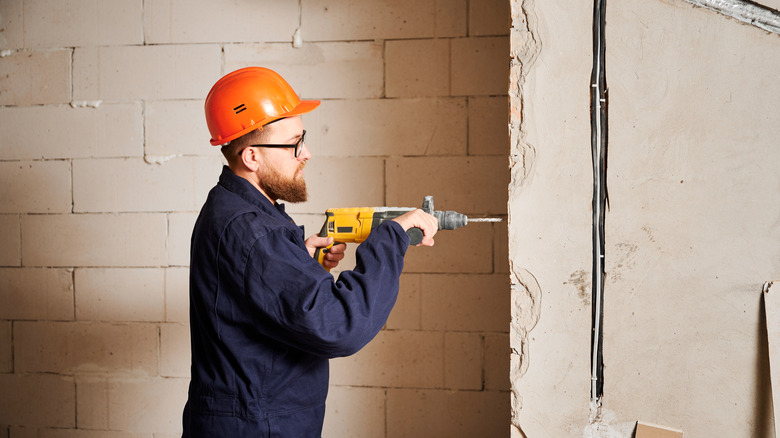

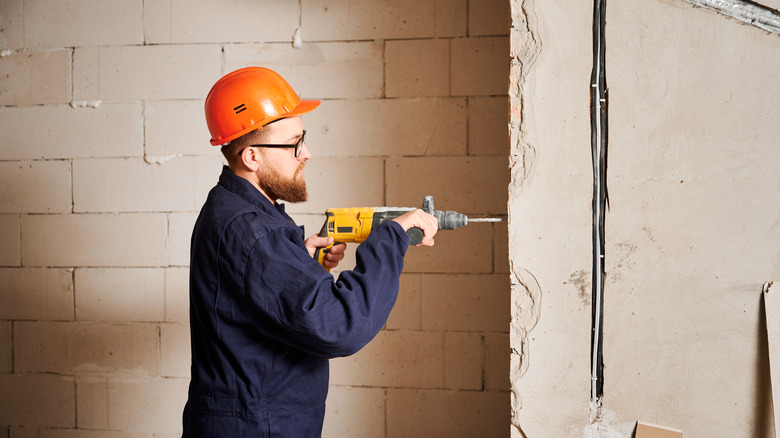
Unless you work at a large construction site or live in places where Reinforced Cement Concrete (RCC) is the staple for construction, you won’t have to drill in concrete and masonry often. Chances are, you might even consider trying to get away drilling a hole or three with your all-purpose drill bit. But that’s one way to ensure your drill bit won’t last long.
Drill bits meant for one material cannot be used interchangeably for others because they are all engineered for a specific material type. A wood bit has a brad point and sharp, aggressive cutting edges designed to make clean, precise holes in a relatively soft organic material. Drilling in metal calls for a different edge geometry, heat-resistant metallurgy, and a titanium nitride coating to reduce friction and heat. A concrete drill bit, on the other hand, is a different beast altogether.
The one thing common between the wood, metal, and all-purpose bits is that they are all equipped with a pair of cutting edges that gradually shave off the material being drilled into, one rotation at a time. But concrete drill bits don’t typically have sharpened cutting edges. Their tips are either fashioned out of an extremely hard and heat-resistant tungsten carbide material, or they have bits of the carbide compound welded onto an alloy steel shaft. Unlike other drill bits that solely rely on their cutting action, concrete bits instead feature blunt tips designed to smash hard materials, such as brick, cement, concrete, aggregate, and rebar into tiny fragments.
Are all concrete drill bits the same?
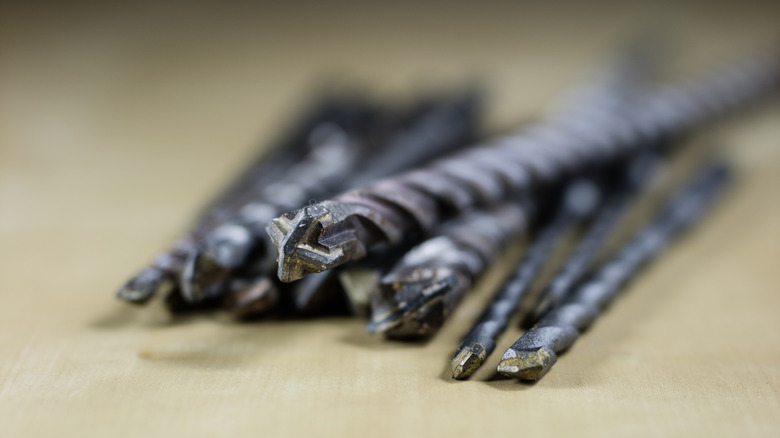
Not only do we have different types of concrete bits with varying tip geometries, but the shank (the end attached to the drill) also differs radically between different types of concrete bits depending upon the severity of the task. Light duty drill bits are meant for masonry and light concrete terminated in either cylindrical shank (meant for drills) or hex shank which is typically designed for impact drivers.
Drilling into tougher materials like reinforced concrete and rock, however, calls for a shank type dubbed as SDS (Special Direct System) that’s designed for quick insertion/removal and an optimal transfer of impact as well as torque. Divided further into SDS Plus and Max variants, these drill bits interface with specialized drills that deliver true hammering action along a large articulation range. These SDS drills can bore holes at a fraction of the time it takes for a regular hammer drill (not to be confused with an impact driver) to do the same. If all this sounds confusing, it thankfully gets easier.
Concrete drill bits, regardless of the shank type, bear tell-tale indicators of their intended purpose. A bit with two carbide edges welded onto the tip is usually meant for light duty masonry and concrete drilling. Those meant to bore through rebar and aggregate reinforced concrete usually have four tungsten carbide cutting edges. Doubling the carbide tips prevents the bit from being bogged down upon hitting the harder rebar and aggregate sections. Meanwhile, specialized rebar cutter bits meant to power through large, thick sections of rebar within reinforced concrete usually sport six carbide tips.
Do regular drill bits work on concrete?
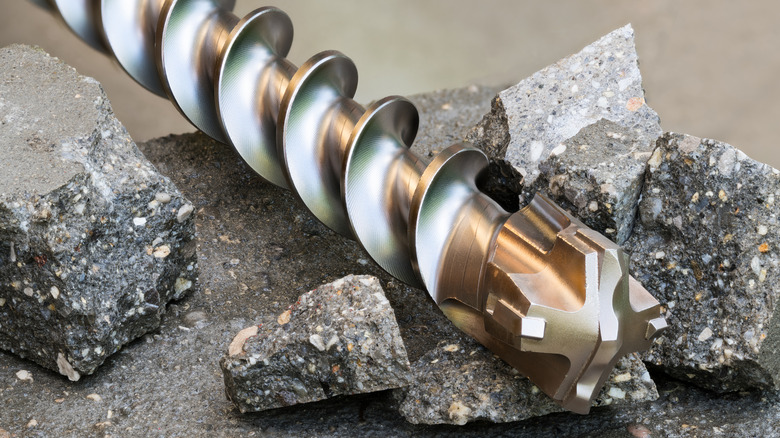
Drilling in concrete not only requires a specialized drill bit, but your tool itself must be equipped with the hammer function at the very least. That’s also why drilling in concrete is basically impossible unless your drill has a selectable hammer mode, which delivers a rapid, concussive force that hammers the drill bit deeper into the hole with each rotation. This compound action transforms the concrete bit’s dull carbide tip into a supercharged chisel that breaks hardened masonry and concrete into tiny fragments, which are subsequently carried out of the hole via the deep spiral flutes machined onto the shaft.
Just like you can’t use your kitchen knife for hammering nails, regular drill bits designed to cut into relatively softer materials can’t be used to drill into concrete either. Be it wood, metal, or all-purpose drill bits, you will dull them drilling into concrete. Furthermore, wood and metal drill bits are hardened for edge retention, which also makes them brittle. Using these in conjunction with your drill’s hammer mode could cause them to shatter. That’s why the shaft of a concrete bit is fashioned out of a tougher, impact-resistant material.

Stephan is the sports journalist for the Maple Grove Report.