AirPods Are Cool, but You Could Be Missing Out on Solid Quality Headphones for a Fraction of the Cost


Planning to drop hundreds on a new pair of headphones soon? You may want to listen up. 

Buying headphones can feel like a leap in the dark. From reading reviews to blindly trusting manufacturer promises for noise cancellation and comfort, you may worry about making the wrong choice in the long term by sticking to brands you know, which may feel like a safe bet. If you’re already deep into Apple’s ecosystem, getting AirPods may feel like an obvious choice. But you could be missing out on other great headphone choices. 

CNET released its People’s Picks, a community-driven awards program that recently asked readers about their favorite tech. This round is all about headphones. Some of the results are surprising, while others are no-brainers — like how much people love AirPods. According to our survey, Apple is the most-owned brand among our readers for both over-the-ear headphones and wireless earbuds. It also wins for several CNET categories, including durability, connectivity and brand loyalty. 

I get it. I’m an AirPods stan, too. But other brands won CNET readers over. Sony won the overall winner, dominating categories such as active noise cancellation, audio quality, battery life and comfort. And Bose was a close runner-up for audio quality, battery life and brand loyalty. Sennheiser was a favorite for over-ear wired headphones, while Sony took the top spot for wireless headphones. 

For years, my AirPods Pro 2 were durable, connected easily, had top-notch sound quality and fit easily in any purse. So when it came down to buying over-the-ear headphones, the AirPods Max 2 seemed like an obvious choice. But a $530 price tag and mixed reviews made me think twice. 

As cool as some headphones may be, keeping your options open may help you save some money if you’re looking for premium headphones within your budget. But how do you really know which headphones are worth your hard-earned money? 

Brand recognition isn’t everything when choosing headphones

You tend to hear about some brands more than others, such as Apple and Sony. But that doesn’t mean you always need to stick to the same brands. CNET readers gave brands including Beats — owned by Apple but marketed as an independent brand — and Bose high customer satisfaction ratings.

Customer satisfaction speaks volumes when it comes to headphones. Apple scored 4.17, while other popular brands such as Beats and Sony scored 4.44 and 4.46 out of 5, respectively. Despite a lower customer satisfaction score, Apple still took the top spot for call quality, durability, ease of use and connectivity. So it’s not all about the brand but rather how satisfied you are with the features that you’ll use the most. 

Choosing between the Beats Studio Pro and Apple’s AirPods Max

Take it from me. My husband gifted me the Beats Studio Pro despite having told him how much I loved Apple’s AirPods Max. My preference had less to do with sound quality, design or active noise cancellation and more to do with staying in the Apple ecosystem, especially since I already use AirPods. But after my husband did some research, he found that the $250 Beats Studio Pro were a solid choice for less. They offer noise cancellation, great sound quality and better battery life and comfort than my AirPods Pro 2 — all for a fraction of the price of the AirPods Pro Max, which are over $500. The Beats Studio Pro use some of the same components of AirPods, so I’m getting a bunch of features, including automatic switching between devices, for way less money.

Watch this: AirPods Max 2 vs. Sony WH-1000XM6: Which Headphones Are Better?

All those features could make a big difference in your day-to-day. Even though it may seem like the right move to choose headphones that win at almost everything, CNET headphone editors have a more helpful tip to help you narrow down which headphones you should invest in.

Think about how you’ll use your headphones the most

David Carnoy, CNET’s executive editor and headphones expert, says it’s good to try new brands, especially if you’re looking for something specific. “For instance, you might try the Shokz Open Fit Pro, Shokz Open Dots or Anker’s Aerofit 2 because you want open buds with ear hooks or a clip-on design for running,” says Carnoy. 

CNET’s survey findings also show that Anker wins for value and scores highly for reliability and battery life, making it a top contender among premium brands such as Apple and Sony.

Or if you’re looking for over-the-ear headphones that have top-tier active noise cancellation to block out noise while you’re exercising or working, you may consider the Sony WH-1000XM6. If you’d rather skip the $400 price tag, the Baseus Inspire XH1 cost $150 and offer the best value when it comes to active noise cancellation. And it’s still worth checking out less notable brands that could have some of the features you want for even less. That said, Carnoy notes that the AirPods Pro 3 are honestly very hard to beat for those already in the Apple ecosystem, thanks to a plethora of upgrades, including better microphones and noise cancellation.

What headphones CNET readers recommend

If you’re unsure what headphones are best based on your must-have features and how you’ll use them, here’s what CNET readers recommend.  

Don’t budge on your headphone must-haves

You may have some non-negotiables that make more costly price tags worthwhile. Jeff Carlson, CNET’s senior writer, pointed out a big bonus for Apple’s headphones: They offer seamless connectivity to whichever device he’s using. Some brands don’t make headphones as seamless as they could be, and that level of integration can be a must-have, especially if you’re already in the Apple ecosystem.

“It’s that lack of friction that finally convinced me to buy AirPods Max over some cheaper over-the-ear headphones I had before. Switching from iPad to iPhone to Mac to Apple TV almost always happens automatically. Before, I’d have to jump through manual hoops,” says Carlson. 

But after Carlson’s AirPods Max died a few months ago, he bought the Anker Soundcore Space One headphones on sale. He paid $88 after spotting the deal through CNET during an Amazon sale. Even though the quality isn’t as good as the AirPods Max, the music and noise cancellation are good enough for working in his shared space.

Watch this: The Secrets Behind Value in Earbuds and Headphones

Some brands you may never have considered may check all your boxes for features and design. You may find that older headphones meet all your expectations, such as buying the Apple AirPods Max instead of the AirPods Pro Max to save about $50. Or you could consider a refurbished pair from a certified retailer. 

Before you settle on one pair, shop around. CNET has recommendations on the best value headphones, how to choose the right headphones for your needs and how many pairs you should own and why. Spoiler alert: It’s more than just one. 


Source link

Leave a Reply

Subscribe to Our Newsletter

Get our latest articles delivered straight to your inbox. No spam, we promise.

Recent Reviews


In Cody v. Jill Acquisition LLC, No. 25-937 (S.D. Cal. June 30, 2025), the Southern District of California declined to enforce a retail site’s terms of use and compel arbitration, holding that the plaintiff, who used guest checkout to place an online order at the retail clothing site, did not have adequate notice of the terms and the arbitration clause. This case should serve as a wake-up call for online entities to reexamine electronic contracting processes. It exemplifies how, even if a website’s visual design and its placement of the hyperlinked Terms of Use during user checkout are comparable to other presentations that have been deemed enforceable, a court could still decline to enforce online terms if the context of the transaction is not the typical e-commerce transaction between a registered customer and a retail site. In this case, the court found that by checking out as a guest without creating an account, the user was less likely to expect a continuing relationship and, therefore, the site’s notice and presentation of the terms below the “Place Order” button were not conspicuous enough in this instance to bind the plaintiff.

The plaintiff in Cody filed a putative class action complaint over the site’s pricing policies for alleged violations of the California Business and Professions Code and the Consumer Legal Remedies Act. The defendant moved to compel arbitration, arguing the plaintiff had agreed to the site’s terms of use that contained a “Binding Arbitration Agreement and Class Action Waiver” when plaintiff clicked the “Place Order” button and completed her purchase from the defendant’s website.

Generally speaking, a contract will be enforceable based on an inquiry notice if: (1) the website provides reasonably conspicuous notice of the terms; and (2) the consumer takes some action, such as clicking a button, that unambiguously manifests assent to those terms. When evaluating whether there was an agreement to arbitrate, the court in Cody first considered the visual design of the webpages and found that the visual aspect of the notice was satisfied by the defendant’s website layout. As the court stated, the relevant criteria for evaluating whether the visual elements provide conspicuous notice are whether the advisal is displayed prominently enough that the court can assume a reasonably prudent Internet user would have seen it. Elements such as a “clear and legible” notice on the order page and a hyperlink placed directly above or below an action button formatted in bright, contrasting color and readable font within a relatively uncluttered web page have been favorably cited by courts in past cases.

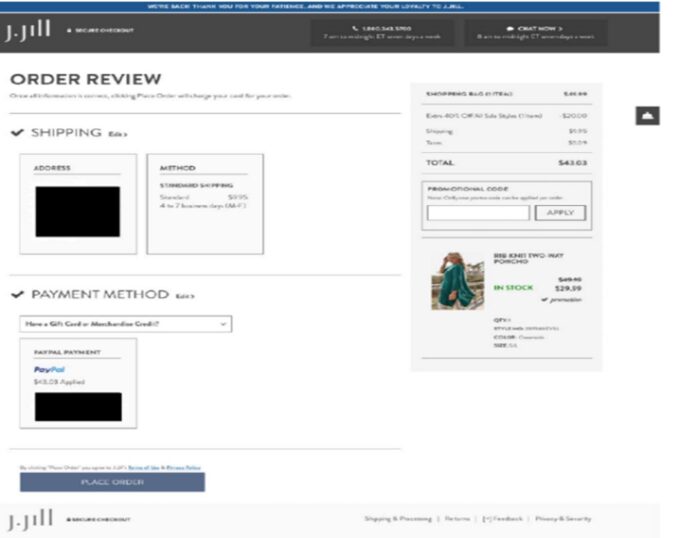
The court here found the visual design to be adequate because of factors such as the underlined blue hyperlink to the terms of use and its location directly below the “Place Order” button. [See below image from the court opinion of the final contracting screen ].

Although the court recognized that the “design of the website alone might support concluding that the notice would be reasonably conspicuous,” it went on to consider the full context of the guest checkout transaction at issue in Cody.  Here, the court distinguished it from those types of transactions where a user might anticipate “some sort of continuing relationship.” The court emphasized that when considering the notice requirement, the visual design of the website must be examined within that context. As it stated: “This means that courts should expect that a reasonable internet user is more vigilant in looking for contractual terms when the context of the transaction reasonably implies a contractual relationship.” To the court, when a user “simply purchases goods or avails herself of a one-time discount offer,” there is less reason for her to expect a continued relationship beyond the purchase. 

In the case at hand, the court considered plaintiff’s decision to check out as a guest as one where the user did not anticipate a continuing relationship, and compared it with other traditional e-commerce transactions involving registered users where the Ninth Circuit previously found that such context would put a user on inquiry notice that a purchase on the company’s website constituted an agreement to its terms.

“Generally speaking, courts are more likely to conclude that a user anticipating ‘some sort of continuing relationship’ would expect to be bound by terms, whereas a user ‘who simply purchases goods or avails herself of a one-time discount offer’ would be less likely to form such an expectation.”

“This context distinguishes this case from those in which the Ninth Circuit has found that the context of the transaction would put a user on inquiry notice that use of a company’s website or services constituted an agreement to its terms and conditions, including an arbitration provision.”

Thus, despite the adequacy of its visual aspects on the J. Jill site, the court found that proper notice was not sufficiently conspicuous in this case because of the guest checkout context of the transaction (“The context of the transaction therefore weighs against concluding that Plaintiff was sufficiently aware that, by placing an order through jjill.com, she would be entering into an agreement including an arbitration provision”).  

In another recent case, Chabolla v. ClassPass, Inc., 129 F.3d 1147 (9th Cir. 2025), the Ninth Circuit affirmed a lower court’s ruling that declined to send a proposed class action to arbitration. In the ClassPass case, the plaintiff signed up for a trial period for ClassPass, a service that sells subscription packages for access to various gyms and fitness studios, but later took issue when subscription charges resumed after gyms reopened following the COVID-19 pandemic. The contracting process in this case involved several signup screens. [An image from the court opinion of the final screen appears below].

In this case, the court’s decision was a flip, of sorts, of the Cody case, with the Ninth Circuit finding the visual presentation of the terms lacking, even though the context of the transaction would seemingly put the user on notice of an ongoing relationship that would contemplate the user agreeing to site terms. The appeals court found that while a trial subscription opportunity may not indicate an anticipation of an ongoing relationship in all instances, the context neither weighs in favor of nor against the notice requirement. This is because, as the court noted, the other aspects of the context – such as how the purchase is described as a “plan” or a “membership” and how the benefit of ClassPass is to gain access to gyms and fitness studios – conjure the idea of a continuing relationship. Nonetheless, the court ultimately decided that a reasonably prudent internet user would not be deemed to have unambiguously manifested assent to the terms by working her way through ClassPass’s multi-page website checkout process.

Taken together, these two recent decisions show that courts – at least those within the Ninth Circuit – are considering the actual context in which these internet transactions occur when deciding whether an online entity’s contracting and checkout process binds the user to the terms. While visual presentation and web flow design remains important for e-commerce sites, the above two court decisions show that context also matters.

We have previously highlighted the importance of web design in determining if a service’s terms are deemed enforceable. Now, companies might take a second look at their own user registration and e-commerce purchase processes to ensure they offer reasonably conspicuous notice of the existence of contract terms and obtain the user’s manifestation of assent to those terms in all contexts and types of transactions, including those transactions where guest or expedited checkout is used.

Contexts that indicate transient relationships, such as guest checkout or a trial opportunity, may mean that even an ordinary presentation of terms in the form of a hyperlink to the terms located beneath a “Place Order” button – a presentation that is used regularly by many sites – might need to be bolstered, in some cases, to provide the user additional notice that he or she is entering into a transaction that mandates acceptance of contractual terms. As the Cody court commented: “[T]he onus must be on website owners to put users on notice of the terms to which they wish to bind consumers.” Ultimately, the above court decisions accentuate the need for counsel to be involved in the decisions underlying the design and wording of online contracting processes and presentation of terms so entities can attain adequate user notice and assent that would satisfy even the most exacting scrutiny for any type of transaction.


Source link