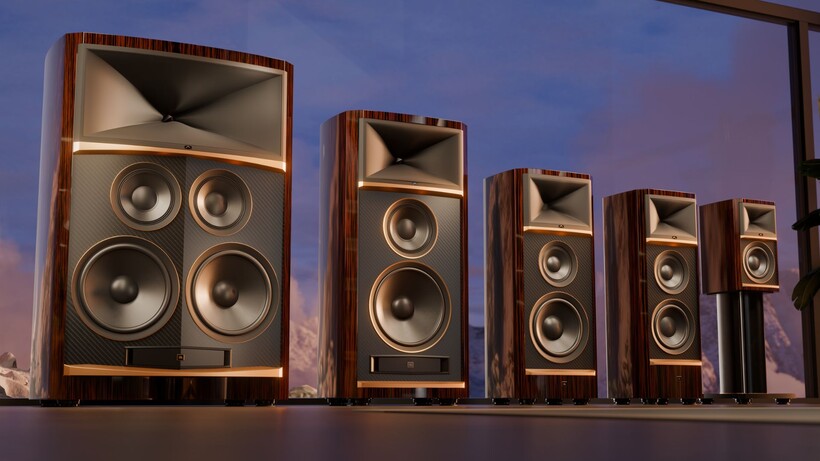
JBL scales the hi-fi mountain with next-gen Summit Everest and K2 speakers


JBL has taken the wraps off its most ambitious home speakers yet. The company is launching the next-generation Summit Everest and Summit K2 models as part of a new flagship Summit Series. This series was unveiled at High End Vienna 2026.

These aren’t just updates to existing speakers. They continue JBL’s long-running “Project” lineage — a designation reserved for the brand’s most technically advanced loudspeakers. In addition, they arrive as part of the company’s 80th anniversary celebrations.

The new range sits at the very top of JBL’s line-up, joining models like Makalu, Pumori, and Ama. However, the Everest and K2 are the clear headline acts. They are reference-level systems for listeners who want no-compromise performance at home.

The Summit Everest sits at the top of the stack, carrying forward the legacy of four previous Everest generations. It uses a redesigned mid and high-frequency system built around JBL compression drivers and a large-format HDI horn.

This is supported with dual 10-inch mid-bass drivers and dual 15-inch woofers, with the intent on delivering deep bass while maintaining precision across the full frequency range.

Advertisement

JBL Summit speaker family
Image Credit (JBL)

Slightly lower in the range, the Summit K2 follows a similar design philosophy but scales things back into a more “accessible” flagship format. Still, it uses JBL’s compression driver system and HDI horn design, paired with a 15-inch woofer and 10-inch mid-bass driver. This approach aims for the same sense of scale and clarity in a smaller footprint.

Both models share JBL’s updated internal architecture, including a redesigned crossover system intended to reduce signal loss and improve power handling. They have also reworked the cabinets, adding heavy internal bracing and damping to minimise unwanted resonance.

Furthermore, new isolation feet decouple the speakers from the floor, delivering cleaner bass response and sharper imaging.

Finish options lean fully high-end, with either high-gloss black with platinum accents or Macassar ebony veneer with gold detailing. Even the hardware has been treated as part of the design, using premium binding posts and high-grade internal wiring throughout.

Advertisement

Pricing underlines exactly where these sit in the market. The Summit Everest comes in at $159,990 per pair. Meanwhile, JBL prices the Summit K2 at $99,990 per pair, firmly placing both models in the ultra high-end territory when they arrive later in 2026.


Source link

Leave a Reply

Subscribe to Our Newsletter

Get our latest articles delivered straight to your inbox. No spam, we promise.

Recent Reviews


Just a few months ago, Elon Musk accused the AI company Anthropic of stealing artificial intelligence training data “at massive scale” in a post on his social network X

That apparently hasn’t stopped the billionaire from doing business with the company. Musk’s SpaceX has signed a data center deal that will give Anthropic access to more than 200,000 Nvidia GPUs worth of power at its Colossus 1 supercomputer facility in Tennessee.

The partnership will give Anthropic additional firepower to “directly improve capacity for Claude Pro and Claude Max subscribers,” SpaceX said in a website post. “As part of this agreement, Anthropic also expressed interest in partnering to develop multiple gigawatts of orbital AI compute capacity.”

Because of this deal, Anthropic said in its own post, the company is raising usage limits for users across some of its products. The changes, effective immediately, double Claude Code rate limits for users of Claude on Pro, Max, Team and seat-based Enterprise plans, remove peak-hour restrictions of Claude Code for Pro and Max accounts and raise API limits for Claude Opus models.

More AI means more data center deals

In the same post, Anthropic listed some of its other data center agreements with companies, including Amazon, Google and Microsoft, and reiterated its intention to keep expanding internationally. In the era of data center backlashes, Anthropic also announced in February that it has pledged to cover the costs of energy price increases driven by data center activity. Critics have questioned how companies such as Anthropic can uphold those pledges.

The deal with SpaceX, which acquired Musk’s AI company xAI earlier this year, may have surprised some, but AI companies are scrambling to secure data center resources as they continue to develop increasingly data-hungry artificial intelligence models.

At the same time, some communities are pushing back on new data center construction, leading some in the industry, Musk in particular, to plan to build data centers in space

Among the groups criticizing the deal is the NAACP, which said in a statement about SpaceX, “Any company that disregards the obvious environmental and health concerns of Black communities to supposedly power a future that will help us all is sending a clear message about who it intends to serve in that future… Anthropic’s use of a data center that pollutes a historically Black community is, at best, an uninformed decision, and at worst, a total disregard for the community’s wishes and health.”

The organization pointed to a lawsuit it has filed against SpaceX over environmental concerns at its Colossus 1 computing center.


Source link


