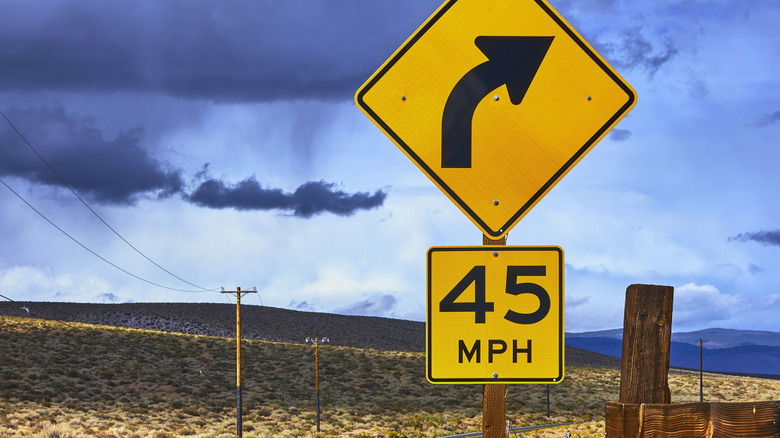

You may have seen that yellow diamond sign with the bendy arrow while on a drive, conveying to you that there’s a twist up ahead. A lot of the time, it’s accompanied by a little number bolted underneath, like 35, that indicates a speed. The bendy arrow, usually found on the run-up to sharp curves, highway off-ramps, steep downgrades, and narrow bridges, means there is a turn ahead that you should be cautious of.
This isn’t the most confusing traffic sign out there, but there is still some nuance involved with the number underneath. It’s actually what traffic engineers call an advisory speed, and it’s not bound to the same rules that black-and-white speed limit signs are. While those are indeed legally binding, the yellow versions are more like a heads-up. Either way, both almost always show a clean round number, though every so often you’ll spot an oddity like a decimal point on a speed limit sign.
The whole point of yellow speed signs is to “alert road users to conditions that might call for a reduction of speed,” as stated by the federal Manual on Uniform Traffic Control Devices. These yellow advisory speed curve signs are usually placed when a curve’s safe speed lands below the posted limit.
What happens if you ignore the sign?

You are not legally bound to follow the advisory speed signs. If the regular limit is 50, then 50 is still technically your ceiling. However, you’d be better off following it, as a quarter of fatal crashes happen around horizontal curves, according to the Federal Highway Administration. That’s also why plenty of the more dangerous curves are designated as no-passing zones, since blind spots render overtaking unsafe.
Traffic authorities actually use a very scientific approach to setting the advisory speed. It involves the use of a tool called a ball-bank indicator. This is basically a curved glass tube with a weighted ball floating in liquid inside. Officials mount this to a car in test drives before driving through the curve at different speeds. Each time, they measure how far the ball moves to understand the maximum speed a car should drive through the curve to reduce the risk of losing control of the vehicle.
If you fly into one of these bends too hot, lose your grip, and end up in a wreck, an officer can still cite you because you were driving too fast for the conditions. Some states also have a basic speed rule drivers are expected to follow at all times, regardless of the number on the curve sign. Washington’s version (RCW 46.61.400), for instance, says no one should drive at a pace “greater than is reasonable and prudent under the conditions.”

Stephan is the sports journalist for the Maple Grove Report.