
Follow ZDNET: Add us as a preferred source on Google.
ZDNET’s key takeaways
- Lithium-ion batteries are now one of the leading causes of fires.
- Damaged, misused, and poor-quality batteries are the most common culprits.
- Knowing what to do can make all the difference in a fire.
Nowadays, we’re rarely far from a device that contains a rechargeable battery. Phones, tablets, laptops, not to mention e-bikes and portable power stations, are everywhere. You have batteries in the car, wear them in devices on your fingers, and sleep with them in technology by your bed. Most of the time, the batteries do what they’re supposed to do — and do it safely. That’s why they’ve become the most popular way to power our portable stuff.
But the sheer volume of batteries in circulation, along with the proliferation of cheaper, poorer-quality devices, means that lithium-ion battery fires are on the rise.
Just how big is the problem?
It’s pretty bad.
Here in the UK, fire departments have to deal with one lithium-ion battery fire every five hours, totaling 1,760 fires in 2025 — a figure that’s up 147% over the past three years, and still climbing. In the US, lithium-ion batteries have caused some 25,000 incidents of fire or overheating over the past five years, ranging from domestic incidents to fires at waste-processing plants and large-scale lithium-ion battery energy storage facilities.
Fires are also becoming a problem on airplanes, with the FAA reporting nearly 2 lithium-battery fires per week.
Also: My top 7 laptop-bag essentials now, after decades of remote work
And this total doesn’t include flight disruptions, such as when passengers place prohibited items, such as power banks, in checked baggage (all items with a rechargeable battery must be in carry-on luggage).
Where’s the problem?
Potentially anything with a lithium battery can be a problem, including power banks, laptops, smartphones, portable speakers, electric toothbrushes, toys, e-scooters, e-bikes, EVs, and vapes. If the device has a rechargeable lithium-ion battery, there’s a risk of thermal runaway.
But some devices are riskier than others.
Also: I switched my solid-state portable battery with this graphene heat dissipation one – here’s why
E-bikes and e-scooters are a leading cause of fires in cities such as New York, where they caused hundreds of fires last year, some of which resulted in fatalities. In the UK last year, e-bike fires accounted for almost a third of all lithium-ion battery fires; bikes retrofitted with a motor and power pack were a bigger risk than factory-made e-bikes.
Vapes are also a big problem, so much so that they are on the radar of insurance companies and regulators.
How do lithium-ion batteries fail?
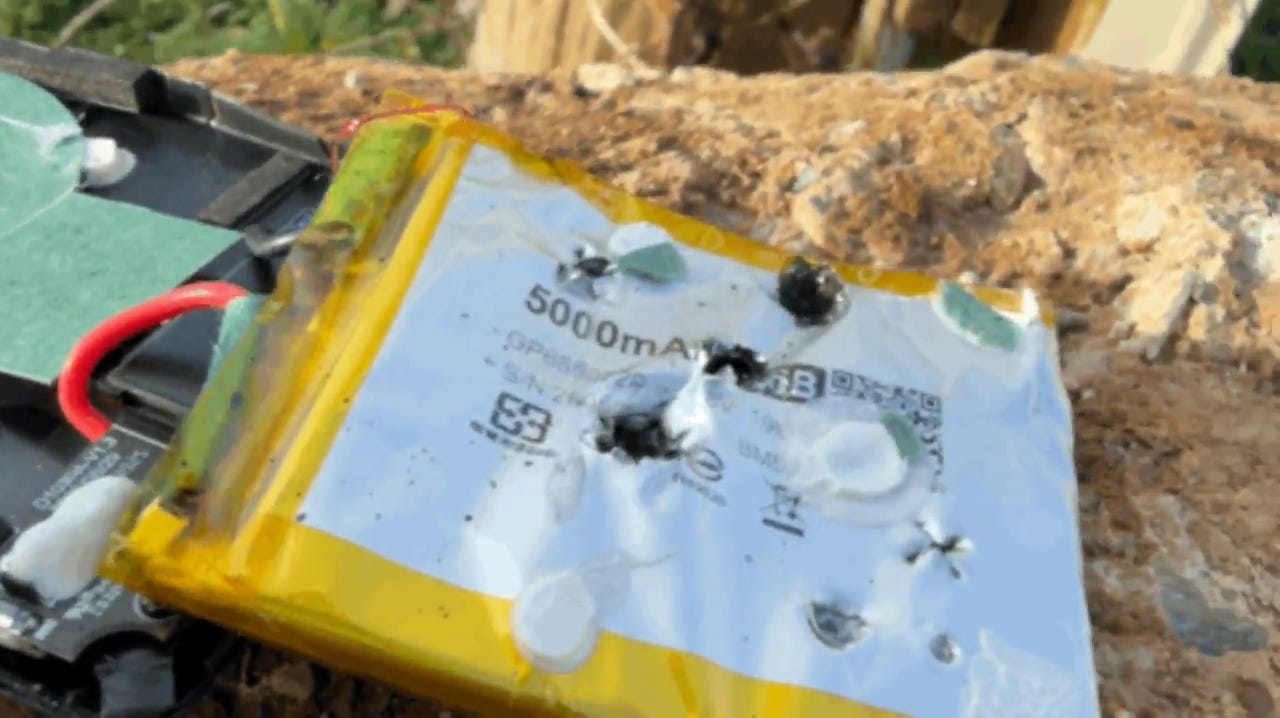
The problem is thermal runaway, where the battery heats faster than it can cool down. This process starts a chain reaction that causes even more heat, leading to smoldering, fire, or even an explosion.
Even the batteries in smart rings can go bad.
Far-Yogurtcloset369/Reddit/ZDNET
Thermal runaway can happen for several reasons:
- Physical damage to the battery, such as punctures or crushing
- Overcharging
- Short circuits
- Exposure to very high temperatures
- Manufacturing defects
- Use of incompatible or damaged chargers or cables
Also: Do yourself a favor and stop buying these cheap SSD drives flooding the market
A battery will sometimes give you a heads-up that things are going to go bad:
- The battery or device becomes unusually hot.
- There are signs of swelling or bulging.
- There is an acrid chemical or sometimes a sweet-smelling odor coming from the device.
- You can hear hissing, crackling, or popping sounds.
- You can see smoke or vapor.
Are my batteries at risk?
It’s hard to make a definitive statement about every rechargeable battery out there. However, I’ve been around a lot of rechargeable batteries and seen them fail both accidentally and on purpose (putting a nail or a screwdriver through a lithium-ion battery will make the best battery go rogue), so I have a good idea of the dangers.
The biggest risks come from the following batteries:
- Batteries that have been damaged (for example, in phones, power banks, or vapes that have been dropped).
- Batteries that have been pushed hard and have overheated (like the batteries you find in e-bikes and e-scooters, or power banks that have been misused).
- Batteries that are left on charge for extended periods (things like vapes that are left charging for hours).
- Poor-quality batteries (you’ll find these all over the place, but cheap power banks, budget e-bikes/e-scooters, and vapes are particularly bad).
Now, take those batteries, and either charge them or use them, and that’s when things can — and do — go wrong.
So, do your best to avoid buying cheap stuff, dropping things that contain batteries, letting battery-powered devices overheat, and don’t leave them charging for hours on end unsupervised. And if you notice a problem, act on it immediately.
Also: How much longer EV batteries last compared to phone batteries – and why I’m not worried
The lowest-risk batteries are discharged batteries, such as a phone that’s been in a drawer for a year or a power tool that’s in the shed all winter. While I can’t recommend leaving battery-powered devices in a drawer or buried in a shed somewhere, the risk is low.
What to do when things go wrong
While prevention is a whole lot better than a cure, sometimes the bad stuff can’t be avoided and needs to be dealt with.
Here’s what to do if you discover a device is possibly experiencing thermal runaway.
If you’re on an aircraft, INFORM A MEMBER OF THE CABIN CREW IMMEDIATELY AND FOLLOW THEIR INSTRUCTIONS.
If you are in a vehicle, PULL OVER AS SOON AS IT IS SAFE TO DO SO.
With those two specific scenarios out of the way, here is my game plan when a battery goes rogue at home or work. The priority is people’s safety, not your device.
If it’s safe to do so:
- Move the device to a non-flammable surface (like a tray) and take it outdoors away from buildings, vehicles, dry vegetation, and other things that can catch fire.
- Call emergency services if there is a fire, significant smoke, or any risk to people or property.
Also: I ignored Apple’s battery tips and charged my iPhone in all the wrong ways – how it fared
If the device is smoking or burning:
- Do not pick it up with your bare hands, and do not try to put it in an enclosed space, such as a pocket, bag, or drawer.
- Call emergency services.
- If possible, use a suitable fire extinguisher to extinguish any flames and cool down the battery.
- If you don’t have an extinguisher, you can use copious amounts of water to help cool lithium-ion battery fires, AS LONG AS THE DEVICE IS NOT CONNECTED TO AC POWER.
After the fire seems to be out:
- Don’t drop your guard. A lithium-ion battery can reignite minutes, hours, or even days later.
- Leave the battery in a safe area, away from people, pets, and combustibles.
- Contact the device manufacturer or local waste disposal service for advice.
Some batteries are safer than others — this is a semi-solid-state battery that’s a lot safer than traditional lithium-ion.
Adrian Kingsley-Hughes/ZDNET
Need a fire extinguisher? Here’s what to buy
The best fire extinguisher for both lithium-ion fires and general home incidents is an ABC extinguisher. These devices are multipurpose fire extinguishers designed to handle three common classes of fires:
- Class A: Combustibles, such as wood, paper, cloth, cardboard, and most plastics
- Class B: Flammable liquids, such as petrol, diesel, paint, solvents, and oils
- Class C: Energized electrical appliances, wiring, computers, and electronics
ABC extinguishers use a dry chemical powder (monoammonium phosphate and ammonium sulfate, pressurized with nitrogen gas) that coats the fuel, smothers it with oxygen, and cools it to stop chemical reactions that keep the fire going.
Also: 10 DIY gadgets I never leave out of my toolkit (and why each one earns its spot)
ABC extinguishers come in all sizes: small, large, and ones designed for cars, boats, and kitchens. Familiarize yourself with the instructions before you need to use the extinguisher.
ABC fire extinguishers can be incredibly messy, requiring a fair amount of cleanup after an incident.
Fire blankets and battery bags
There are a couple of other things I recommend you keep around the home to deal with any fires you might encounter:
As always, familiarize yourself with the instructions before you need to use them.
Bottom line
While lithium-ion batteries are generally safe and fires are rare, it’s always good to know what can cause batteries to go rogue and what to do when you come across a smoldering battery.