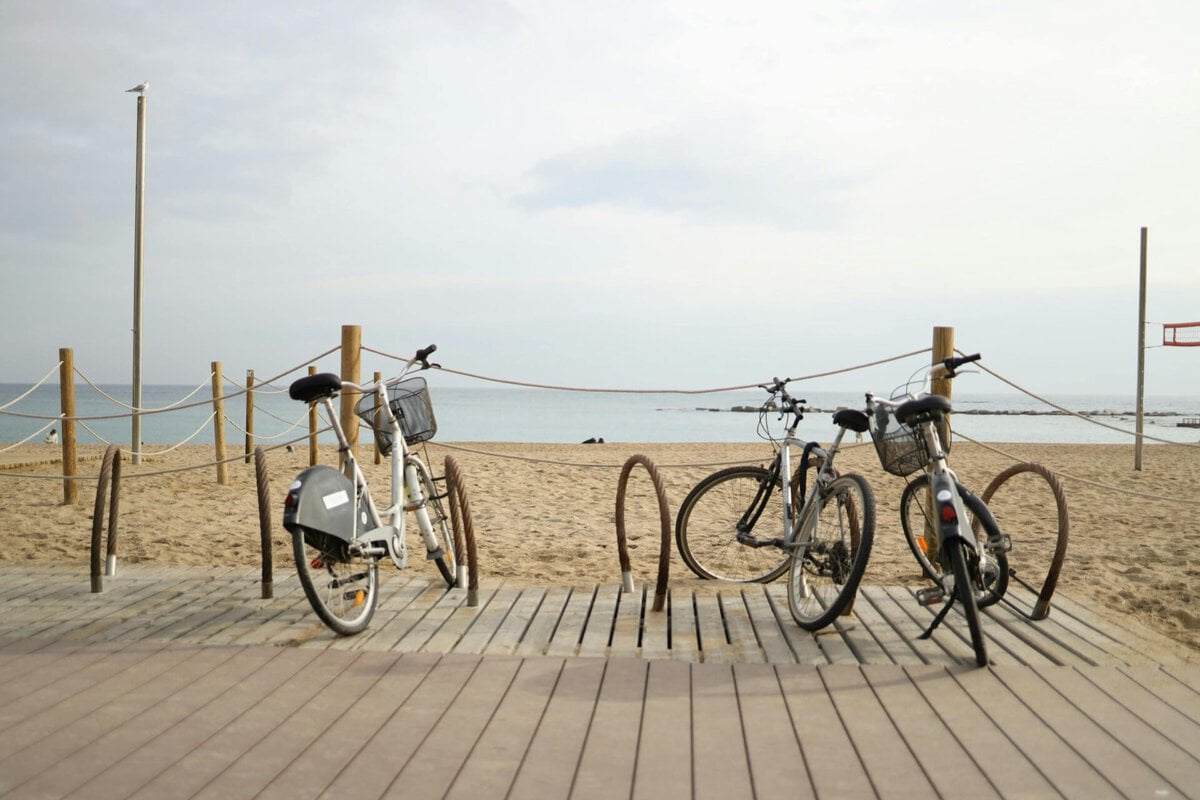

Barcelona rewards slow movement. On a bike, the city opens up differently than it does on foot or through a taxi window — you catch the light on the Modernista facades, feel the gradient of Montjuïc before you see its summit, and find yourself stopping at a beach bar in Castelldefels because you can.
These are the Barcelona bike routes worth knowing, from the flat coastal paths to the vineyard roads outside the city.
Related read: Unique Things to Do in Barcelona
Coastal Barcelona Bike Routes
Barcelona Promenade
Distance: 4.7 km | Difficulty: Easy
A dedicated cycle lane runs the length of this seafront path, connecting Nova Icària beach with Mar Bella. It’s flat, well-maintained, and lined with restaurants serving straightforward Mediterranean food. Good for easing into the city on your first morning, or for an easy evening ride when the light on the water is worth the trip on its own.
Litoral and Besòs Park
Distance: 9 km one way (18 km return) | Difficulty: Easy
This paved route follows the Besòs River through Litoral Park, connecting Montcada i Reixac with the river mouth at Sant Adrià del Besòs and the Forum. A separated pedestrian path runs alongside, with ramps throughout, making it a comfortable ride for mixed groups. The return trip adds up to 18 km — enough to feel earned without being a serious undertaking.
Castelldefels
Distance: 8 km | Difficulty: Easy
Twenty-four kilometres south of the city centre, the Castelldefels seafront promenade has a flat, safe cycle lane running its full length along the beaches of Castelldefels and Gavà Mar. Beach bars and cafés appear regularly along the route. It’s a good excuse to get out of the city entirely for a half-day.

Mountain Barcelona Bike Routes
Collserola Natural Park
Difficulty: Easy to Moderate
With over 283 km of cycle paths, Collserola covers a wide range of ability levels. Top routes worth knowing:
- Bird’s Eye View — 7.9 km there and back, 215 m elevation gain. A family-suitable trail that connects with Paseo de las Aguas in the Baix Llobregat area. Recommended for ages 9 and up.
- Tibidabo from Sant Cugat — roughly 8 km ascent, 378–400 m elevation gain. Start at FGC Sant Cugat del Vallès station and follow the route through Can Borrell, Pantà de Can Borrell, and Coll de l’Erola before the final climb to Tibidabo or Carretera de les Aigües.
- Baixador de Vallvidrera to La Floresta — 9.78 km, 324 m elevation gain. Starts at FGC Baixador de Vallvidrera station and passes through forested areas. Also used by trail runners, so expect company on the path.
- Molins de Rei River Route — approximately 5 km to Sant Vicenç dels Horts (10 km return). Easy and appropriate for all ages.
- Carretera de les Aigües — 10 km, sitting 450 metres above the city. Unpaved but mostly flat, with uninterrupted views of Barcelona along the full length of the route.
Penedès Vineyard Route
Difficulty: Easy to Moderate
Just outside the city, the Penedès wine region offers a cycling experience that moves through vine rows with the Montserrat massif in the background. The Penedès 360 route takes in small villages and quiet paths with no technical sections — suitable for anyone comfortable on a bike. Most guided versions include visits to two family wineries, lunch at a local restaurant, and an introduction to the area’s cava production. A useful half-day or full-day option when you want to leave the city.
Montjuïc
Distance: approx. 3–4 km | Difficulty: Moderate
The standard route climbs from Plaça d’Espanya to the Laribal Gardens, passing the MNAC, the Olympic Stadium, the Magic Fountain, Poble Espanyol, and Montjuïc Castle. The ascent requires some effort; the descent does not. Go in the late afternoon and the views over the city from the top are worth the climb.

Urban Barcelona Bike Routes
Green Cycling Ring
Distance: approx. 75 km (usually ridden in sections) | Difficulty: Easy to Moderate
A circular route that loops around most of the city using cycle lanes and park paths. Most cyclists take it in sections rather than all at once. Two worth picking out:
- Avenida Diagonal — 11 km through the city, shared with runners and skaters, with the scale of the avenue working in your favour as a cyclist.
- Llobregat River section — connects the city with the Llobregat River through a mix of green corridors and urban infrastructure.
Sants to Montjuïc
Distance: 3–4 km | Difficulty: Moderate
A short route with mostly flat terrain and one short, steep climb at the end. Passes along Avenida Maria Cristina and the Olympic Ring. Good for an hour when you want some elevation without committing to a full mountain route.
Modernist Route
Difficulty: Easy
A flat urban ride connecting the city’s major Modernista buildings: Arc del Triomf, Casa Comalat, Casa Amatller, Casa Batlló, Casa Calvet, La Pedrera, and the Hospital de Sant Pau. Part cycling, part city walk. The route works well for anyone who wants architectural context alongside the riding.

How to Make Your Barcelona Bike Routes More Sustainable
- Use an electric or traditional bicycle and try to avoid motorcycles and cars.
- Check your bicycle before setting off: brakes, wheels, handlebars, etc.
- Plan and organize your route using apps such as Google Maps in bike mode or Komoot.
- Take a reusable water bottle with you and always pick up your rubbish.
- Respect pedestrians and obey traffic signs.
Related read: How to Stay Sustainable During your Trip to Barcelona
Practical Information
Bike hire in Barcelona:
- Barcelona E-Bike Rent: Located at Carrer de Cervantes, 5, this establishment offers electric bicycle hire of various types, for all kinds of routes.
- Step&Scoot: Located at Passeig de Sant Joan, 98, you will find this shop where they have bicycles that are ideal for riding around the city or going on group excursions.
- Rivera Bike Rental: Located at Carrer d’en Roca 26, in the heart of the Gothic Quarter, you will find different types of bicycles. You can hire them and enjoy a tour of El Born or travel wherever you wish.
Barcelona is one of the best cities for combining cycling routes with culture, nature and good weather. So, if you are in Barcelona and want to do something different, we encourage you to choose one of these routes.
Frequently Asked Questions
Do I need to be an experienced cyclist to ride in Barcelona?
Most routes listed here are suitable for casual cyclists. The coastal routes and urban itineraries require no particular fitness level. The Montjuïc climb and the Collserola Tibidabo route involve real ascents and are better suited to riders who cycle regularly, though neither requires specialist equipment.
When is the best time of year to cycle in Barcelona?
Spring (March to May) and autumn (September to November) offer the most comfortable conditions — warm enough to ride comfortably, without the concentrated heat and tourist volumes of July and August. The coastal routes are rideable year-round; mountain routes can be muddy in winter.
Related read: When is The Best Time to Visit Barcelona?
How much does bike hire typically cost in Barcelona?
Expect to pay roughly €15–25 per day for a standard bike and €30–50 for an electric bike, depending on the provider and the rental duration. Prices vary by season and booking lead time.
Can I take a hire bike on Barcelona’s public transport?
Bicycles are permitted on FGC and Rodalies trains outside peak hours, and on the Barcelona Metro at off-peak times (generally before 7:30am and after 9:30pm on weekdays, and most of the day at weekends). Check current restrictions with the operator before your trip, as rules are updated periodically.
Is the Penedès vineyard route accessible without a car?
Yes. You can reach the Penedès region by Rodalies train (R4 or R8 line) from Barcelona Sants station. Vilafranca del Penedès is the main access point. Some guided cycling tours include transport from the city, which removes the logistics entirely.
Are the Collserola routes suitable for children?
The Bird’s Eye View route is specifically recommended for families and is suitable for ages 9 and up. The Molins de Rei river route is flat and appropriate for most ages. The Tibidabo and Baixador de Vallvidrera routes involve significant elevation gain and are better suited to older teenagers and adults.


Stacie Harris is a local resident and reporter of the Maple Grove area. Stacie reports on medicine and science for the Maple Grove Report.