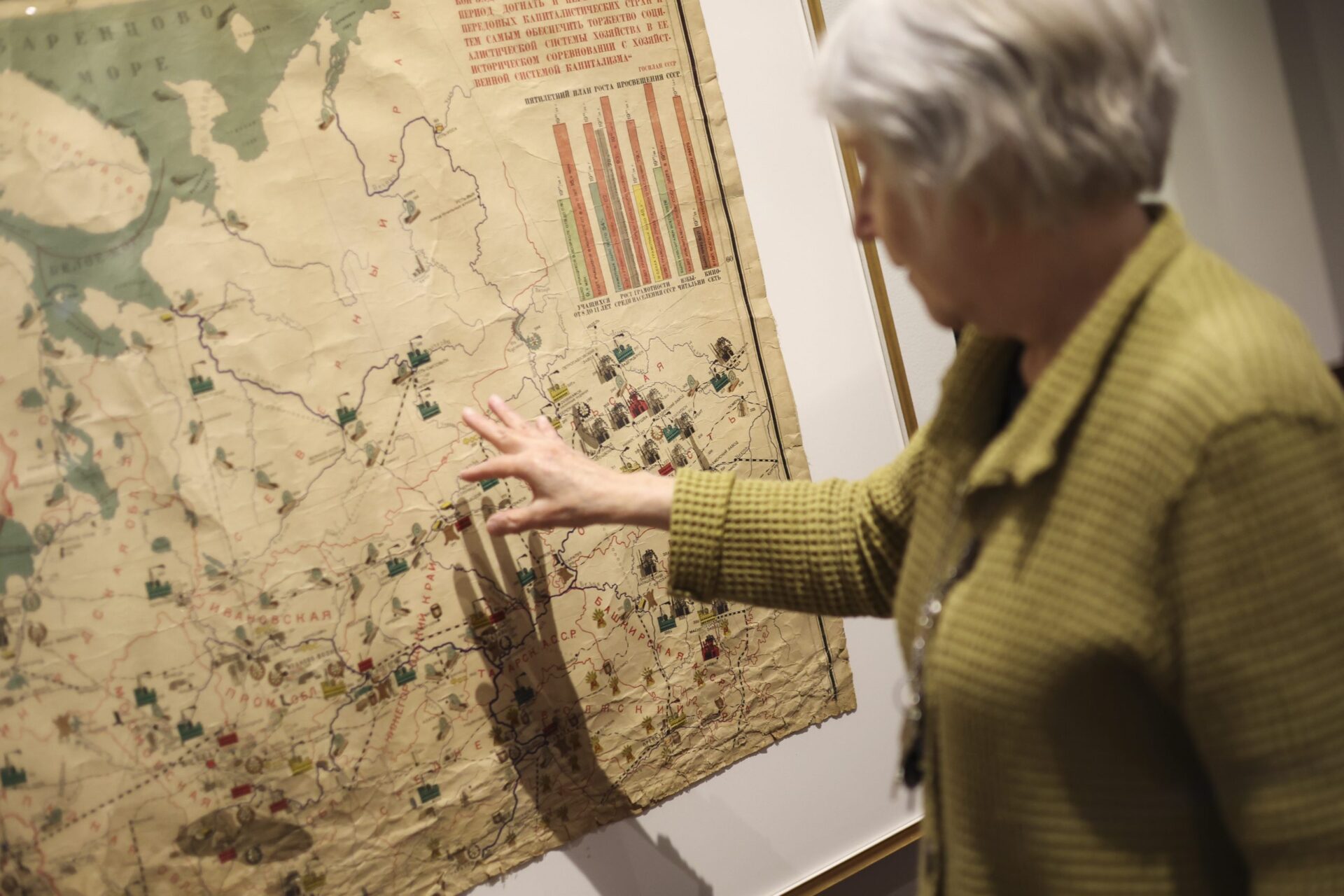
Asked why she wanted to settle in Minnesota, Maria Zavialova responded with the realpolitik outlook of a mother who immigrated across oceans and continents alone with her children:
“It’s not just what I like and what I want,” she said, “it’s what is possible.”
Zavialova, curator at the Russian Museum of Art in Minneapolis, was legally allowed to stay because she made herself indispensable. Several years after earning her doctorate at the University of Minnesota in 2008, she applied for and received a National Interest Waiver, a green card pathway that lets accomplished individuals in certain fields self-sponsor if their work is deemed to be in the national interest.
Socially and financially, she was able to stay because there were Russian, and non-Russian, individuals and groups that helped her with the adjustment pangs common in such a profound relocation.
Minnesota’s Russian community, estimated at 10,000 Russian born individuals and their American-born children, is diverse, dispersed, and difficult to describe in broad brush.
But in the lottery that some in the legal community refer to as “Refugee Roulette,” where one’s chances to receive asylum or refugee status are based in part on where they were born, Russian immigrants are the winners.
Since 2010, Russian asylum cases have seen a 77% approval rate at Fort Snelling immigration court, compared to 11% across all countries.

However, during President Trump’s second term, approvals of Russian asylum cases at the court have dropped by 24 percentage points from previous averages, mirroring the broader drop-off in asylum approvals here and nationwide since Trump returned to office.
Russians annually make up around 1% of asylum applicants seen at the Fort Snelling court, a relatively small share compared to applicants from Mexico and Central America. Still, they account for the largest total number of approvals here since Trump returned to office and have the highest rate of success in the court over the last decade and a half. Between 2010 and the beginning of Trump’s second term, 77% of their applications were granted. Since January 2025, 53% of Russian application cases have been successful.
Analysts attribute Russians’ high success rates to a legal framework that favors the nature of their persecution claims as well as the historic geopolitical enmity between the United States and Russia.
Belarus, a close European ally of Russia, had the second-highest success rate for asylum applicants in Fort Snelling court for all years, but dropped to third during Trump’s second term.
Russia political persecution cases usually more clear
Asylum cases from Russia tend to rest on tried-and-tested legal arguments that involve instances of straightforward political or religious persecution, experts said.
Because the United States recognizes that political dissidents in Russia are often imprisoned or harassed because of their opposition to the government, a judge would likely accept that returning to Russia can put the applicant in danger. Moreover, since that legal analysis has been applied for decades, it puts decisions to approve asylum cases on more stable ground.
“Many cases from Russia are usually straightforward, political opinion-type of cases,” said Sarah Brenes, executive director at the Binger Center for New Americans at the University of Minnesota.
Over the past several decades, as asylum claims from Central America and elsewhere have surged, many of those cases rely on arguments that are related to gang violence, general instability, or the lack of safety available for people of certain groups, such as women, indigenous people, or the LGBTQ community.
Related: Asylum approvals plummet at Fort Snelling immigration court as case numbers soar
Those cases are “legally murkier and more difficult to prove,” than the relatively uncomplicated cases coming from Eastern Europe, said Brenes.
Judges interpret those issues differently, and recent decisions by the federal Board of Immigration Appeals have strengthened the current administration’s arguments to push for removal whenever possible.
“Those [BIA] rulings continually narrow who is eligible for asylum… based on gang-related, gender-based, or domestic violence reasons,” said Steven Thal, a Twin Cities-based immigration attorney.
Certain jurisdictions – such as immigration courts falling under the Fifth or Eighth Circuit courts of Appeals – have their own, stricter precedent to apply to those “gray-area” cases.
Cold War-era geopolitics boost Russia asylum cases
Other cases from Russia involve long-documented instances of religious persecution of people outside of the Russian Orthodox Church.
Zavialova said that friends in the Russian-American community had leaned on their Baptist or Jewish faiths, and the organizations that protect followers of those faiths, in their asylum applications.
U.S. asylum law is more accepting of religious persecution claims than other forms of home country instability. This is especially the case for the violence of cartels, gangs, and other armed groups that is not explicitly ideologically-driven, but increasingly has links to political groups or political goals, according to Armed Conflict Location and Event Data, a nonprofit that catalogues political violence.
There is also the fact that Russia and the U.S. have been rivals for decades. Each has gleefully accepted the dissidents of the other since the Cold War, as proof that one country’s system of governance was superior to the other.
“[I] can imagine that judges could be more disposed to grant asylum to people fleeing countries that are not in the good graces of the United States government,” said Virgil Wiebe, a law professor at St. Thomas University’s School of Law who studies immigration law.
Related: Fort Snelling joins nationwide trend of holding ‘mega master’ immigration hearings, raising due process concerns
Zavialova recalled her time walking the University of Minnesota’s network of tunnels and skyways that connect buildings so one can make their way across much of the Twin Cities campus while being sheltered from the weather.
In getting to her classes for her doctorate in cultural studies, she sometimes cut through the other departments.
“I saw a lot of Eastern European and Russian names on the doors of their physics professors, and I realized that was, I would say, the brain drain,” she said.
As many immigrants point out, leaving their home and their family was never their first option. Few people are eager for that kind of displacement or cultural shock.
“For immigrants, we are always weighing what we are losing against what we are gaining when we leave home,” she said.
Now, as the curator of the only museum of Russian art in the United States, she is uniquely placed to help form the public image of Russian culture.
Zavialova, affectionately known as Masha at the museum, credits friends she made on an earlier exchange program, the St. Panteleimon Russian Orthodox Church in Minneapolis, and social services groups for her success in Minnesota.
“When I came, I didn’t have a car, I didn’t have a driver’s license, so I’m very grateful to friends. And friends, they become like family for immigrants. They’re like family. We don’t have our family quite often, but we have this community that’s really, really supportive,” she said. “And I think any community, regardless of the country, would be the same.”
Related