
Verdict
Strong looks and stronger sound make the Samsung Music Studio 7 a real contender – as long as you take a moment to consider its position in your room it has a whole lot going for it where spatial audio is concerned
-
Big, spacious and remarkably assertive sound
-
Extensive app is just one control option
-
Understated, sophisticated looks and exemplary build quality
-
High frequencies can easily sound splashy
-
Needs space in which to operate
-
Design would suit more colours than the two currently available
Key Features
-
Power
150 watts of Class D power
-
Audio set-up
3.1.1 -channel layout
-
Looks
Dot Design by Bouroullec
Introduction
Samsung has been hoovering up audio companies lately, but if you thought this meant the end of Samsung as a music hardware brand you can think again.
The Music Studio 7 is a stand-alone wireless speaker that can be half of a stereo pair, a part of a multichannel home cinema system or an element of a multi-room set-up too – and it goes head-to-head with some of the best pound-for-pound wireless speakers around.
Design
- Available in black or white
- Bouroullec Dot Design
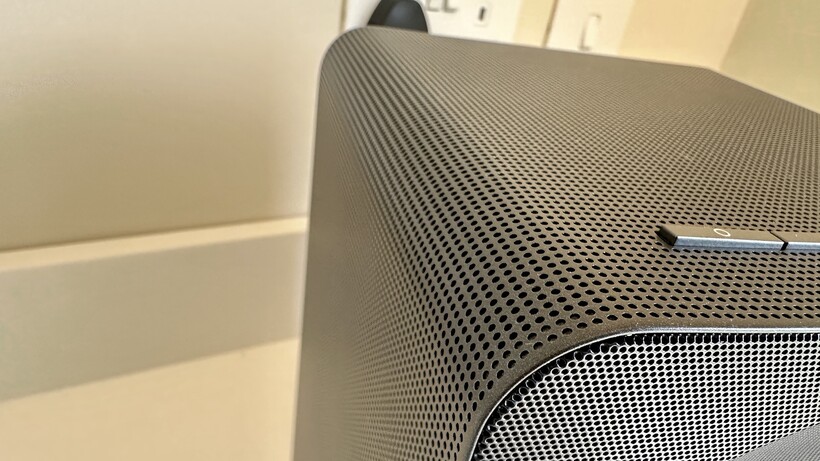
Without going mad (as Sonos did with the great-sounding, bizarre-looking Era 300), Samsung has managed to deliver a wireless speaker that appears expensive and individual while still looking reassuringly like a speaker.
At 269 x 185 x 191mm (HWD) it’s nicely proportioned and strikes a good balance between worktop, shelf and speaker stand size – it’s too big for a desktop really, but in any other space it works well.

But it’s the curved, perforated metalwork that begins to set it apart, and the overall design (which is by Erwan Bouroullec) is confident and understated – the dished area on the front panel that looks like a speaker driver but isn’t seems the sort of visual flourish that could easily become a trademark of quite a large range of Samsung Music Studio speakers if the company so desires.
Build quality is well up to standard (just as well, given the amount of money Samsung wants for the Music Studio 7) and the finish is impressive too. As it stands, black or white is hardly the most inspiring selection of colours – but there is (unofficial, off-the-record) talk of a wider range of colours in the not-too-distant future.

Features
- 3.1.1 -channel layout
- 24-bit/96kHz hi-res audio
- 150 watts
The Samsung Music Studio 7 is configured to serve up an impression of 3.1.1 -channel spatial audio (specifically Dolby Atmos, although the speaker is also compatible with Eclipsa Audio) – and so it deploys five drivers and a couple of passive radiators to do the sonic business.
Facing forwards there’s a mid/bass driver above a tweeter. There’s another tweeter angled upwards from the top of the cabinet, and on each side there’s another tweeter beneath a racetrack-shaped passive radiator.

Samsung isn’t all that keen on discussing the size or the composition of these drivers, and the frequency response they’re capable of generation is a secret too – but there’s 150 watts of Class D power on tap to move these five drivers, which in a speaker of these relatively modest dimensions should prove more than sufficient.
Getting audio information into the speaker can be done in a number of different ways. Dual-band Wi-Fi is available, naturally – and this means that as well as Spotify Connect and TIDAL Connect, the Music Studio 7 is Roon Ready and is compatible with AirPlay and Google Cast too.

It’s even compatible with Samsung’s Q Symphony technology, which means it can wirelessly connect to an appropriate Samsung TV. In fact, Q Symphony means that the Music Studio 7 can easily become part of a full-on wireless home cinema surround-sound system – but that’s a review for another day. For now, I’m just considering the Music Studio 7 as a single, stand-alone wireless speaker.
Spotify Tap is on board, for those who just can’t wait to get some music on the go, and Bluetooth 6.0 is available too. There are also some physical inputs on the rear of the cabinet. An HDMI eARC is obviously extremely useful to anyone who fancies incorporating their (non-Q Symphony) TV, while a digital optical input is handy if the TV in question is of a certain (pre-HDMI) vintage. The USB-A slot is only for service and updates, though.

Predictably, Samsung isn’t making the details of the digital-to-analogue conversion hardware known. But the Music Studio 7 can handle Hi-Res content of up to 24-bit/96kHz, which is straightforwardly impressive, and can deal with every worthwhile audio file type.
Control is available via a few buttons on the top of the speaker, or on a remarkably granular level in the Samsung Sound app that’s free for iOS and Android. Here’s where you can deploy the obligatory AI features, such as the AI Adaptive Sound setting that’s intended for use when the speaker is part of a home cinema system – it automatically adjusts audio output to suit the content you’re watching – while AI Dynamic Bass Control tries to maximise low-frequency output while minimising the inevitable cabinet vibrations that result.

Here’s where you can adjust the sound using either a two- or a seven-band EQ or choose from a selection of presets. Here’s where SpaceFit Sound Pro (an automatic room calibration routine) and Active Voice Amplifier Pro (which boosts the midrange to make dialogue more easily discerned) can be accessed. Auto Volume is self-explanatory, and there’s plenty more besides. It’s a clean and stable app, and overall it’s one of the better examples currently around.
The Music Studio 7 is also compatible with Samsung’s SmartThings app, and so can be easily integrated into a much wider smart home ecosystem than merely forming part of a multichannel or multiroom audio system. And if you prefer to just ask, the speaker has Alexa built in and covers Works with Google too – although strangely, Bixby is not on board.
It’s not like Samsung to admit defeat inside a decade, though, so I imagine we’ll be seeing (if not hearing) more of Bixby in the future…

Sound Quality
- Big, direct sound
- Impressively chunky and expansive presentation
- Slight lack of high-frequency substance
There’s really only one place to start with a wireless speaker that fancies itself where spatial audio is concerned, and that’s with some Hi-Res content mixed in Dolby Atmos and available via TIDAL Connect. The Atmos mix of De La Soul’s timeless 3 Feet High and Rising, it seems safe to say, allows the Music Studio 7 to showcase a lot of its undoubted talents.
First and foremost, the Samsung is a spacious, expansive listen while managing to be quite well focused at the same time. Some less capable spatial audio speakers can do the scale thing without too many problems, but remaining sharp rather than vague at the same time is a trickier discipline – the Music Studio 7 creates a sound that’s demonstrably taller and wider than the cabinet it’s coming from, but the soundstage it describes is carefully controlled and coherently laid out.
And as well as sounding wide and tall, the Music Studio 7 also sounds nicely balanced. It can lose the run of itself a little where high-frequency reproduction is concerned – it doesn’t need any especially unsympathetic recording to make the Samsung sound just a little splashy and edgy, but I guess that’s what can happen when you put four tweeters in a relatively small box.

Otherwise, though, the tonal balance is nicely neutral, and there’s a very well-judged amount of low-frequency wallop available for when the action in your music or your movie really kicks off.
If and when it does all kick off, the Samsung has plenty of dynamic headroom available to make the upturn in volume or intensity plain. It controls its low-end activity well, though, so something like the De La Soul recording that relies heavily on rhythmic expression, is handled properly. And it’s just as adept when it comes to the more subtle stuff, too – detail levels are high at every point in the frequency range, and there’s more insight into the dynamics of harmonic and textural variation that is the norm in products like this.
It communicates eloquently through the midrange and loads voices with information – details of attitude and emotion are just as readily available as those concerning tone and timbre. This, of course, is good news where music is concerned but even better news if you’re listening to a spatial audio movie soundtrack – and the Music Studio 7 projects the midrange forward well, even if the rest of the frequency range is in uproar.

Naturally, all of the above applies only if you give the speaker the space in which to properly do its thing. If it’s on a bookshelf, there can be no shelf directly above it – that upward-firing tweeter needs room in which to operate.
Similarly, the drivers that face outwards from the sides of the cabinet must not be firing onto a surface that’s very nearby otherwise the sound will become muddy and confused. But as long as you give the Samsung the elbow-room, it’s a very satisfying performer indeed.
Should you buy it?
You’re interested in looks as well as sound
The Music Studio 7’s audio credentials are impressive, but the appeal of its clean, understated design is strong too.
You’re intending to position it on a shelf
Or, at least, if it’s not the top shelf – the upward-firing tweeter needs some space in which to operate.
Final Thoughts
I’d assumed that Samsung would, in the audio/visual market, stick to the TVs and soundbars it’s so good at and leave the more specialised audio stuff to one or more of the many very credible audio brands it now owns. Shows what I know, doesn’t it?
This is the best Samsung-badged audio product I’ve heard in… well, I’m not sure how long exactly, but it’s quite a while.
How We Test
The Samsung Music Studio 7 was positioned on a kitchen worktop, on the top shelf of an AV rack next to a TV, and a dedicated speaker stand during the course of the test. Music was streamed wirelessly from an Apple iPhone 14 Pro, both via Bluetooth and via TIDAL Connect.
Spatial audio movie soundtracks came via an HDMI cable from the TV connected to the speaker’s eARC socket. This allowed for lots of different content, of different types and resolutions, to be dealt with by the Samsung, and this happened for well over a (working) week.
- Tested with real world use
- Tested for a week
- Tested across multiple source
FAQs
Yes, the black of this review sample or white. The rumour is that different options will follow, but it’s just a rumour at the moment.
The Music Studio 7 supports Stereo Play, which makes it easy for two speakers to operate as a single stereo system.
If your TV has an HDMI ARC output then the Samsung can play spatial audio soundtracks when connected this way. And if you have an appropriate Samsung TV, Q Symphony is available too.
Full Specs
| Samsung Music Studio 7 (LS70H) | |
|---|---|
| UK RRP | £499 |
| USA RRP | $499 |
| EU RRP | €549 |
| CA RRP | CA$649 |
| AUD RRP | AU$749 |
| Manufacturer | Samsung |
| Size (Dimensions) | 185 x 191 x 269 INCHES |
| Weight | 5.6 KG |
| Release Date | 2026 |
| Driver (s) | 4 x tweeter; mid/bass driver; 2 x BMR |
| Ports | HDMI eARC; digital optical |
| Connectivity | Dual-band Wi-Fi; Bluetooth 6.0 |
| Colours | Black, White |
| Frequency Range | – Hz |
| Audio Formats | Dolby Atmos Music, ,Dolby Atmos, Dolby 5.1ch, Dolby Digital Plus, Dolby True HD, Multi-channel LPCM, MP3, AAC, OGG, FLAC, WAV, ALAC, AIFF |
| Power Consumption | 20 W |
| Speaker Type | Wireless Speaker |

Stephan is the sports journalist for the Maple Grove Report.